
By Aaron Miller-
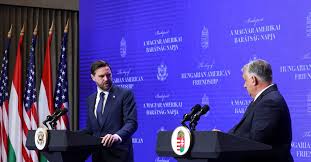
U.S. Vice President JD Vance has ignited a transatlantic political storm, accusing the European Union of meddling in Hungary’s domestic affairs even as he stepped onto the campaign stage in Budapest to back Prime Minister Viktor Orbán ahead of a pivotal national election.
The unusually direct intervention by a senior American official has rattled diplomatic norms and intensified tensions between Washington and Brussels, with critics highlighting the striking contradiction between Vance’s denunciation of foreign influence and his own overt support for a candidate in a closely fought European vote.

AD: Capeesh Restaurant
The visit, just days before a closely contested national vote, represents one of the most direct interventions by a senior American official in a European election in recent history.
Speaking at rallies and a joint press conference, Vance alleged that EU officials had attempted to undermine Hungary’s economy and energy independence in order to weaken Orbán’s government, describing it as among the worst examples of foreign interference he had seen.
Vance made little effort to conceal his own objective. He told supporters he had come to Hungary to help Orbán secure re-election, a statement that immediately drew accusations of hypocrisy from critics across Europe.

AD: Oysterian Sea Food Restaurant And Bar
The timing of the visit is politically charged. Orbán, who has ruled Hungary for more than a decade, is facing one of the toughest electoral challenges of his career from opposition figure Péter Magyar, whose campaign has focused on corruption, economic concerns and democratic reforms.
With the Trump administration, the stakes extend beyond Hungary itself. The election has become a symbolic test of a broader nationalist political movement that links Washington and Budapest, with Orbán widely viewed as a key ideological ally.
Vance’s intervention has been widely described by analysts as a significant departure from established diplomatic practice. Historically, U.S. officials have avoided explicitly endorsing candidates in allied democracies, particularly during active election campaigns.
Vance not only endorsed Orbán but also appeared at campaign events and urged voters to support him, even connecting the rally audience with Donald Trump, who praised the Hungarian leader in a live phone call.
The move reflects a broader shift in transatlantic relations that has been unfolding since Trump returned to power. Tensions between Washington and Brussels have intensified over issues ranging from trade and defence to democratic norms and foreign policy priorities. In particular, disagreements over Russia, Ukraine and energy policy have placed Hungary at odds with many EU member states.
Orbán’s government has long clashed with the EU over migration, media freedom and judicial independence, with critics accusing his ruling Fidesz party of undermining democratic institutions. Supporters, however, argue that his policies reflect national sovereignty and voter preferences, positioning Hungary as a counterweight to what they see as excessive EU influence.
Vance echoed this narrative during his visit, portraying Hungary as a country resisting external pressure and defending its independence. He criticised EU energy policies and sanctions on Russia, arguing they had harmed Hungarian consumers and weakened economic stability.
The rhetoric has further strained relations with European leaders, many of whom view Hungary’s stance on Russia and Ukraine as a challenge to collective security. The EU has pushed to reduce reliance on Russian energy following Moscow’s invasion of Ukraine, while Orbán has maintained closer ties with Moscow, creating friction within the bloc.
The controversy surrounding Vance’s visit underscores the broader geopolitical significance of Hungary’s election. Orbán is seeking to extend his long tenure in office, but polling suggests a competitive race, with Magyar’s opposition movement gaining ground among voters dissatisfied with economic conditions and governance.
With Orbán, international backing particularly from the United States serves as a powerful campaign tool. Through aligning himself with Trump and his administration, he aims to reinforce his image as a leader with strong global alliances and a clear ideological vision.
Yet the strategy carries risks. Critics argue that overt foreign support, whether from Washington or Brussels, could backfire by reinforcing concerns about external influence in Hungary’s democratic process. Magyar himself has condemned both the EU and the United States for what he describes as interference, highlighting the sensitivity of the issue among voters.
The election is unfolding against a complex backdrop of regional and global tensions. Hungary’s position on the war in Ukraine, its economic ties to Russia and its disputes with EU institutions have all become central campaign issues. These factors have transformed the vote into a focal point for competing visions of Europe’s future, with implications that extend far beyond Hungary’s borders.
Vance’s involvement also reflects a broader trend of ideological alliances crossing national boundaries. Hungary has emerged as a hub for nationalist movements in Europe and beyond, attracting political figures and thinkers who see Orbán’s model as an alternative to liberal democratic norms.
While the election approaches, the impact of Vance’s visit remains uncertain. While his endorsement underscores the importance the Trump administration places on Orbán’s re-election, analysts caution that Hungarian voters are likely to be more influenced by domestic concerns such as the economy, public services and corruption.
What is clear, however, is that the episode has intensified scrutiny of both Hungary’s political direction and the evolving relationship between the United States and Europe. The clash between accusations of interference and overt political backing has highlighted the contradictions at the heart of the current geopolitical landscape.
With days remaining before voters head to the polls, Hungary finds itself at the centre of a wider struggle over sovereignty, democracy and international influence a contest in which the outcome could reshape not only the country’s future but also the balance of power within Europe and the transatlantic alliance.
The election has evolved beyond a domestic political race into a symbolic battleground between competing visions of governance: one rooted in nationalist control and resistance to supranational institutions, and the other aligned with deeper European integration and liberal democratic norms. The stakes are deeply personal, tied to concerns over economic stability, public services and the direction of the country after years of polarising leadership. Yet the intensity of foreign attention has amplified the sense that Hungary’s choice carries implications far beyond its borders.
International alliances, energy policy and relations with both Russia and Western partners are all implicitly on the ballot, shaping how the next government will position itself in an increasingly fragmented geopolitical landscape.
The involvement of high-profile foreign figures has only heightened this dynamic, reinforcing perceptions that Hungary has become a testing ground for broader ideological movements. Analysts warn that the result could embolden similar political forces elsewhere in Europe or, alternatively, signal limits to their appeal.
While campaigning enters its final stretch, the convergence of domestic discontent and global scrutiny ensures that Hungary’s election will resonate long after the votes are counted, influencing debates over democracy, sovereignty and cooperation across the continent.

AD: Heritage And Restaurant Lounge Bar