
By Chima Phillips-
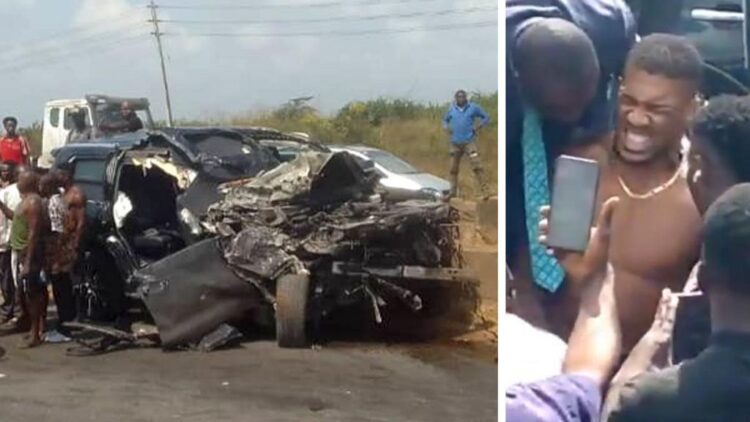
When British boxing star Anthony Joshua’s SUV collided with a stationary truck along the busy Lagos‑Ibadan Expressway last week, the force of the crash was brutal and instantaneous. Two of the four passengers riding with him died at the scene, in one of the most painful news of the year.
Joshua and his friends were off to his family house for new celebrations when calamity struckJ oshua walked away with minor injuries, a fact that has prompted experts and eyewitnesses to scrutinise every detail of the collision, especially where he was seated at the moment of impact.

AD: Capeesh Restaurant
Joshua’s survival, while a tragic loss unfolded around him, has raised questions about how slight differences in position can mean the difference between life and death in a high‑speed crash and what lessons might be learned about vehicle safety, impact dynamics, and chance under extreme conditions.
Shortly after 11 a.m. on a morning that began like any other, the SUV carrying Joshua and three companions lost control during an overtaking manoeuvre and collided violently with a stationary truck. Local road safety officials say the vehicle was travelling above the legal speed limit when a tyre blew, leaving the driver unable to maintain control.
Eyewitness accounts and police reports consistently describe Joshua as seated in the rear seat behind the driver with another two passengers, who were his friends sat beside him at the time of impact. There was also a passenger beside the driver in the front seat. There is no way any of the passengers could know in advance which sitting position would prove fatal in a crash they had not envisaged.

AD: Oysterian Sea Food Restaurant And Bar
Two of the four occupants both seated on the right side of the vehicle were killed on the spot. Joshua and the driver, both located on the left side, escaped with injuries that medical teams have described as minor.
“It appears that the damage was concentrated on the right side of the SUV,” a road safety official told The Punch. “That side of the vehicle bore the brunt of the impact when it struck the truck.”
Traffic safety experts stress that in side‑impact collisions, especially those involving large stationary objects like trucks, the point of impact and structural response of the vehicle can dramatically affect who survives and who does not.
A collision with a stationary truck typically concentrates force where the vehicles meet. In this case, the SUV’s right side was almost completely destroyed, according to crash imagery shared by witnesses and law enforcement. The vehicle’s frame likely absorbed severe kinetic energy on the passenger side, crushing the space where the two victims were seated.
In comparison, the structural integrity along the left side of the vehicle appears to have held somewhat better, leaving a survivable “cavity” around Joshua and the driver. “That side of the car likely experienced less direct force during the collision,” one expert said, “which can preserve occupant space and reduce fatal injuries.”
Experts say that even minor shifts in seating position, inches, can be a decisive influence on survivability in high‑impact scenarios. The Lexus SUV involved in the crash was not designed as a specialised safety cell like those found in racing cars.
Civilian SUVs rely on crumple zones and reinforced doors to absorb impacts. While these systems can protect occupants in many types of crashes, a concentrated side impact at speed can overwhelm them.
“In a side collision, where the force is highly localised, the side the occupant is on becomes critically important,” said a crash dynamics analyst. “If the impact zone collapses inward, it can intrude on occupant space and cause fatal trauma.
If, however, the occupant is on the opposite side and the frame absorbs most of the collision elsewhere, they might walk away with minor injuries.”
Analyses of similar crashes around the world support the idea that seating position relative to the point of impact plays a major role in outcomes. While vehicle safety improvements like side‑curtain airbags and reinforced rocker panels have reduced fatalities in many side impacts, they are not fool proof against high‑speed collisions.
The Human Cost and Road Safety Context
Joshua’s survival has triggered a wave of relief among fans and peers, but the deaths of his companions, identified as Latif Ayodele, his longtime personal trainer, and Sina Ghami, his strength and conditioning coach, have cast a heavy shadow over the story. Both were seated on the side of the vehicle struck most forcefully, and both died at the scene.
Local authorities are also using the tragedy to highlight the broader dangers of one of Nigeria’s most notorious highways. The Lagos‑Ibadan Expressway, linking major economic centres, is among the country’s deadliest roads due to heavy traffic, frequent speeding and overtaking, and poorly marked hazards. Officials have repeatedly called for improved enforcement of traffic laws and better maintenance of both roads and vehicles.
Joshua is hospitalised and reported to be in stable condition, with medical teams monitoring his recovery closely. His promoter has asked for privacy for families affected by the crash, emphasising the emotional toll the incident has taken.
While the boxer will likely face questions about his future in the ring, public and expert commentary has also turned toward questions of vehicle safety awareness, post‑crash emergency response, and road safety practices.
Accidents of this severity often lead to calls for stronger adherence to speed limits are among the measures road safety advocates suggest. In the days ahead, investigators will continue examining the precise mechanics of the crash, including vehicle speed, tyre condition, road configuration and other factors that influenced its devastating outcome.
Each piece of evidence adds to a clearer understanding of how Joshua’s position in the rear seat on the side least impacted by the collision may have helped him survive when others did not.
The news is all the more sad because his friends that died were very close to him, and were not the ones driving. Observers believe the driver was likely showing off to Joshua and his pals by speeding. The heavyweight boxer had just picked up a £70m pay check barely ten days earlier for beating Jake Paul, and the group would have been on a high. The identity of the driver has not yet been disclosed.
Joshua is said to be in a stable condition in hospital where he is being comforted by members of his family, including his mother, Yeta.
Several tributes have been paid to his two friends, Latif Latz Ayodele and Shaii Ghammi, who died in the crash. The story is all the more sorrowful because at the time of the accident, Anthony Joshua had only been in the country for six hours, and not even settled down at all.
Several tributes have been paid to both friends in what must be a very difficult time for the families involved who are no doubt devastated.
May their souls rest in perfect peace,

AD: Heritage And Restaurant Lounge Bar