
By James Simons-
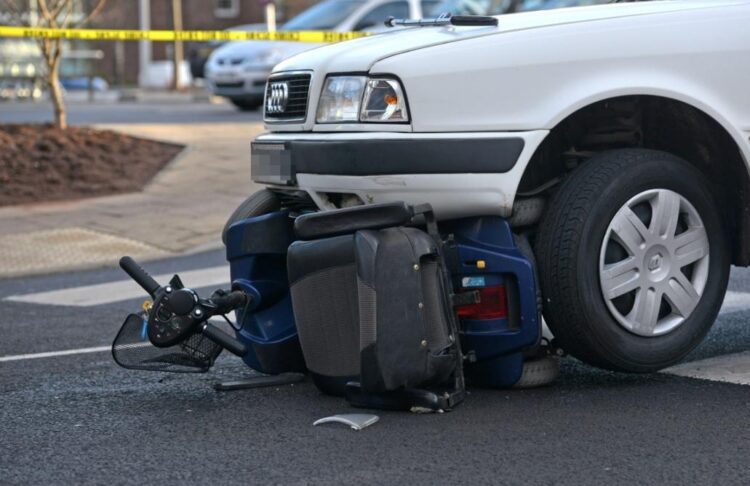
An 87-year-old woman has died after the mobility scooter she was riding was involved in a collision with a car in Salford, Greater Manchester. The tragic accident took place on Thursday morning and has raised renewed concern over the safety of mobility-scooter users on UK streets.
The incident occurred at around 11:15 a.m. on Thursday, 27 November 2025, on Manchester Road West in Little Hulton, Salford, according to the Greater Manchester Police (GMP). The elderly woman was travelling on the pavement when her mobility scooter — for reasons not yet established — “suddenly” began to cross the road, colliding with a west-bound Volvo.

AD: Capeesh Restaurant
Emergency services were swiftly called to the scene. The woman was taken to hospital with serious injuries. Despite efforts to save her, she later died, marking yet another fatality involving a mobility scooter and a motor vehicle.
Police have opened a serious collision investigation and are appealing for anyone who witnessed the crash — or who may have dash-cam or CCTV footage — to come forward. Their log reference for the incident is 1148 of 27/11/25.
At this stage, investigators have not commented on whether they believe the crash was the result of driver negligence, mechanical failure, user error, or a combination of factors. Officers say their focus is to establish exactly what happened.

AD: Oysterian Sea Food Restaurant And Bar
Growing concerns: mobility scooters, vulnerability and road safety
This tragic death is not an isolated incident. Recent data and expert analysis suggest that users of mobility scooters in the UK face significantly greater risks than many assume. According to a report covered by STV News, mobility scooter users are “more than twice as likely to be killed in a crash than other road users.”
Much of the danger stems from the fact that mobility scooters — while essential for many older or disabled people to maintain independence — are often ill-equipped for busy, fast-moving urban environments. The combination of slow-moving scooters, limited visibility, and mixed traffic (cars, vans, lorries) creates a hazardous dynamic.
In addition, unlike drivers, many scooter users are older and more physically vulnerable, meaning that collisions are more likely to result in serious or fatal injuries.
Campaigners and safety experts have long warned that mobility-scooter users need stronger protections — including clearer recognition under road safety regulations. According to one analysis, mobility scooter–related casualties nearly doubled in 2023 compared with the previous year, with a growing number of fatal and serious incidents.
Despite these concerns, mobility scooter users remain largely outside some of the formal protections afforded to other “vulnerable road users.” For example, campaigners have argued that scooters should be included in the legal framework alongside pedestrians, cyclists, and motor-vehicle drivers — a change that could improve infrastructure, signage, and public awareness to better safeguard riders.
Local authorities and councils are also under pressure to review how pavements, crossings, and kerbs are designed, to ensure they are safe for mobility device users. Without such adaptations, elderly and disabled people may increasingly be at risk simply getting around their communities.
News of the 87-year-old woman’s death has triggered a wave of sorrow across Little Hulton and the wider Salford area. For many, the collision underscores a grim reality — that mobility scooters, designed to enable independence, can still leave their users tragically exposed on roads not designed for them.
Local campaigners and disability advocates have called for urgent action. They argue that the incident should be a wake-up call for municipalities, transport planners, and policymakers to prioritise the safety of older and vulnerable road users. As one advocate put it, “mobility should not mean risk.”
Safety groups are renewing demands for mobility scooter users to be formally recognised in the legal framework of the Highway Code — alongside other vulnerable road users — to ensure clearer guidance for both scooter riders and drivers, and to prompt infrastructure improvements where needed.
Some experts also point out the need for better training for scooter users, public awareness campaigns, and improved street design — including safer crossings, smoother pavements, and traffic-calming measures in residential areas. Without these steps, more tragedies may follow.

AD: Heritage And Restaurant Lounge Bar