
By Aaron Miller-
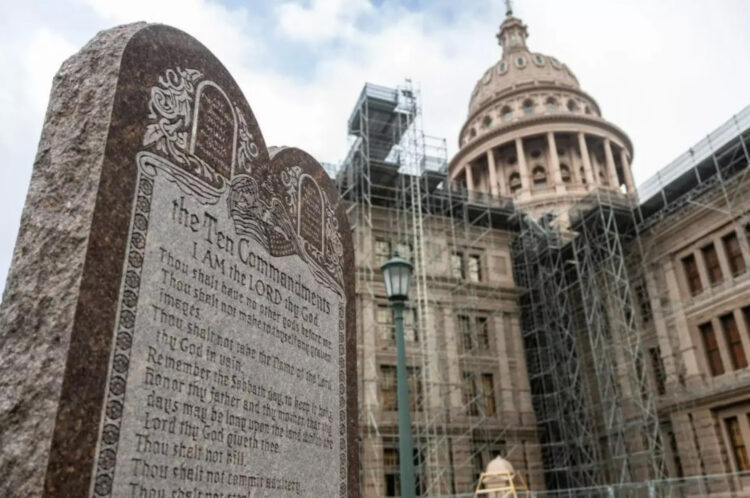
A federal judge has ordered at least fourteen public school districts in Texas to remove Ten Commandments displays from classrooms by December 1, 2025. U.S. District Judge Orlando L. Garcia ruled that a recently passed state law requiring these displays violates constitutional protections. The decision directly challenges Texas Senate Bill 10, which mandated that the posters be installed in every public school classroom across the state.
The new ruling by the federal judge added 14 more Texas public school districts to a list that requires them to remove Ten Commandments posters in public classrooms by Dec. 1.

AD: Capeesh Restaurant
In September, a new law went into effect requiring them to be displayed, but in October, during a school board meeting, Galveston ISD was one of the districts that voted to delay putting up any posters while they wait to see what happens in court.
Because of that decision, the state’s attorney general’s office sued the district for not complying.
The ruling follows a lawsuit brought by a coalition of fifteen families, including parents from multi-faith and nonreligious backgrounds. These plaintiffs argued that the Ten Commandments displays represented an unconstitutional government endorsement of religion. The case has since become a central issue in the broader national debate surrounding the separation of church and state in public education.

AD: Oysterian Sea Food Restaurant And Bar
Although the order only applies to the districts in the suit, the organizations that filed the lawsuit on behalf of Texas parents in Cribbs Ringer v. Comal Independent School District are urging all of the state’s school districts not to comply with S.B. 10.
A separate preliminary injunction was also issued to 11 other Texas school districts in August for implementing S.B. 10.
The plaintiffs in both cases are represented by Americans United for Separation of Church and State, the American Civil Liberties Union of Texas, the American Civil Liberties Union and the Freedom From Religion Foundation.
“All school districts, even those that are not parties in either ongoing lawsuit, have an independent obligation to respect students’ and families’ rights under the U.S. Constitution, which supersedes state law,” said Americans United for Separation of Church and State in a Tuesday statement.
The court’s injunction on Tuesday was the latest volley in a nationwide debate in America over whether U.S. states can require public schools to prominently feature Christian texts in their classrooms. The fight has pitted parents and students against conservative groups trying to make expressions of faith more prominent in U.S. society.
Last June, a federal appeals court blocked Louisiana from enforcing a law that similarly required the Ten Commandments to be displayed in all classrooms of the state’s public schools and universities. The same appeals court will hear a challenge to the Texas law when it rehears the Louisiana case in January.
In October, Oklahoma’s Education Department withdrew a 2024 directive that required teachers to have the Christian Bible in every classroom and incorporate it into their lessons, after challenges that it was unconstitutional prompted the state supreme court to halt the requirement.Texas Attorney General Ken Paxton sued two other state school districts on Tuesday for refusing to display the Ten Commandments in their classrooms, accusing them of disregarding “the will of Texas voters who expect the legal and moral heritage of our state to be displayed in accordance with the law.”
What the Ruling Entails and Which Districts Are Affected
In his ruling, Judge Garcia determined that Senate Bill 10, which went into effect on September 1, 2025, forces school districts to act in a manner that violates the Establishment Clause of the U.S. Constitution. He wrote that it would be “impractical, if not impossible” to shield students from “unwelcome religious displays” without stopping districts from enforcing the law.
The injunction specifically applies to fourteen school districts, including Comal ISD, Conroe ISD, Fort Worth ISD, McKinney ISD, Frisco ISD, Northwest ISD, Azle ISD, Rockwall ISD, Lovejoy ISD, Mansfield ISD, Georgetown ISD, Arlington ISD, Flour Bluff ISD, and McAllen ISD. By the December 1 deadline, these districts are required to remove any Ten Commandments posters from classrooms. They must also file a compliance report with the court by December 9to confirm that all mandated displays have been taken down.
Senate Bill 10 was championed by state lawmakers who argued that displaying the Ten Commandments in public schools reflects Texas’s “moral heritage” and provides students with a historical foundation for understanding U.S. law and ethics. Critics, however, argue that the bill constitutes government-sponsored religious instruction, which the U.S. Constitution explicitly forbids in public schools. The law prompted a flurry of legal challenges soon after it was enacted, illustrating the contentious nature of religion in public education.
This decision follows earlier rulings by federal courts, including one by U.S. District Judge Fred Biery, who temporarily blocked SB 10 in eleven other Texas districts. Judge Biery had stated that the law “crosses the line from exposure to coercion” and pressures students toward a particular faith.
The legal challenge argues that Senate Bill 10 forces religious doctrine into secular public classrooms, infringing upon the religious freedom of students and families who do not share the same beliefs. The lawsuit, titled Cribbs Ringer v. Comal ISD, is being pursued by the ACLU of Texas, Americans United for Separation of Church and State, and the Freedom From Religion Foundation.
In his order, Judge Garcia emphasised that public schools are meant for education and not for religious indoctrination. He wrote that “public schools are for education, not evangelization,” reinforcing a long-standing constitutional principle.
Historically, the question of Ten Commandments displays in public schools has been repeatedly litigated in the United States. The U.S. Supreme Court ruled in Stone v. Graham (1980) that a Kentucky law requiring the posting of the Ten Commandments in public school classrooms violated the Establishment Clause.
The Court emphasized that such displays lacked a secular purpose and endorsed a particular religious viewpoint. Other rulings, including McCreary County v. ACLU (2005), further reinforced that the government may not promote religious texts in public institutions without a legitimate secular purpose. These precedents form the legal backbone supporting Judge Garcia’s ruling against SB 10.
Daniel Mach, director of the ACLU Program on Freedom of Religion and Belief, praised the ruling as a “victory for religious freedom” and highlighted that government officials should not favour any faith over another. Rachel Laser, president and CEO of Americans United for Separation of Church and State, added that “families—not public-school officials—get to decide how and when religion is introduced to their children. This ruling respects that fundamental choice.”
Sam Grover, senior counsel at the Freedom From Religion Foundation, said that while the court’s decision is welcome, Texas never should have placed students and parents in this situation. One parent, Lenee Bien-Willner, stated that she was “relieved that my children, who are among a small number of Jewish children at their schools, will no longer be continually subjected to religious displays.”
The ruling has sparked intense reactions across Texas. Religious conservatives, including Texas Attorney General Ken Paxton, strongly defended Senate Bill 10. Paxton argued that the Ten Commandments display reflects the “moral heritage” of Texas and that the law was passed to reaffirm the state’s legal and Christian foundations. His office has already filed an appeal against the injunction, signalling that the legal battle is far from over.
Paxton has described the Ten Commandments display as part of the “cornerstone of our moral and legal heritage.” The appeal is likely to move to the U.S. Fifth Circuit Court of Appeals, where similar state laws have previously faced judicial challenges.
Civil liberties groups have urged other Texas school districts, even those not named in the lawsuit, to voluntarily remove the displays. Chloe Kempf, attorney for the ACLU of Texas, stated, “All school districts should take this ruling seriously. They have an independent legal obligation to respect students’ constitutional rights.”
Educators and administrators are now facing practical and political challenges as they work to comply with the ruling. Some fear backlash from parents and community groups who support SB 10, while others express relief that the court has provided clear legal guidance.
Constitutional scholar Dr. Maria Hernandez stated that Judge Garcia’s ruling could set a precedent for future cases. She emphasized that the decision demonstrates judicial impatience with state laws that mandate religious displays in secular contexts. First Amendment attorney John Fields noted that the legal fight is likely to continue at higher levels of the judiciary and could ultimately reach the U.S. Supreme Court.
School districts must navigate compliance while balancing community sentiment. Civil liberties advocates argue that the court’s reasoning should be applied statewide, and educators are tasked with implementing the order without inflaming political tensions.
Judge Orlando L. Garcia’s decision to block the mandatory display of the Ten Commandments in Texas classrooms is a significant moment in the ongoing debate over religion in public education. By ordering the removal of these displays by December 1, 2025, the court has established a clear boundary on how far the state can mandate religious content in public schools.
Civil liberties groups have hailed the decision as a defence of religious freedom, while opponents, led by Attorney General Ken Paxton, are preparing for an extended legal fight. As the appeal process unfolds, the case may have wide-reaching implications not only for Texas but also for similar constitutional debates nationwide.
School districts are now tasked with implementing the court’s order while maintaining community trust. The compliance deadline will test both the legal system and the political will of communities across the state. This case is more than a legal dispute; it is a test of how the First Amendment will be interpreted in public education in an increasingly divided America.
The addition of historical context regarding prior Supreme Court rulings reinforces why many legal experts consider the Texas law constitutionally problematic. Observers predict that the appeals process will be closely watched as a potential landmark moment in the ongoing tension between religious expression and secular public schooling in the United States.
Texas Attorney General Ken Paxton sued two other state school districts on Tuesday for refusing to display the Ten Commandments in their classrooms, accusing them of disregarding “the will of Texas voters who expect the legal and moral heritage of our state to be displayed in accordance with the law. Texas is a very religious state, with a high percentage of its population identifying as religious. The largest religious group in Texas is Evangelical Protestant, followed by Roman Catholics. Evangelical Protestantism plays a particularly strong role, with Texas being home to millions of Southern Baptists. Court battles over religious disputes are not rare in America.

AD: Heritage And Restaurant Lounge Bar