
By Aaron Miller-
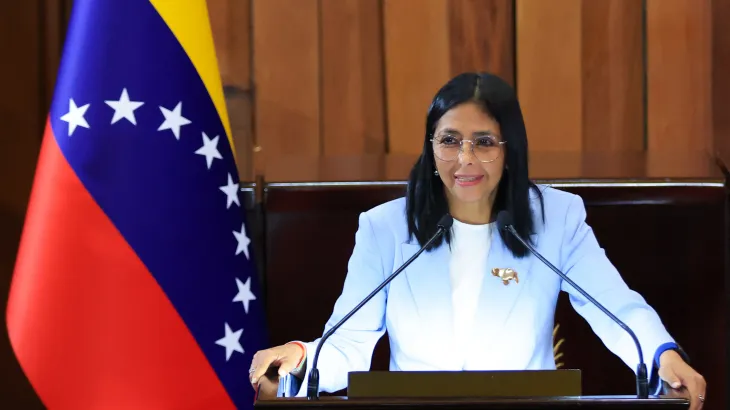
CARACAS, Venezuela — Venezuela’s acting president Delcy Rodríguez unveiled a sweeping amnesty bill that could lead to the release of hundreds of political prisoners, including journalists, opposition leaders, human rights defenders and civic activists detained over decades of political confrontation and repression.
The announcement marked the most significant upheaval in Venezuelan domestic politics in years — one rooted not only in internal strife but in dramatic international intervention.

AD: Capeesh Restaurant
Rodríguez’s proposal — described by government officials as a “general amnesty law” — would apply to politically motivated detentions spanning back to 1999, including periods under the late Hugo Chávez and his successor, Nicolás Maduro. While the text of the draft legislation has not been publicly released, Rodríguez said it is intended to “heal the wounds” inflicted by years of polarisation.
“This law will serve to heal the wounds left by political confrontation fuelled by violence and extremism,” Rodríguez said at a televised address to government officials, judges, and military leaders on January 30, 2026. “It is time to redirect justice and coexistence among Venezuelans.”
Yet, the announcement also exposed deep divisions within Venezuelan society — between hope and scepticism, aspiration and mistrust — and between demands for justice and fears of impunity.

AD: Oysterian Sea Food Restaurant And Bar
A Nation Long Fractured by Political Prisoners
Venezuela’s political prisoner crisis has long drawn the attention of international and domestic rights groups. Throughout the 2020s, countless detainees were held in detention centers and prisons for charges widely considered politically motivated — arrests that activists described as punitive responses to dissent, protest, and civic engagement. Among those jailed during Maduro’s increasingly contested rule were opposition figures, community leaders, academics, and journalists documenting state abuses.
Human rights organisations including Foro Penal and Provea have tallied hundreds of individuals still detained, with estimates varying between roughly 700 and 800 prisoners as of late January 2026. Many of these detainees were arrested following contested elections and protest movements that emerged after the 2024 presidential election, which international observers widely dismissed as flawed.
Among those still in detention at the end of January were prominent opposition figures such as former lawmaker Freddy Superlano, lawyer Perkins Rocha, and Juan Pablo Guanipa, a former governor and key ally of opposition leaders. Many journalists who covered protests, elections, and human rights violations were also detained under charges that critics say criminalised press freedom.
The toll of political detention has been staggering: families have camped outside prisons, issued public appeals, and beseeched government officials for information and release. The slow pace of releases — even after promises of change — has deepened frustration within civil society. “We, Venezuelans, have all endured so much… all unjust, merciless and trampling on our dignity,” said one former detainee’s relative during a protest in Caracas.
The Amnesty Bill Offers Promise and Controversy
Rodríguez’s proposed amnesty bill is ambitious in scope. According to statements by government officials, it would cover politically motivated detentions from 1999 to the present, effectively reaching back through the Chavez era and into Maduro’s contentious decade-plus in office.
It will not extend to individuals convicted of serious violent crimes — including murder, drug trafficking, corruption, and grave human rights abuses. Those convicted of such crimes would not qualify for amnesty. The bill is framed as a step toward national reconciliation and justice reform.
However, significant questions remain in that eligibility criteria have not been clearly defined, and activists fear exclusionary practices. Critics have decried what they see as a lack of transparency in drafting the legislation.
Many detainees may remain in custody for months or years, even if the bill passes, due to bureaucratic processes and judicial bottlenecks.
Human rights groups have cautiously welcomed the move. Foro Penal’s president said that a general amnesty “is welcome as long as its elements and conditions include all of civil society, without discrimination, that it does not become a cloak of impunity, and that it contributes to dismantling the repressive apparatus of political persecution.”
Similarly, the group Provea stressed that while the release of political prisoners is urgent, “the announcement of an amnesty should not be conceived, under any circumstances, as a pardon or act of clemency on the part of the State.” It emphasised that many detainees had been “arbitrarily imprisoned for exercising rights protected by international human rights instruments, the National Constitution, and Venezuelan laws.”
Journalists Caught in the Crossfire
Among those potentially affected by the amnesty are members of the press — a group that has faced severe repression under successive Venezuelan administrations.
Journalists operating in Venezuela over recent years have been detained, threatened, or charged with offenses related to their reporting. Independent media outlets have documented cases where reporters were arrested during coverage of protests or investigative work into government conduct. As of mid-January 2026, at least 15 journalists had been released from Venezuelan jails in the wake of preliminary amnesty actions, according to activist reporting.
These releases have included both Venezuelan and foreign journalists. Rights advocates see media freedom as central to national transparency and accountability — and point to press freedom as a key barometer of democratic openness.
Yet the uncertainty over how the amnesty will be implemented, and who precisely will be covered, has left several journalists and their families in limbo. Some continue to languish behind bars, while others are awaiting verification of eligibility or bureaucratic processing.
The Shadow of El Helicoide
Rodríguez’s announcement also touched on one of Venezuela’s most notorious symbols of political repression: El Helicoide, a sprawling detention facility in Caracas long criticised by international human rights groups for torture and abuse.
Rodríguez said the facility — which once housed political detainees and was widely seen as a centre of oppression — would be shut down and transformed into a community and cultural space, including sports and social programs. The symbolic shift underscores how deeply the issue of political imprisonment is woven into Venezuela’s national psyche.
The planned closure has drawn praise from some quarters as a decisive break from past abuses. But others warn that structural and bureaucratic obstacles may limit the immediate impact of such plans.
Coverage of Venezuela’s current political trajectory must necessarily grapple with the dramatic international events that have reshaped the country — particularly the U.S. military intervention and removal of former President Nicolás Maduro in early January 2026.
On January 3, 2026, U.S. forces carried out a strike in Venezuela’s capital, Caracas, capturing Nicolás Maduro and his wife, Cilia Flores, and transporting them to the United States in connection with long-standing charges including drug trafficking and terrorism-related offences.
The operation — authorised by then-U.S. President Donald Trump — marked an unprecedented direct intervention into the internal politics of a sovereign Latin American state. Trump framed the intervention as a decisive action against corruption, narco-terrorism, and authoritarianism.
In the immediate aftermath, Maduro — who had led Venezuela since succeeding Hugo Chávez in 2013 — was de facto removed from power. While Maduro’s government continued to assert his legitimacy, the reality on the ground shifted dramatically.
Under Venezuelan constitutional procedures, Vice President Delcy Rodríguez assumed presidential powers following Maduro’s removal, citing Article 233 — a provision that allows the vice president to assume duties in the event of a presidential vacancy.
Trump’s intervention was met with intense debate internationally:
Supporters hailed it as a bold effort to dismantle a regime accused of deep corruption, repression, and human rights abuses.
Critics — including international law experts and global institutions — condemned the intervention as a violation of Venezuelan sovereignty and international law, arguing that the action lacked clear legal justification.
Domestically, the capture of Maduro and the installation of Rodríguez represented both an opportunity and a source of tension. Rodríguez, who had served as Maduro’s vice president, has faced scepticism that she will fundamentally depart from the political impulses of the previous regime — even as she negotiates with the United States and navigates a shifting international landscape.
In the aftermath of Maduro’s removal and the amnesty bill announcement, Venezuela’s political environment remains in flux. It is the potential end of one of the most oppressive detention centres in the country’s recent history.
The prospect of reintegrating long-imprisoned political actors into civic life.
On the other hand, significant barriers remain. Hundreds of political prisoners may still be held even after the amnesty bill passes.
Doubts about the transparency and fairness of the amnesty process persist among civil society.
Trust between opposition forces and the government is tentative, with many wary of superficial reforms.
International actors will also play a major role. Washington has made clear its interest in seeing Venezuelan political freedoms restored, and the U.S. State Department confirmed that all known U.S. citizens detained in Venezuela have been released.
Yet the path forward is far from linear. For many Venezuelans, the amnesty bill and planned releases are a critical but insufficient step in a long journey toward political stability and justice.
The amnesty bill, if enacted and implemented with genuine transparency and fairness, could be a landmark moment in Venezuela’s history.
But for millions who have lived through years of political imprisonment and repression, hope will depend not only on legislation but on the tangible restoration of rights, accountability for abuses, and a sustained commitment to democratic norms.

AD: Heritage And Restaurant Lounge Bar