

By Tim Parsons-
With the 2026 FIFA World Cup approaching, the United States government has unveiled a major investment into counter‑drone technologies designed to protect stadiums, fan zones and surrounding public spaces during one of the world’s largest sporting events.
The initiative reflects rising concern over the potential misuse of unmanned aerial systems, even as security planners prepare for millions of visitors and billions of global viewers.

AD: Capeesh Restaurant
The U.S. Department of Homeland Security (DHS) announced that it will allocate $115 million in funding toward counter‑drone measures that will enhance security efforts at World Cup venues and associated events celebrating the nation’s 250th anniversary.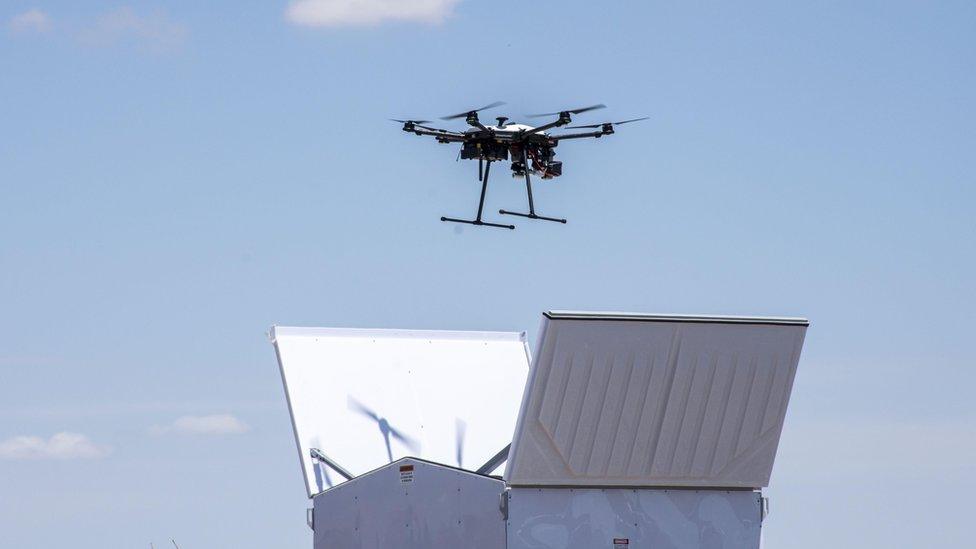
Drones detects potential aerial threats at the 2026 FIFA World Cup
Officials have described the funding as part of a broader effort to adapt to evolving aerial threats that have emerged in recent years.

AD: Oysterian Sea Food Restaurant And Bar
While specific details about the technologies to be deployed at match sites have not been released, industry experts say that a range of tools is under development or deployment across the country.
These can include radar and sensor networks to detect unauthorized drones, electronic systems to disrupt their control signals, and advanced tracking software designed to distinguish between benign and malicious aerial activity.
The investment comes amid heightened public awareness of drone capabilities, following incidents in conflict zones and at major transportation hubs that have highlighted vulnerabilities in airspace security. Many of these concerns have been amplified by the ongoing war in Ukraine, where both sides have increasingly used unmanned aircraft in military operations.
Those developments have pushed governments around the world to accelerate counter‑drone programs, not only for military applications but also to protect critical infrastructure and mass gatherings from potential threats.
According to DHS, match locations across the United States will benefit from the enhanced attention, as well as from existing preparedness grants distributed in recent months.
The Federal Emergency Management Agency (FEMA) awarded $250 million in funding to 11 states hosting World Cup matches to strengthen their ability to detect and mitigate threats from unmanned aircraft systems.
The creation of a dedicated office within DHS tasked with rapidly acquiring and deploying counter‑drone systems signals a commitment to integrating these technologies into national security strategies.
The new Program Executive Office for Unmanned Aircraft Systems and Counter‑Unmanned Aircraft Systems will oversee funding decisions and operational planning aimed at staying ahead of emerging aerial threats.
Security officials have made no secret of the fact that mass sporting events pose unique challenges. With thousands of fans in and around stadiums and heightened media attention, any breach of secure airspace would have far‑reaching consequences.
The decision to enhance counter‑drone capabilities, therefore, aligns with broader homeland security objectives and earlier legislative efforts to bolster detection and response capacity across multiple jurisdictions.
The approach to counter‑drone technology at the FIFA World Cup has drawn interest from local, state and federal stakeholders who see airspace security as a key element of the overall safety strategy. Local law enforcement agencies, emergency responders and event managers have been drawing up contingency plans that incorporate new systems funded at the federal level with existing public safety protocols.
Some critics have raised questions about the balance between security measures and civil liberties, particularly when technologies such as signal disruption or autonomous interdiction are under consideration.
National debate over how far such tools should be used in domestic settings continues, especially in contexts where law enforcement agencies are expected to operate alongside private security and event personnel. Nevertheless, supporters argue that the investment represents a necessary precaution that protects fans and participants alike.
The investment also underscores an evolving threat environment in which small unmanned aircraft systems have expanded beyond recreational use. In some parts of the world, these systems have been used for surveillance, contraband delivery and even weaponised strikes.
The evolution of such threats has shifted perceptions of drones from benign novelties to devices that require coordination across military, law enforcement and civil aviation sectors to ensure safe operation.
In practical terms, counter‑drone technologies may be deployed at perimeter zones around stadiums, transportation hubs and fan engagement areas. Detection platforms, some of which use radar, radio frequency sensing or artificial intelligence to pick out rogue drones, are expected to link into existing security infrastructure that already monitors crowds, vehicles and air traffic.
Federal funding is not limited to equipment alone. DHS’s new counter‑unmanned aircraft systems office and FEMA grants are supporting training programs intended to build capability within local agencies to respond quickly to aerial threats.
Law enforcement officials receiving support through these programs will be able to develop familiarity with detection systems and response protocols, helping to reduce response times if unauthorized drones are identified near match areas.
Some of the investment flows into states such as Missouri, where local public safety officials have already received millions in federal funds to develop drone detection and response capabilities. Officials there emphasised the priority placed on drone risk mitigation as part of their overall World Cup security planning.
Alongside public safety considerations, private sector partners are also playing a role. A number of U.S. companies specialising in counter‑drone technologies have expanded research, development, and production in recent months.
This growing industry reflects broader global demand for tools capable of protecting airspace in crowded and sensitive environments, particularly as high‑profile events draw attention.
Ultimately, the investment underscores a commitment to proactive security measures. DHS leaders have made clear that the United States intends to leverage advanced technologies to safeguard public events, welcoming the world to a tournament expected to draw historic attendance.
Given the stakes involved, from fan safety to national prestige, the focus on counter‑drone systems resonates across agencies tasked with upholding safety and order.
The investment marks a notable example of how governments are adapting security practices to the realities of modern threats, striving to ensure that the world’s largest sporting tournament unfolds without aerial disruption and with confidence in the safety of fans, athletes and host communities.

AD: Heritage And Restaurant Lounge Bar