
By Ben Kerrigan-
Britain has been warned by former U.S. President Donald Trump not to “ignore the real world,” following Prime Minister Sir Keir Starmer’s landmark diplomatic visit to China the first by a British leader in eight years. Speaking publicly after Starmer’s trip, Trump cautioned that closer UK–China ties could be “very dangerous,” thrusting Britain’s foreign policy into the center of a delicate global debate.
Starmer, however, pushed back against the criticism, insisting that the UK cannot simply “stick its head in the ground” when it comes to engaging with Beijing. His remarks highlight the country’s effort to navigate a complex landscape of economic opportunity, national security, and long-standing alliances.

AD: Capeesh Restaurant
Starmer’s words, delivered during his trip to Beijing and Shanghai, came after Trump publicly warned that closer UK–China ties could be “very dangerous,” thrusting the UK’s foreign policy into the centre of a delicate geopolitical debate.
The UK’s stance sits at the intersection of competing pressures: sustaining the “special relationship” with the United States, navigating rising Chinese global influence, and securing economic opportunities for British businesses.
Starmer’s pragmatic approach promoting trade and cooperation while asserting national security priorities has won both praise and criticism at home and abroad.

AD: Oysterian Sea Food Restaurant And Bar
Starmer’s visit began in Beijing, where he met Chinese President Xi Jinping and senior leaders to reset and expand bilateral relations.
The prime minister described talks as “very warm” and “successful,” securing several tangible outcomes: tariffs on Scotch whisky will be cut significantly, British citizens will be able to travel to China without a visa for short visits, and business partnerships are being deepened.
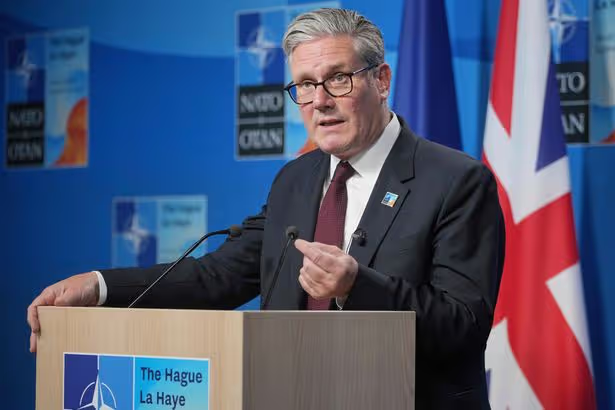
“Our relationship with the United States is one of the closest we hold,” Starmer told reporters, underscoring that engaging with China doesn’t mean sacrificing ties with Washington. “It doesn’t make sense to stick our head in the ground and ignore China,” he said, stressing that the UK must recognise China’s role as the second-largest economy in the world.
This approach comes amid a broader global recalibration. After years of sometimes frosty relations under previous governments, Starmer signalled Britain’s desire for a stable, “sophisticated” relationship with China one that balances dialogue on trade, investment, security and human rights issues alike.
He also pledged not to force a binary choice between the U.S. and China, telling Bloomberg before the trip that Britain could pursue both strong allied ties and constructive engagement with Beijing.
Despite these diplomatic overtures, Trump’s intervention in the UK’s foreign policy narrative on 30 January 2026 has complicated the picture. The U.S. president told reporters in Washington that deepening UK–China economic ties was “very dangerous” a stark rebuke that mirrored his recent criticism of Canada for similar engagements.
“It’s even more dangerous, I think, for Canada,” Trump said, reiterating his broader scepticism of allied economic rapprochement with China.
That comment drew immediate attention, given the historical strength of UK–U.S. relations in defence, intelligence and trade. Downing Street responded by pointing out that the U.S. administration was aware of Starmer’s objectives in China and that Trump himself is planning a visit to Beijing in April 2026, highlighting that diplomatic strategy is in flux across Western capitals.
Starmer’s mission reflects a broader strategic bet: that the UK can engage economically with China without undermining its security interests or Western alliances. Officials argue that British firms stand to benefit from expanded access to one of the world’s largest markets, particularly as global trade patterns adapt to supply-chain shifts and technological competition.
One high-profile result of the trip was AstraZeneca’s announcement of a planned £10 billion investment in China by 2030 to expand its footprint in manufacturing and research a move that underscores how commercial interests are central to the reset talks.
While Starmer has emphasised economic pragmatism, his government has also publicly raised difficult issues with Chinese leaders, including human rights concerns and geopolitical tensions over Hong Kong and Ukraine. This dual track underscores the UK’s attempt to manage cooperation and contestation simultaneously.
Yet Trump’s comments have not only highlighted Western divisions but also sparked domestic debate in the UK. Some commentators and politicians have accused Starmer of being too conciliatory, suggesting that prioritising business with China dulls Britain’s moral and strategic edge.
Others counter that failing to engage one of the world’s most consequential powers would be “absolutely bonkers” and harmful to British trade and influence.
This split reflects a larger conversation in global diplomacy: whether nations should hedge their bets across great powers in a multipolar world or firmly align with longstanding allies in pursuit of shared values and security objectives.
Starmer’s assertion that Britain will not be forced to choose between alliances reflects a carefully crafted middle path one that recognises both the economic gravity of China and the political realities of the UK’s relationship with the U.S..
Internationally, reactions to the UK’s approach have been varied. Chinese state media has interpreted Starmer’s engagement as a sign of economic pragmatism, lauding Britain’s willingness to focus on mutual benefit and business cooperation rather than confrontation. This narrative aligns with Beijing’s preferred messaging of stability and non-confrontational diplomacy.
In contrast, some commentators in Washington and other capitals have framed Trump’s warning as part of broader tensions in U.S.–China relations that are shaping the foreign policies of allied nations.
Countries like Canada, which recently pursued their own China engagement and faced similar pushback from Washington, illustrate the challenges of navigating competing geopolitical pressures.
With the UK, the stakes are particularly high. China is a major trading partner and a key player in global supply chains, but it is also a country with which the West has profound disagreements over issues such as cyber security, military expansion and human rights.
The UK’s diplomatic strategy embracing cooperation while guarding national interests will be watched closely in capitals from Tokyo to Brussels.
Back in Westminster, Starmer’s critics argue that acquiescing to economic imperatives without stronger safeguards on security and rights could weaken Britain’s international standing, a point likely to resurface in debates over the government’s foreign policy direction.
Supporters, meanwhile, contend that Britain must be a bridge between East and West if it hopes to remain a relevant player on the global stage, especially as trade dynamics shift and emerging markets assert economic influence.
Whether Trump’s warning will translate into lasting pressure on the UK remains to be seen. But Starmer has made clear that his government sees value in open engagement, even if it invites criticism from allies as well as opponents. With China’s economy and geopolitical reach only growing, the UK like many nations is being forced to define its place in a complex international order.
Prime Minister Sir Keir Starmer’s remarks that Britain cannot simply “stick its head in the ground” over China capture a defining moment in UK foreign policy. While global power balances shift, economic imperatives and strategic alliances increasingly intersect, challenging established diplomatic orthodoxies.
Whether this approach will yield sustained economic dividends without compromising security values is one of the central questions emerging from Starmer’s visit. Trump’s warning stark, public and pointed adds a layer of urgency to that debate, reminding international audiences that great power competition and cooperation remain deeply intertwined.

AD: Heritage And Restaurant Lounge Bar