
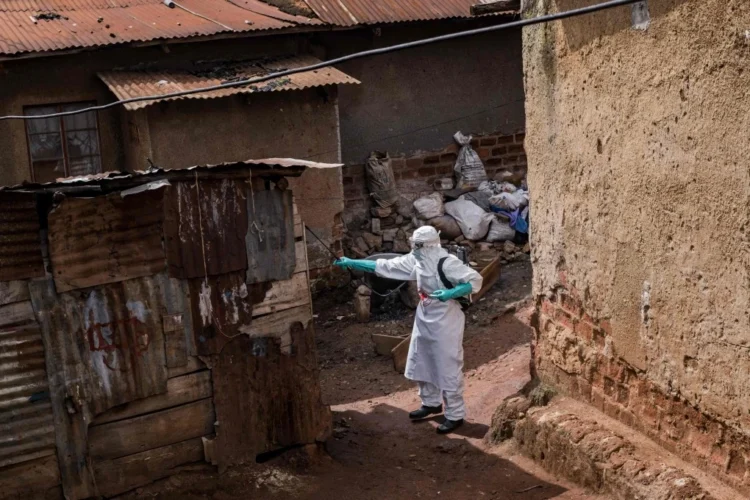
By James Simons-
Uganda has shut its border with the Democratic Republic of Congo after a sharp rise in cases linked to a rare and highly dangerous strain of Ebola, escalating fears of a broader regional health emergency in East Africa.
The emergency measure, announced by Ugandan authorities this week, follows mounting concern over the spread of the Bundibugyo strain of Ebola a rare variant for which there is currently no approved vaccine or specific treatment. Health officials say the outbreak, centered in eastern Congo’s conflict-ridden Ituri province, has already crossed borders and exposed medical workers in neighbouring Uganda.

AD: Capeesh Restaurant
Uganda’s decision to close its frontier with Congo marks one of the most dramatic responses yet to the outbreak, which the World Health Organisation formally declared a Public Health Emergency of International Concern earlier this month.
The WHO warned that the combination of armed conflict, weak healthcare infrastructure, population displacement and delayed detection could allow the virus to spread rapidly across Central and East Africa.
According to Ugandan officials, the closure will initially remain in place for four weeks, though essential cargo and limited humanitarian crossings may continue under strict health supervision. Anyone granted emergency entry into Uganda will reportedly face mandatory 21-day isolation and extensive screening procedures.

AD: Oysterian Sea Food Restaurant And Bar
The move underscores growing alarm among regional governments as case numbers climb at an accelerating pace. Congolese authorities have reported more than 1,000 suspected infections and over 220 deaths linked to the outbreak, though experts warn the actual toll could be significantly higher due to underreporting and the difficulty of reaching communities in conflict zones.
Health workers on the ground say the epidemic may already be spreading faster than containment efforts can manage. International aid organisations have described scenes of overcrowded clinics, shortages of protective equipment and overwhelmed burial teams struggling to prevent transmission during funerals one of the most common ways Ebola spreads. In some areas, armed groups and local mistrust have forced health workers to suspend operations entirely.
The outbreak has revived painful memories of previous Ebola crises that devastated parts of West and Central Africa over the last decade. Although Uganda and Congo have both dealt with Ebola outbreaks before, officials say the Bundibugyo strain presents an especially difficult challenge because medical countermeasures remain limited.
Unlike the Zaire strain of Ebola, which has approved vaccines and treatments developed after the catastrophic 2014-2016 West African epidemic, the Bundibugyo virus has received comparatively little global attention. Scientists say the rarity of the strain meant research funding and vaccine development lagged behind other Ebola variants.
The current outbreak was first officially identified in Congo’s Ituri province earlier this month, though investigators now believe the virus may have circulated undetected for weeks beforehand. Several early cases reportedly involved healthcare workers who later died, raising concerns that hospitals themselves became sites of transmission.
Ugandan authorities say the border closure became necessary after infected Congolese patients crossed into Uganda before the outbreak was publicly declared. Officials reported that local health workers were unknowingly exposed while treating patients who later tested positive for Ebola.
Uganda has so far confirmed seven Ebola cases, including one death, according to the latest health ministry figures. Several infections have been tied directly to contact with Congolese patients or cross-border travel.
Regional Fears Grow as International Response Intensifies
The outbreak has triggered an increasingly coordinated international response, with countries around the world tightening travel rules and expanding screening procedures for passengers arriving from affected regions.
The United States, Canada and several Middle Eastern nations have introduced temporary restrictions or enhanced health checks for travellers who recently visited Congo, Uganda or neighbouring countries. Kenya has established additional isolation facilities and intensified monitoring at border crossings, while India and Mexico have begun airport screening programs.
Public health officials stress that Ebola does not spread through the air like COVID-19, but rather through direct contact with bodily fluids from infected individuals. Symptoms typically include fever, weakness, vomiting and, in severe cases, internal and external bleeding. Even so, experts warn that the combination of high fatality rates and fragile healthcare systems makes rapid containment essential.
The WHO has urged countries not to impose blanket border closures, arguing that such measures can unintentionally drive travellers toward unofficial crossings where screening becomes impossible. However, political pressure on regional governments has intensified as fear spreads among local populations.
In Uganda, authorities have launched aggressive public awareness campaigns urging citizens to avoid physical contact with symptomatic individuals, wash hands frequently and immediately report suspected infections. Schools, churches and public transport operators have also been instructed to strengthen hygiene protocols.
The outbreak is unfolding in one of the world’s most unstable regions. Eastern Congo has long been plagued by militia violence, mass displacement and weak governance, conditions that health experts say create ideal circumstances for infectious diseases to spread unchecked.
WHO Director-General Tedros Adhanom Ghebreyesus this week called for an immediate ceasefire in parts of eastern Congo to allow medical teams safer access to affected communities. He warned that attacks on hospitals and population movements caused by conflict were severely undermining efforts to track infections and isolate patients.
In one reported incident, dozens of Ebola patients reportedly fled a hospital after violence erupted nearby, complicating efforts to trace their contacts and prevent further transmission. Aid workers say rumours and distrust remain major obstacles, particularly in remote mining communities where government authority is weak.
The crisis has also reignited debate over global preparedness for infectious disease outbreaks after years of strained international health funding. Several humanitarian organisations warn that aid reductions by major donor countries have left response systems dangerously overstretched.
Reuters reported that only a small percentage of identified Ebola contacts in affected areas are currently being monitored effectively, raising fears that the virus may already be spreading beyond known transmission chains.
Meanwhile, researchers are racing to develop potential vaccines for the Bundibugyo strain. Scientists at several institutions, including teams linked to the University of Oxford, are reportedly working to accelerate trials, though experts caution that developing and distributing effective vaccines could take months.
Communities near the Uganda-Congo border, the outbreak has already transformed daily life. Markets that once bustled with cross-border traders have emptied. Families separated by the shutdown face uncertainty over how long restrictions will last. Truck drivers transporting food and fuel through the region now encounter lengthy inspections and health checks.
Economic disruption is becoming increasingly visible in towns that depend heavily on informal trade between the two countries. Local business owners say fears surrounding Ebola have sharply reduced movement even in areas without confirmed infections.
Still, health officials insist the measures are necessary to prevent a catastrophe similar to previous Ebola epidemics that killed thousands across Africa. The WHO has repeatedly warned that the next several weeks will likely determine whether the outbreak can be contained or evolves into a much larger regional crisis.

AD: Heritage And Restaurant Lounge Bar