
By Theodore Brown-
Haiti’s national football team settles into its World Cup training base in Florida, one player remains stranded in Port-au-Prince, caught between a dream realised and a visa still pending.
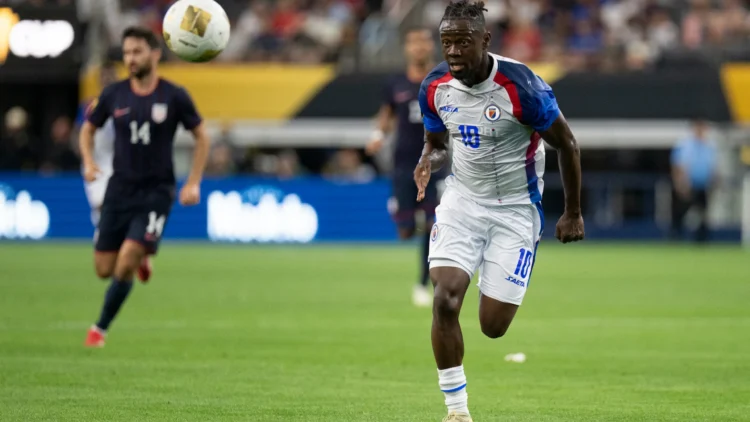
Woodensky Pierre, the only member of Haiti’s World Cup squad currently living and playing in Haiti, has yet to secure authorisation to travel to the United States, even as his teammates begin preparations for the country’s first World Cup appearance in more than five decades.

AD: Capeesh Restaurant
Pierre’s situation has quickly become symbolic of the broader struggles facing Haiti a nation grappling with political instability, gang violence, economic collapse and increasingly difficult international mobility.
While the other 25 members of Haiti’s World Cup squad compete professionally abroad in countries such as France, Portugal, England, Canada and the United States, Pierre continues training in Pétion-Ville, an area of Port-au-Prince considered safer than much of the capital.
The defensive midfielder plays for Violette AC, one of Haiti’s most historic clubs. But unlike many of his teammates who developed careers overseas, Pierre remained in Haiti, navigating a football system battered by insecurity and shrinking opportunities.

AD: Oysterian Sea Food Restaurant And Bar
His home neighbourhood, Cité Soleil, has become one of the country’s most dangerous areas, heavily affected by gang warfare, displacement and food shortages. According to international humanitarian agencies, thousands of residents have fled the district amid escalating violence over the past year.
Haiti’s football federation says it remains hopeful that Pierre’s visa will be approved before the tournament begins. The squad has already started training in Port St. Lucie, Florida, ahead of warm-up matches against New Zealand and Peru in South Florida. Haiti opens its World Cup campaign on June 13 against Scotland in Foxborough, Massachusetts, before facing Brazil and Morocco in Group C.
The timing of Pierre’s visa uncertainty has intensified attention on U.S. immigration policies surrounding the 2026 FIFA World Cup. The tournament, jointly hosted by the United States, Canada and Mexico, is expected to attract millions of visitors, yet concerns have grown over how expanded travel restrictions could affect athletes, officials and fans from countries facing visa scrutiny, including Haiti.
Haiti’s Return to the Global Stage
With Haiti, qualification for the 2026 World Cup already represents one of the nation’s most significant sporting achievements in decades. The Caribbean country last appeared at football’s biggest tournament in 1974, when nearly the entire squad was based domestically. This time, the team reflects the realities of Haiti’s diaspora, with most players developing careers abroad after leaving the country at young ages.
Coach Sébastien Migné’s squad includes players from Major League Soccer, European leagues and Canadian clubs, highlighting how Haitian football talent increasingly flourishes outside the country’s borders. Figures such as Fafà Picault and Woobens Pacius embody that international identity, representing a generation shaped by migration and dual heritage. Pierre, however, represents something different: a player who stayed.
That distinction has elevated his story beyond football circles. Haitian federation spokesman Thecieux Jeanty described Pierre as a source of national pride, not only because of his talent but because his presence in the squad demonstrates that football still survives inside Haiti despite the country’s turmoil. Jeanty told reporters that scouts and international clubs are likely to watch Pierre closely during the tournament, potentially opening a pathway to a professional contract abroad.
“There is soccer in Haiti,” Jeanty said in comments. “It’s a country that wants to live.”
The national team itself has also faced extraordinary logistical challenges. Haiti could not host World Cup qualifiers in Port-au-Prince because security concerns made the national stadium unsafe. Instead, the federation staged “home” matches in Curaçao, depriving players and fans of the atmosphere usually associated with qualification campaigns.
Despite those obstacles, Haiti secured a place in the expanded 48-team World Cup, marking one of the tournament’s most emotional qualification stories. FIFA formally announced Haiti’s squad earlier this month, with Pierre included among the selected midfielders.
Immigration Concerns Shadow the Tournament
Pierre’s delayed visa has also reignited debate over how immigration enforcement may affect the World Cup experience in the United States. Advocacy groups and immigrant-rights organisations have warned that heightened border scrutiny and visa restrictions could discourage supporters from attending matches, particularly among communities from countries facing travel limitations.
Although U.S. authorities have stated that players, coaches and essential staff connected to the World Cup are exempt from broader restrictions, delays and administrative uncertainty continue to affect several delegations. Reports indicate that additional Haitian football officials are also still waiting for visas ahead of the competition.
The issue extends beyond athletes. Haitian supporters in the United States and abroad have voiced concerns about travel risks and immigration enforcement surrounding tournament venues. Some immigrant advocacy groups have issued advisories warning fans to remain cautious while attending matches in the U.S., particularly in states where immigration enforcement has intensified.
Meanwhile, the U.S. government recently announced adjustments to visa bond requirements for World Cup visitors after criticism that additional financial hurdles would deter attendance. Officials said qualifying ticket holders and accredited tournament participants would receive exemptions or expedited processing measures.
The political backdrop only deepens the emotional stakes surrounding the tournament. The country remains mired in crisis, with armed gangs controlling large portions of Port-au-Prince and public institutions struggling to function.
International observers have repeatedly warned that Haiti faces one of the hemisphere’s most severe humanitarian emergencies. Against that backdrop, football has become a rare source of collective hope and international visibility.
Pierre’s journey encapsulates that tension. Every training session he completes in Port-au-Prince carries uncertainty about whether he will actually board a plane to join his teammates.
Within Haiti, his selection alone has already resonated powerfully. Social media users, local football supporters and members of the Haitian diaspora have rallied behind him, viewing his story as proof that talent and ambition can still emerge from a country enduring immense hardship. The clock, however, is ticking. Haiti’s pre-tournament friendlies are approaching, and the World Cup opener against Scotland is less than three weeks away.
Federation officials continue to express optimism that the visa issue will be resolved in time, but until formal approval arrives, Haiti’s most symbolic player remains on the outside of the squad’s Florida camp looking in. Haiti training under the Florida sun preparing for its return to the world stage, one of its most compelling stories remains unfinished.

AD: Heritage And Restaurant Lounge Bar