
By Ben Kerrigan-
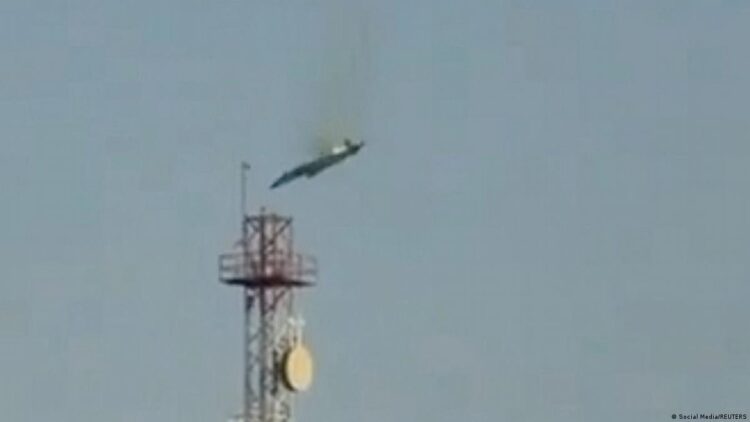
A dramatic escalation in the Middle East conflict unfolded today after Kuwait mistakenly shot down three F‑15E Strike Eagle jets belonging to the United States during heavy combat operations linked to the ongoing war with Iran, defence officials confirmed. All six crew members ejected and were recovered in stable condition, though the incident has sent shockwaves through diplomatic and military circles as leaders grapple with the risks of broader conflagration.
The friendly‑fire incident occurred against the backdrop of a region already on edge following coordinated Operation Epic Fury strikes by American and allied forces on Iranian targets, including facilities alleged to be linked to Tehran’s military capabilities.

AD: Capeesh Restaurant
The strikes over the weekend by the U.S and Israeli governments which analysts say were among the most significant of recent years, have prompted a wave of Iranian retaliatory attacks including ballistic missiles, drones, and cruise missiles aimed at US and partner installations across the Gulf.
“At 11:03 p.m. ET, March 1, three U.S. F-15E Strike Eagles flying in support of Operation Epic Fury went down over Kuwait due to an apparent friendly fire incident,” U.S. Central Command said in a statement. “During active combat—that included attacks from Iranian aircraft, ballistic missiles, and drones — the U.S. Air Force fighter jets were mistakenly shot down by Kuwaiti air defenses.
”All six aircrew ejected safely and survived, the statement said, with further details expected when Pentagon chief Pete Hegseth gives a press conference at 8 a.m. Eastern time.

AD: Oysterian Sea Food Restaurant And Bar
“Kuwait has acknowledged this incident, and we are grateful for the efforts of the Kuwaiti defense forces and their support in this ongoing operation.”
In a series of sharp statements, US officials condemned what they described as Iran’s “reckless” assaults and warned that the combination of hostile actions and misidentification by allied air defence systems could further destabilise an already fragile region.
The United States Central Command expressed both regret and determination to investigate the Kuwait incident, underscoring the dangers posed by complex battlespaces where multiple forces operate in close proximity.
The broader conflict has already disrupted civil life across the Gulf. Key airspaces over United Arab Emirates, Kuwait, and neighbouring territories were closed following retaliatory missile barrages, leading to widespread flight cancellations by major carriers and emergency alerts for civilians.
Residents in capital cities reported explosions and air‑raid sirens as governments scrambled to protect infrastructure and population centres.
Travel warnings issued by foreign governments have added to the sense of upheaval; Australia’s officials recently cautioned citizens about limits to evacuation help amid the region’s airspace chaos and mounting airline cancellations.
Analysts say that this confluence of military operations, air defence misfires, and civilian disruption illustrates just how quickly the crisis has moved from international headlines to public alarm.
Complicating matters further, regional theatres beyond Kuwait including Beirut and southern Lebanon have seen intense clashes between Israeli forces and Iranian‑aligned groups, triggering mass displacements and humanitarian concerns. Global markets are already reacting to fears of sustained tension, with energy prices spiking as uncertainty over Gulf stability deepens.
Leaders from around the world are navigating a difficult diplomatic landscape. Some allies have echoed Washington’s warnings about Iran’s recent attacks, while others are urging restraint and greater emphasis on negotiation.
Combined with the unexpected loss of US aircraft through friendly fire, the situation is amplifying debate in capitals from France to United Kingdom about how best to prevent further escalation without conceding strategic objectives.
With Kuwait, the incident has been particularly sobering. Air defence officials had been engaged in intercepting incoming missiles and drones, having previously condemned Iranian strikes as violations of its sovereignty and international law. The country’s armed forces are now cooperating with US military investigators to determine how the downed jets were misidentified amid the fog of war.
While all crew members survived, the symbolic impact of three sophisticated warplanes being lost to friendly fire is significant. It highlights the dangers inherent in crowded air defence environments and raises pressing questions about command and control protocols in multi‑national operations.
With diplomatic pressure mounting and calls for de‑escalation growing louder, the international community faces a critical test: can leaders avert a wider conflagration that threatens not only military personnel but also civilian lives and regional economies? As the crisis continues to unfold, the answers may redefine the geopolitical landscape of the Middle East for years to come.
The accidental downing of three US fighter jets by Kuwait’s air defence forces has underscored the fragility of regional security arrangements. While no lives were lost thanks to the timely ejection of all crew members, the symbolic impact of such an incident cannot be understated.
Military analysts warn that the combination of miscommunication, overtaxed defence systems, and high-stakes operations could easily escalate into miscalculation, sparking a wider confrontation that drags multiple nations into open conflict.
The United States, as both a principal military actor in the region and a key ally of Kuwait, now faces the dual challenge of reinforcing security while avoiding an escalation that could spiral beyond control.
Iran’s continued missile and drone attacks have further heightened the stakes. Washington and allied governments describe these strikes as “reckless” provocations that jeopardize not just military personnel but also regional commerce and civilian infrastructure. Ports, energy installations, and urban centres across the Gulf are increasingly at risk, and even minor disruptions could ripple across global markets.
Oil prices have already surged as investors react to potential threats to supply from key exporting nations, while shipping companies are forced to reroute vessels away from the Persian Gulf, amplifying economic uncertainty.
Diplomatically, the situation has galvanized a patchwork of responses. Nations with vested interests in regional stability, including the European Union, the United Kingdom, and Japan, have urged restraint while emphasising the need for dialogue and humanitarian support.
Yet opinions diverge sharply. Some Gulf states have called for robust military deterrence against Iranian escalation, while others caution that aggressive responses may only deepen the conflict, highlighting the complexity of balancing security with diplomacy.
The human dimension of the crisis is increasingly apparent. Thousands of civilians have fled southern Lebanon and Beirut in the wake of Israeli strikes against Iranian-aligned groups, seeking safety from the intensifying conflict.
Reports indicate that emergency shelters are overcrowded, and humanitarian organizations are struggling to provide essential services, from food and water to medical care. The displacement crisis adds another layer of urgency, as the risk of civilian casualties rises amid ongoing military operations.
Moreover, the Gulf airspace shutdowns and travel disruptions are extending the crisis beyond the immediate warzone. Airlines have cancelled flights, and international travel advisories have complicated evacuation and humanitarian efforts, leaving both foreign nationals and regional populations in a state of uncertainty.
Governments such as Australia have explicitly warned citizens about limits to evacuation support, signalling the logistical challenges that arise when civilian infrastructure intersects with high-intensity military operations.
Military strategists also warn that the current situation highlights the dangers of overlapping operational theaters. Multiple allied forces operating in proximity, combined with reactive air defence systems, increase the risk of further friendly-fire incidents.
Analysts suggest that without a robust framework for coordination and communication, the region could witness additional accidents with potentially catastrophic consequences. The Kuwait downing incident has thus become a stark reminder of the fine line between conflict management and unintentional escalation.
While the Middle East teeters on the edge of a larger confrontation, the role of international mediators may prove decisive. The coming days are likely to see intensified shuttle diplomacy, emergency United Nations briefings, and negotiations aimed at creating firebreaks in an increasingly combustible environment.
The success or failure of these efforts may not only determine immediate security outcomes but also reshape alliances, defence postures, and economic dependencies across the Gulf and beyond. In this high-stakes crucible, every decision, statement, and action carries weight far beyond its immediate tactical purpose, holding the potential to influence the region’s geopolitical trajectory for decades.