
By Samantha Jones-
A former drug counsellor who admitted supplying ketamine to Matthew Perry in the weeks leading up to the actor’s fatal overdose has been sentenced to two years in federal prison, closing another chapter in one of Hollywood’s most closely watched celebrity death investigations.
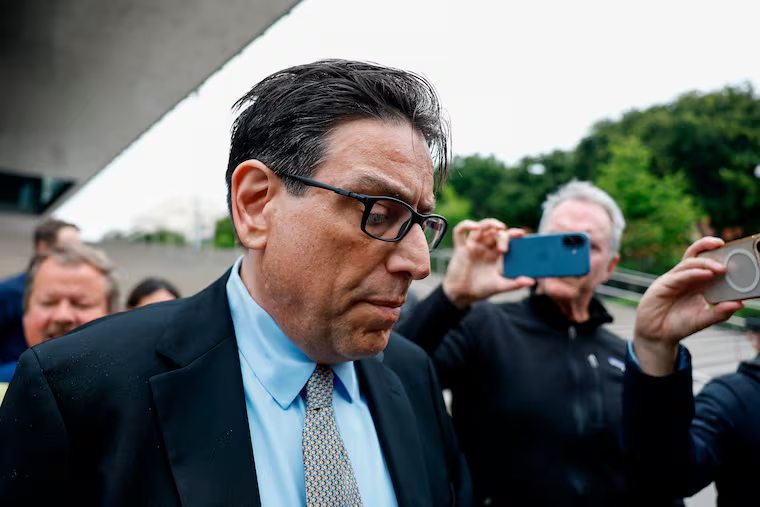
Erik Fleming, a 56-year-old former television producer and licensed addiction counselor, was sentenced Wednesday in a Los Angeles federal court after pleading guilty to conspiracy to distribute ketamine and distribution of ketamine resulting in death.

AD: Capeesh Restaurant
Prosecutors said Fleming acted as a middleman in the drug network that provided Perry with dozens of vials of ketamine shortly before the “Friends” star died in October 2023.
Federal authorities argued that Fleming helped facilitate access to large amounts of the anesthetic drug after Perry sought supplies outside of medically supervised treatment.
Court filings showed Fleming obtained ketamine from Jasveen Sangha later labeled by prosecutors as the “Ketamine Queen” and transferred the drugs to Perry’s assistant, Kenneth Iwamasa, who injected the actor multiple times in the days before his death.

AD: Oysterian Sea Food Restaurant And Bar
Perry, best known for playing Chandler Bing on the hit sitcom Friends, was found dead in the hot tub of his Los Angeles home on October 28, 2023. The Los Angeles County Medical Examiner later ruled that he died from the acute effects of ketamine, with drowning and coronary artery disease contributing to his death.
The sentencing hearing marked a dramatic moment in a case that has exposed what prosecutors described as a profit-driven underground network exploiting a vulnerable celebrity struggling with addiction.
Although Perry had publicly discussed his decades-long battle with substance abuse and recovery, investigators said his condition worsened in the months before his death as he increasingly sought ketamine from illegal suppliers.
In court on Wednesday, Fleming reportedly expressed remorse and told the judge he was “haunted” by his role in the actor’s death. His attorneys argued that he had relapsed into addiction after years of sobriety and had since rebuilt his life through recovery programs and counselling work.
Prosecutors acknowledged Fleming’s cooperation in the broader investigation but maintained that his actions directly contributed to Perry’s death. U.S. District Judge Sherilyn Peace Garnett ultimately sentenced Fleming to 24 months in prison followed by three years of supervised release.
Prosecutors had sought a sentence of two-and-a-half years, while defence lawyers requested leniency because of Fleming’s cooperation and lack of prior criminal convictions. The case has drawn global attention not only because of Perry’s celebrity status but because it revealed how ketamine a legally approved anesthetic increasingly used in mental health treatment can become deadly when distributed outside medical supervision.
Ketamine has gained wider acceptance in recent years as a treatment for depression, anxiety and post-traumatic stress disorder through regulated clinics and prescription programs. However, federal investigators said Perry’s addiction escalated after he sought larger doses than doctors were willing to prescribe.
According to prosecutors, Perry initially received ketamine infusions legally through a clinic as part of depression treatment. But after medical providers declined to increase the dosage, he allegedly turned to doctors and dealers willing to supply him illegally.
Authorities later uncovered text messages among the defendants discussing how much money could be made from Perry because of his celebrity wealth and desperation for the drug.
The investigation ultimately resulted in charges against five people, including two doctors, Perry’s assistant, Fleming and Sangha, the alleged supplier at the center of the operation.
Expanding Fallout From Perry Investigatiom
Fleming’s sentencing comes weeks after Jasveen Sangha received a 15-year federal prison sentence for supplying the ketamine prosecutors say caused Perry’s death. Authorities accused Sangha of operating a large-scale drug distribution network out of a North Hollywood residence stocked with narcotics including methamphetamine, cocaine and ketamine.
Federal prosecutors said Sangha continued trafficking drugs even after Perry’s death and showed little remorse in the months that followed. In court filings, Perry’s family described her as “heartless” and urged the judge to impose the maximum punishment possible.
The two doctors charged in the case also received sentences in recent months. Dr. Salvador Plasencia, accused of illegally distributing ketamine and personally administering injections to Perry, was sentenced to two-and-a-half years in prison after surrendering his medical license. Another physician, Dr. Mark Chavez, received eight months of home confinement for helping obtain the drugs under false pretences.
Kenneth Iwamasa, Perry’s longtime personal assistant, remains the final defendant awaiting sentencing. Prosecutors said Iwamasa injected Perry repeatedly on the day the actor died despite lacking medical training. Court records showed he administered at least three injections in Perry’s final hours. His sentencing is expected later this month.
The legal fallout has reignited broader concerns about ketamine abuse in the United States, particularly as the drug becomes increasingly common in wellness clinics and alternative mental health treatment programs. Medical experts have warned that although ketamine can be effective under professional supervision, misuse can quickly become dangerous because of its dissociative and sedative effects.
Addiction specialists say Perry’s death illustrates how relapse vulnerabilities can persist even after years of recovery. The actor had openly chronicled his addiction struggles in his 2022 memoir, where he described repeated hospitalisations, detox treatments and the emotional toll of fame.
Following his death, renewed attention has focused on accountability within celebrity healthcare culture, where private doctors, assistants and suppliers can sometimes enable destructive behaviour behind closed doors. Legal analysts noted that the Perry case stands out because prosecutors aggressively pursued everyone involved in the supply chain rather than treating the overdose as an isolated incident.
Federal officials said the investigation was intended to send a broader warning about professionals who exploit addiction for profit. Prosecutors argued that Perry’s fame and wealth made him an easy target for people willing to ignore ethical and medical boundaries in exchange for money.
In recent months, documentaries and television specials examining Perry’s death have continued to fuel public interest in the case. A recent episode of the documentary series “Hollywood Demons” alleged that Perry showed visible adverse reactions to ketamine before his death but still received increasing supplies through informal channels.
Fans around the world have continued mourning Perry, whose role on “Friends” made him one of television’s most recognisable stars during the 1990s and early 2000s. Since his death, tributes from former castmates, addiction recovery groups and mental health advocates have emphasised both his comic legacy and his honesty about substance abuse struggles.
Outside court Wednesday, legal observers described Fleming’s sentence as comparatively lenient given the seriousness of the charges, though prosecutors acknowledged his cooperation substantially aided the wider investigation. Fleming avoided a potentially much longer sentence after assisting authorities in identifying Sangha and other suppliers connected to the case.
The sentencing offered little closure for many close to Perry, whose death remains one of the most shocking celebrity overdoses in recent years.
Nearly three years after the actor was found unresponsive in his home, the case continues to resonate far beyond Hollywood as both a cautionary tale about addiction and a stark example of how desperation, celebrity and illicit drug networks can collide with fatal consequences.

AD: Heritage And Restaurant Lounge Bar