

By Aaron Miller-
Tanzanian President Samia Suluhu Hassan formally began her second term in office this week, taking the oath during a heavily guarded ceremony that conspicuously excluded the public. The low-key inauguration, held at a military parade ground in the capital city Dodoma, replaced the traditional, open-air stadium celebration from previous years.
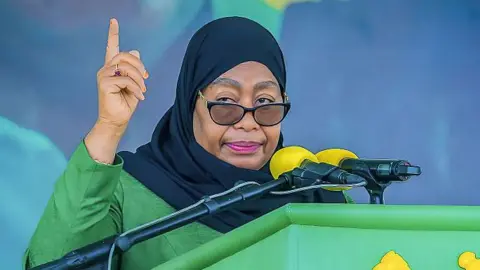
Samia was declared the winner with 98% of the vote. Pic: AFP via Getty Images
State television broadcast the event live, featuring numerous regional leaders and high-level dignitaries, including the presidents of Somalia, Zambia, Mozambique, and Burundi. Wearing a signature red headscarf and dark glasses, Samia took her oath following an election the opposition swiftly rejected as a complete sham, citing widespread irregularities and violent unrest.

AD: Capeesh Restaurant
The ruling party’s candidate, Samia, secured a declared victory on Saturday with an overwhelming 98% of the vote. She faced very little legitimate competition during the campaign period; notably, authorities either imprisoned or barred key rival candidates from participating.
International observers immediately voiced serious concerns about the poll’s transparency and its violent aftermath, which included alarming reports of hundreds of people killed in clashes.
The authorities have worked diligently to downplay the true scale of the violence. Obtaining accurate, verifiable information from within the country remains extraordinarily difficult, largely because of a nationwide internet shutdown that authorities implemented immediately following election day.

AD: Oysterian Sea Food Restaurant And Bar
The absence of credible counter-data exacerbates the growing fear surrounding the Tanzania Election Security Crisis. Despite the official narrative, President Samia strongly defended the process in her earlier victory speech, calling the poll “free and democratic” while labelling anti-government protesters as “unpatriotic.”
Opposition leaders and human rights activists paint a much darker picture than the official government reports, alleging hundreds died during brutal clashes with security forces immediately after the vote. The primary opposition group, the Chadema party, informed the AFP news agency it had recorded “no less than 800” fatalities by Saturday alone.
Simultaneously, a diplomatic source operating in Tanzania told the BBC they possessed credible evidence indicating at least 500 people had died in the unrest. Even the UN human rights office weighed in on the issue, stating it had received credible reports of at least 10 deaths across three major cities. These deeply concerning casualty figures highlight the severity of the Tanzania Election Security Crisis currently gripping the nation.
Further exacerbating the tension, police spokesman David Misime publicly blamed the violent demonstrations and subsequent acts of vandalism on specific groups. He pointed the finger at motorbike operators and, significantly, “foreign nationals,” whom he accused of deliberately entering the country illegally with the explicit intention of causing chaos.
Misime then took the unusual step of urging all Tanzanians to report “any foreigner who is unknown or whose activities in Tanzania are unclear” to the authorities immediately. His controversial remarks quickly followed reports that several Kenyan nationals had gone missing in Tanzania.
A Kenyan activist, Hussein Khalid, reported on X receiving information that a Kenyan teacher had been killed, with others still officially unaccounted for. The situation surrounding the Tanzania Election Security Crisis quickly escalated into a matter of international concern, triggering high-level diplomatic statements.
Pope Leo XIV publicly called for prayers on Sunday, stating that post-election violence had erupted “with numerous victims.” European Union foreign affairs chief Kaja Kallas also urged Tanzanian authorities to exercise maximum restraint to preserve lives.
Meanwhile, UN Secretary-General António Guterres expressed profound concern about the developing situation, including all reports of deaths and injuries. You can track the official statements and findings from international monitoring bodies regarding human rights via the Amnesty International Annual Report on Tanzania.
The political unrest immediately translated into severe economic hardship across many areas of the country. Following the violence, prices for fuel, food, and other essential goods have dangerously doubled or even tripled in many communities.
Schools and colleges have closed their doors, and public transport operations have abruptly halted, crippling daily life. This widespread instability, driven by the Tanzania Election Security Crisis, creates immense suffering for ordinary citizens.
The Chadema party, which authorities barred from competing in the election, adamantly rejects the 87% turnout figure announced by the electoral commission. Chadema leaders stated the announced results had “no basis in reality as the truth is that no genuine election took place in Tanzania,” subsequently calling for a completely fresh election. Tellingly, polling stations remained largely empty on election day itself, contrasting sharply with the official high turnout claim.
The ruling party, Chama Cha Mapinduzi (CCM), and its predecessor, Tanu, have consistently dominated the country’s political landscape, maintaining power and never losing an election since achieving independence. Samia is the country’s first female president, having assumed office in 2021 after the sudden death of former President John Magufuli. Her administration has faced international condemnation regarding its approach to democratic freedom. Ahead of the election, rights groups fiercely condemned government repression.
Amnesty International specifically cited a “wave of terror” involving documented torture, enforced disappearances, and extrajudicial killings targeting opposition figures. Authorities rejected these grave claims, maintaining that the recent election would be fundamentally free and fair.
The most prominent opposition leaders did not even contest the recent election; Tundu Lissu is currently being held on treason charges he denies, while Luhaga Mpina of the ACT-Wazalendo party was excluded on legal technicalities. Only sixteen minor fringe parties, none of whom historically command significant public support, were allowed to run. The failure to address core democratic concerns ensures the Tanzania Election Security Crisis will continue destabilizing the nation.

AD: Heritage And Restaurant Lounge Bar


