
By Gabriel Princewill-
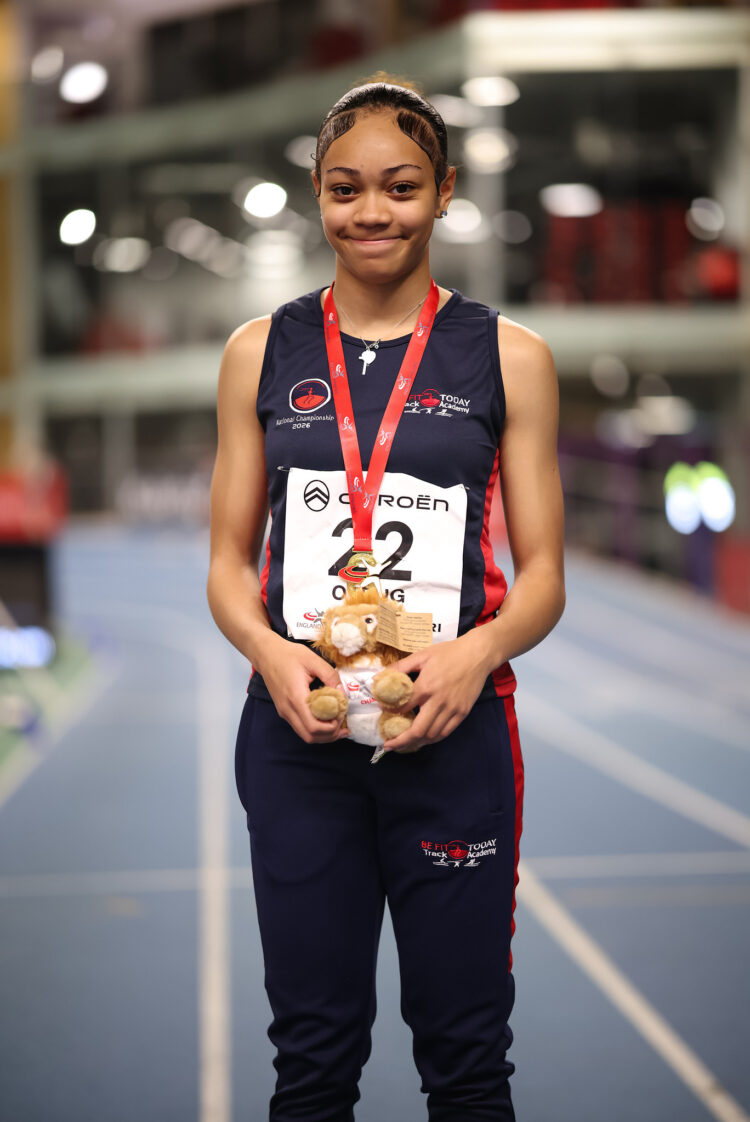
Promising under 15 teenager, Honor Otteng,(pictured) stole the show at last weekend’s National Indoor Championships – a tournament that delivered one of the most compelling showcases of emerging British sprint talent in recent years, with records tumbling and teenage stars announcing themselves on the national stage.
Amid the flurry of standout performances, it was the composure, resilience and explosive speed of 13 year old sprinter, Oteng that captured the imagination of the viewing audience.

AD: Capeesh Restaurant
The new kid on the block stole the show with a brilliant double gold in the Under-15 category, underlining her status as one of the most exciting prospects in her age group.
After suffering disappointment in the semifinals of the 60 metres in which she came second, Oteng returned to the track with renewed focus to produce a personal best of 7.47 seconds in the final, securing the national title. She then doubled her triumph the following day, storming to victory in the 200 metres to complete an impressive championship sweep.
Her performance was one of several highlights across a competition that saw established junior talents break long-standing records, and a number of clubs stake their claim as incubators of Britain’s sprinting future.

AD: Oysterian Sea Food Restaurant And Bar
Redemption and Resolve
Oteng’s road to gold was not straightforward. Having been beaten in the semifinals of the 60m, many young athletes might have allowed disappointment to dent their confidence. Instead, she channelled it into motivation.
Returning for the final, the bright prospect produced the fastest run of her young career, clocking 7.47 seconds — a personal best delivered on the biggest domestic stage available to her age group. The time not only secured gold, but marked a significant progression in her development this season.
Observers noted the technical refinement in her start and drive phase, — often the differentiating factors at 60 metres — as well as her composure under pressure. In junior sprinting, margins are razor-thin and emotional resilience can be as decisive as raw speed. Oteng demonstrated both.
The following day, she confirmed that her success was no one-off. Switching to the half-lap 200 metres, she displayed strength and endurance to match her acceleration, powering to a second gold medal.
Her achievement compares favourably with recent editions of the National Indoor Championships, where U15 sprint doubles have been infrequent. In many past championships, winners in the 60m and 200m have often been split between specialists in short acceleration and those better suited to longer sprint mechanics.
Oteng’s ability to dominate both distances suggests a versatility that could serve her well as she matures into the U17 and U20 ranks.
BFTTA’s Medal Haul
Oteng’s triumph was central to an impressive collective showing from the BFTTA squad, which sent 11 athletes to the championships and returned with five medals — a highly efficient conversion rate at a national event of this scale.
Michelle Thompson added to the club’s tally with a bronze medal in the 200m. In a tightly contested race, Thompson demonstrated determination and tactical awareness to secure a place on the podium. Her contribution ensured that BFTTA featured prominently in the sprint events across the weekend.
The club’s medal return is particularly noteworthy when viewed against previous championship campaigns. In earlier editions, BFTTA has often fielded competitive athletes but fallen just short of multiple podium finishes.
This year’s haul reflects both depth and progression within the training group.
Head Coach TJ Ossai was quick to emphasise that the success was collective.
“It was a team effort, from support coaches, therapists, and all operational staff contributing to a successful weekend,” Ossai said. “It’s important that young people can dream and believe they can achieve through hard work and commitment.”
Ossai’s remarks underline a broader trend in youth athletics: behind every breakout performance lies a support infrastructure that includes coaching, sports science, physiotherapy and parental commitment. Clubs investing in holistic development are increasingly reaping the rewards on national podiums.
While Oteng’s double gold was a defining storyline, the championships will also be remembered for a remarkable European record-breaking run.
Sixteen-year-old Divine Iheme delivered one of the most electrifying moments of the weekend, clocking 6.68 seconds in the U17 60 metres to break a 26-year-old European record. The time sent shockwaves through the athletics community and immediately positioned Iheme among the fastest U17 sprinters in European history.
Breaking a record that has stood for more than a quarter of a century is no small feat. Youth sprint records are often durable because they represent the exceptional outliers of their generation. For Iheme to eclipse such a mark underscores both his raw talent and the quality of preparation behind him.
His performance inevitably invites comparisons with previous national championships. In many past editions, winning times in the U17 60m have hovered in the low 6.7s to high 6.8s range.
Iheme’s 6.68 not only secured victory but elevated the standard to a new level, signalling that British junior sprinting is entering a particularly fertile phase.
Equally impressive was the performance of 12-year-old Emmanuel Ofori-Manteaw, who claimed U15 gold in 7.08 seconds. For an athlete so young, dipping close to the seven-second barrier is an indicator of exceptional speed. His victory demonstrated the depth of talent emerging in the younger age groups.
In the U17 Boys 60m, Dylan Williams won gold in 6.71 seconds, narrowly edging Mayo Alabi, who clocked 6.72s in a thrilling finish. The razor-thin margin between first and second illustrated the fiercely competitive environment in which Britain’s top junior sprinters are developing.
Teammate Bright Otiora secured bronze in 6.83 seconds, completing a high-quality podium. The clustering of times within a fraction of a second reflects a championship where standards were exceptionally high across the board.
Taken together, the performances across the U15 and U17 categories suggest that the current cohort of British youth sprinters may be among the strongest in recent memory.
In past national championships, standout individuals have often dominated headlines. This year, however, the narrative was broader. Multiple athletes across age groups delivered performances that would have been medal-worthy in most previous editions.
The breaking of a long-standing European record by Iheme stands out historically, but the depth behind him — Williams, Alabi, Otiora and others — suggests a competitive ecosystem rather than isolated brilliance.
For younger athletes like Oteng and Ofori-Manteaw, witnessing such performances can be transformative. Exposure to record-breaking standards raises expectations and recalibrates what is perceived as possible.
Indoor championships often serve as a litmus test for technical proficiency. The 60 metres, in particular, is unforgiving. With no room to recover from a poor start, athletes must execute flawlessly from the blocks.
Well done to the athletes!

AD: Heritage And Restaurant Lounge Bar