
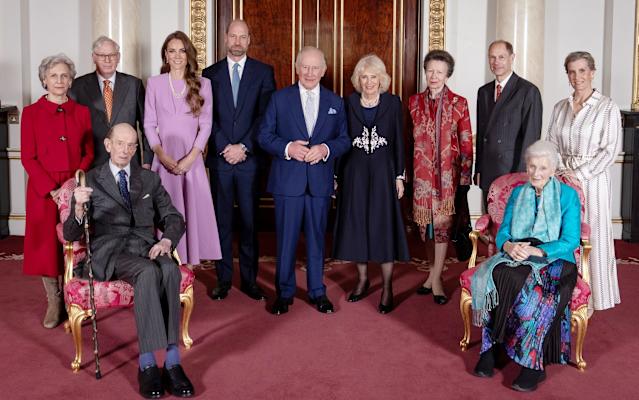
The British royal family marked what would have been the 100th birthday of Queen Elizabeth II with a series of high-profile events across London, culminating in a Buckingham Palace reception that underscored both remembrance and continuity.
Fronting the commemorations, the Princess of Wales emerged as a key figure embodying the late Queen’s enduring influence, offering a modern reflection of a legacy defined by duty, resilience, and public service.
The centenary celebrations brought together senior royals, political leaders, and members of the public to honour a monarch whose 70-year reign left an indelible mark on Britain and the Commonwealth.

AD: Capeesh Restaurant
The occasion also served as a moment of transition, highlighting how the next generation of royals is shaping the monarchy’s future while drawing heavily on the example set by Elizabeth II.
At a reception held in the Marble Hall of Buckingham Palace, the Princess of Wales Catherine, Princess of Wales was seen engaging warmly with guests, including centenarians and individuals connected to the late Queen’s charitable patronages. Her interactions, widely described as personal and empathetic, echoed the approachable style that defined Elizabeth’s later years.
The event, attended by King Charles III, Queen Camilla, and Prince William, was one of several engagements designed to celebrate the Queen’s life while reinforcing the monarchy’s continued relevance.

AD: Oysterian Sea Food Restaurant And Bar
The centenary programme was deliberately structured to showcase the breadth of Elizabeth II’s legacy, from her commitment to public service to her influence on national identity. Across multiple events including exhibitions, memorial previews, and community initiatives the royal family sought to present a narrative of continuity rather than nostalgia.
Central to that narrative was the role of younger royals, particularly the Princess of Wales, whose presence at the Buckingham Palace reception drew significant attention. Wearing jewellery associated with the late Queen, including pearl pieces long linked to royal tradition, she visually reinforced the symbolic connection between past and present.
Observers noted that her conduct throughout the event marked by attentiveness, warmth, and an ease in public engagement mirrored qualities often attributed to Elizabeth II. In one widely reported moment, she embraced an elderly guest attending in memory of his late wife, a gesture that resonated with the Queen’s reputation for quiet compassion.
The broader programme of commemorations also reflected the late monarch’s priorities. A major exhibition at the King’s Gallery, titled Queen Elizabeth II: Her Life in Style, traced her evolution from princess to sovereign through more than 300 items of clothing, highlighting how image and symbolism were central to her public role.
Meanwhile, at the British Museum, senior royals reviewed designs for a national memorial that will stand in St James’s Park, further cementing the Queen’s place in Britain’s historical landscape.
These events collectively reinforced a central theme: that Elizabeth II’s legacy is not confined to the past but continues to shape the monarchy’s identity and public engagement today.
While the Buckingham Palace reception provided a focal point for the centenary, other events across the capital highlighted the enduring scope of the Queen’s influence. Among them was the opening of the Queen Elizabeth II Gardenby Princess Anne, a space designed for reflection and sustainability that pays tribute to the late monarch’s lifelong commitment to the environment and public life.
The garden, featuring climate-resilient planting and accessible pathways, reflects a modern interpretation of the Queen’s legacy, aligning traditional commemoration with contemporary concerns such as biodiversity and public access.
Public sentiment surrounding the centenary has underscored the lasting impact of Elizabeth II’s reign. Polling and market indicators suggest that her image and symbolism remain deeply embedded in British culture, with memorabilia and public affection continuing to outpace that associated with the current monarch.
With King Charles III, the centenary has also been a moment of personal reflection. In a recorded message, he paid tribute to his “darling Mama,” emphasising her unwavering dedication and the values she instilled in both the royal family and the nation.
Yet it is the visible role of the next generation particularly the Prince and Princess of Wales that has drawn attention as a sign of the monarchy’s future direction. Their involvement in centenary events, combined with a more informal and accessible public style, suggests an evolving approach to royal engagement that remains rooted in the principles established by Elizabeth II.
The Princess of Wales’s role at the centenary, in particular, has been widely interpreted as evidence that the late Queen’s legacy is being actively carried forward. Her ability to balance tradition with relatability reflects a broader effort within the royal household to adapt to changing public expectations while preserving core values of service and continuity.
While the commemorations draw to a close, the centenary of Queen Elizabeth II’s birth stands as both a tribute and a transition point. It has offered a moment to reflect on a remarkable reign while also highlighting how its legacy continues to shape the present and, increasingly, the future of the British monarchy.
In that sense, the message of the celebrations has been clear: while the era of Queen Elizabeth II has passed, the principles she embodied remain firmly in place. Through the actions of the current generation, and particularly the poised public role of Catherine, Princess of Wales, the monarchy is signalling that the late Queen’s legacy is not only preserved but actively guiding its path forward.
This continuity is being expressed not just through ceremony, but through a renewed emphasis on accessibility, empathy, and public service qualities that defined Elizabeth’s reign and are now being adapted to meet the expectations of a changing society.
Senior royals, including King Charles III, have increasingly leaned into a more personal and outward-facing approach, engaging with communities in ways that reflect both tradition and modern relevance.

AD: Heritage And Restaurant Lounge Bar