
By Ben Kerrigan-
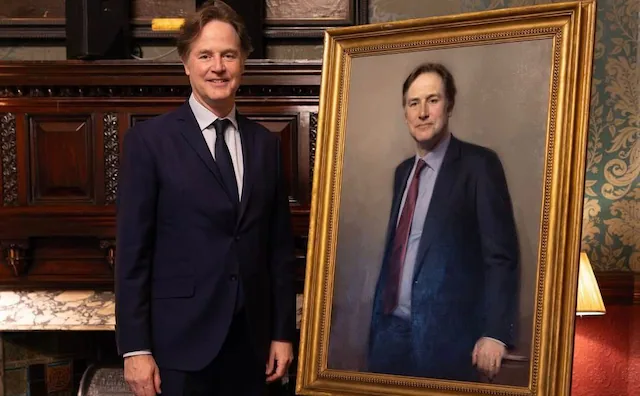
When Nick Clegg unveiled his official portrait at the National Liberal Club in London this week, the intention was to celebrate his long and varied career in public life. Instead, the reaction was immediate, bemused and at times downright bewildered, with critics online asking, “What on earth happened?” as social media lit up with commentary over the strikingly unconventional work. The portrait bold, idiosyncratic and very different from traditional political painting has sparked debate across the UK and beyond about how contemporary figures should be commemorated and what portraiture can say about modern politics.
Much of the early reaction has come from users online, with many expressing confusion over the artistic choices made. The work has left many scratching their heads and wondering whether this is a sincere homage or a misstep in style that fails to flatter its subject.

AD: Capeesh Restaurant
But beyond a humorous social media squabble, the controversy touches on deeper issues: who gets to decide how politicians are immortalised, how much artistic licence is appropriate, and what it means for public figures to control their own legacy in a media age where interpretation can be as influential as fact.
Unveiled amid a gathering of colleagues, aides and supporters, Clegg’s portrait was meant to mark his tenure in political life, from his years as Deputy Prime Minister of the United Kingdom to his influential role in international tech policy after leaving Westminster.
Clegg’s post‑government career, including his time as Meta’s head of global affairs and subsequent roles in global tech diplomacy, has kept him in the public eye long after his parliamentary career ended.

AD: Oysterian Sea Food Restaurant And Bar
The portrait’s unveiling ceremony drew a respectable turnout, with many eager to witness the official depiction of one of Britain’s more colourful and controversial modern politicians.
Once images of the new painting began circulating online, reactions shifted quickly from polite curiosity to widespread amusement and criticism.
Users on social media and forums, where public figures like Clegg are frequently debated and analysed, replayed GIFs, jokes and commentary as they tried to interpret the unusual artistic choices.
Online threads discussing Clegg’s public image where some users are openly dismissive of his media presence and tech policy views reflect the kind of sentiment that drove much of the discussion around the portrait’s release.
The portrait itself, unveiled at the National Liberal Club in London and shared digitally by observers, provided the visual spark for the discussion.
While users circulated photos of the artwork, comments ranged from bemusement at its abstract or unconventional style to jokes about it resembling a digitally generated or AI‑inspired image, reflecting the broader culture of online social commentary about political figures.
Art critics and the broader public have offered contrasting interpretations of modern political portraiture, suggesting that official depictions can be as contentious as they are commemorative.
Coverage of King Charles III’s first official portrait, for example, noted that its bold, modern style and unexpected aesthetic sparked mixed reactions online, with some praising its break from tradition and others questioning its effectiveness as a royal image.
Similarly, debates around other political portraits such as criticism of a recent official painting of Donald Trump that drew public rebuke from the subject himself highlight how artistic intent and public expectation can diverge sharply when politics and portraiture intersect.
The public’s fascination with Nick Clegg’s new portrait reflects his unique and often polarising place in British political history. Leader of the Liberal Democrats from 2007 to 2015, he guided the party into a coalition government with the Conservatives under David Cameron a move that earned both praise and sharp criticism, fundamentally reshaping his legacy.
After leaving Parliament, Clegg transitioned into the tech world, joining Facebook (later Meta) as vice‑president and eventually president of global affairs. His role in Silicon Valley positioned him at the intersection of politics, technology, and global policy, drawing headlines in both political and tech circles and complicating public perceptions of his career.
In this post‑political capacity, Clegg has influenced debates on digital governance and the regulation of tech platforms, a role that has been both influential and controversial, particularly among critics concerned about the growing power of Silicon Valley firms.
That complex legacy may partly explain the range of responses to the portrait. For supporters, the painting is a celebration of a figure who has navigated both the rough‑and‑tumble of British politics and the equally turbulent world of global tech policy.
To detractors, it seems yet another opportunity for Clegg to place himself at the centre of attention, this time through an artwork that many feel doesn’t reflect his public image at all.
In political terms, the portrait controversy might be as revealing as the image itself: public figures can no longer rely on dour, uncontroversial depictions to define how history remembers them.
The online reaction has underscored the way public opinion now forms in the digital age. Memes, tweets and forum threads circulated within hours of the unveiling, with some commentators likening the portrait to everything from surreal art to stock character illustrations, often not kindly.
While such responses might seem superficial on the surface, they reflect a broader scepticism toward how the political class chooses to present itself and how seriously the public continues to take official symbols of achievement.
There’s also a humorous side to the backlash. Some commentators have joked that the portrait could be mistaken for a caricature, that it would make a perfect subject for a satirical show, or that it could be used as a modern art piece in a gallery where visitors guess the subject’s identity.
These light‑hearted reactions underscore a serious point: today’s citizens have little patience for images that feel out of step with their lived reality or that seem to elevate politicians above everyday scrutiny.
Clegg himself has yet to offer a detailed public response to the outcry over his portrait, though aides have defended the artist’s creativity and noted that art is inherently subjective. Supporters in the political and tech worlds have pointed out that a lack of universal acclaim does not make a piece of art illegitimate, and that controversy can be a powerful spur to public engagement with art and history.
Whether Clegg views the reaction as a distraction or an odd but welcome burst of attention remains unclear, but there is little question that his portrait has taken on a life of its own far beyond the walls of the club where it was first displayed.
The conversation around the painting also raises broader questions about how politicians shape their post‑career image and what responsibilities artists have when portraying figures steeped in controversy.
Is the goal to flatter and commemorate, or to provoke reflection and debate? The case of Clegg’s portrait suggests that in the 21st century, those aims are sometimes at odds, and the public reaction can be as unpredictable as the art itself.
A figure whose career has spanned coalition politics, digital policy and global public affairs, the intense scrutiny of a single painting might seem a surprisingly small stage.
Yet in an era where every image can be shared instantly and every reaction archived indefinitely, the unveiling of this portrait has become a microcosm of modern public life where legacy, interpretation, mockery and memory converge in unexpected ways.
That the resulting debate has only just begun suggests that the true impact of this so‑called “underwhelming” artwork may be felt for months, even years, to come.
Whether this portrait will eventually be seen as a bold reinterpretation or a curious footnote in Clegg’s varied public life remains to be seen. But for now, it has given the public something to question, to critique and, in many cases, to laugh about a reminder that art and politics, when they collide, can produce moments that are as baffling as they are revealing.

AD: Heritage And Restaurant Lounge Bar