
By Ben Kerrigan-
A Manchester Airport engineer has been described by colleagues as “lucky to be alive” after falling from a Jet2 passenger aircraft during routine ground operations, in an incident that has triggered a formal multi-agency investigation involving the airline, airport authorities, and emergency services.
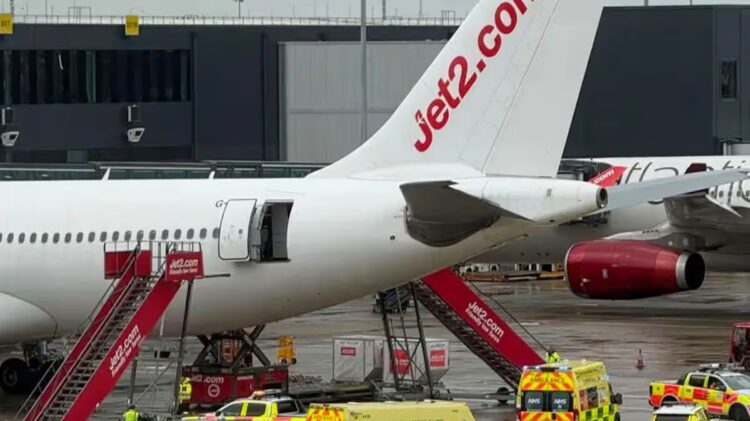
The accident happened on Saturday morning at around 8am on the airport’s apron area while the aircraft was being prepared for a scheduled flight to Tenerife. Emergency services, including paramedics from the North West Ambulance Service, were called to reports of a worker falling from height on the tarmac and arrived within minutes to treat the injured man before transporting him to hospital.

AD: Capeesh Restaurant
Jet2 confirmed that a contractor working on its behalf had been injured during ground handling procedures and said it was cooperating fully with investigators. In a statement cited by multiple UK outlets, the airline stressed that safety remains its “highest priority” and confirmed that the aircraft involved was taken out of service following the incident.
Witness accounts reported by UK media suggest the engineer may have mistakenly opened the rear door of the aircraft under the belief that boarding steps were correctly positioned. When he realised there were no steps in place, he attempted to regain balance while strong winds affected the open door area, but he fell from an estimated height of around 30 to 35 feet onto the concrete surface below.
The injured man, believed to be in his 60s and working for a third-party engineering contractor, suffered serious injuries and was taken to Manchester Royal Infirmary for emergency treatment.

AD: Oysterian Sea Food Restaurant And Bar
Early reports from hospital sources and emergency responders indicate he sustained multiple fractures and trauma consistent with a high-impact fall, though his condition has been described as serious but not believed to be life-threatening.
Aviation investigators are now examining whether a breakdown in communication, equipment positioning, or procedural adherence contributed to the incident. Ground operations at major airports such as Manchester involve tightly coordinated systems in which aircraft doors, mobile stairs, and jet bridges must be precisely aligned before any access is made to the aircraft cabin.
Preliminary witness statements reported by UK news outlets indicate that confusion may have arisen over the positioning of mobile stairs on the aircraft. One account suggests the engineer believed the stairs were on one side of the aircraft when they were in fact positioned elsewhere, leading to the fatal misjudgment when the door was opened.
Investigators are expected to review a range of operational evidence, including CCTV footage from the apron area, radio communications between ground staff, and maintenance and engineering records, to reconstruct a full timeline of events leading up to the incident.
According to the UK Civil Aviation Authority, aviation safety investigations rely heavily on structured reporting systems such as Mandatory Occurrence Reporting, which requires detailed accounts of airside incidents and supporting operational data to help identify causes and prevent recurrence.
Manchester Airport said that emergency services attended the scene and that operations were adjusted to accommodate the incident response. While the airport has not provided detailed commentary, it has stated that it is cooperating fully with all relevant authorities.
Jet2, one of the UK’s largest leisure airlines, has also confirmed its cooperation with the investigation. The airline operates a large number of European routes, including services from Manchester Airport, and relies heavily on contracted ground handling and engineering providers, a common structure in the aviation industry.
Aviation safety specialists note that falls from aircraft during ground operations are rare but potentially catastrophic due to the height involved and the hard surface of airport aprons. Even controlled environments carry significant risk, particularly during aircraft turnaround periods when multiple teams are working under time pressure.
The aircraft involved remained grounded following the incident, and the scheduled departure was cancelled. Passengers were re-booked or transferred to alternative services, according to airline reports cited in UK media coverage.
Emergency responders from the North West Ambulance Service confirmed they were called to reports of a fall from height at Manchester Airport and provided immediate care at the scene before transporting the patient to hospital. Fire crews also assisted in securing the area to allow medical teams safe access around the aircraft.
While the investigation continues, authorities are expected to focus on whether existing safety procedures were followed correctly and whether additional safeguards may be needed to prevent similar incidents in the future. A full report is likely to take weeks or months, depending on the complexity of the evidence gathered.
The injured engineer remains under medical care, while colleagues and aviation workers across Manchester Airport await further updates on his recovery, as well as the findings of the ongoing investigation into how a routine ground operation escalated into a serious workplace accident.
Medical staff continue to monitor his condition closely following the fall, which left him with significant injuries requiring urgent hospital treatment. Although early reports suggest he survived the impact, his recovery is expected to be gradual given the severity of the incident and the nature of injuries typically associated with falls from height.
Within the airport community, there is a growing sense of concern and reflection among ground handling staff, engineering teams, and airline contractors who work daily in high-pressure operational environments.
Many workers rely on strict safety protocols designed to prevent exactly this type of incident, and the case has prompted renewed attention to how those procedures are communicated and followed in real time.
While aviation workplaces are among the most regulated in the transport sector, incidents on busy aprons can still occur when coordination between teams breaks down or when environmental conditions, such as wind and visibility, add unexpected risks.
Attention is now also turning to the broader safety systems in place at Manchester Airport, one of the UK’s busiest transport hubs, where aircraft turnaround times are tightly scheduled and multiple contractors often operate simultaneously around a single aircraft.
Investigators are expected to examine whether all required checks were completed before the aircraft door was opened and whether ground equipment, such as mobile stairs or access platforms, was correctly positioned at the time of the incident.
The investigation, involving airport authorities, the airline, and aviation safety regulators, is expected to take time as evidence is collected and reviewed, including CCTV footage, radio communications, and maintenance logs. Until then, speculation remains secondary to the priority of supporting the injured worker’s recovery and ensuring that accurate conclusions are drawn from verified facts.
Across the wider aviation sector, the incident has also reignited discussion about risk management during ground operations, particularly in adverse weather conditions or during night or early-morning shifts when visibility and fatigue can become contributing factors.
Safety experts continue to emphasise that while such events are rare, they highlight the importance of constant vigilance and adherence to established procedures.The focus remains firmly on the engineer’s recovery and the hope that he will make a full recovery, while the findings of the investigation are awaited to provide clarity on how a standard operational procedure resulted in such a serious and preventable workplace accident.

AD: Heritage And Restaurant Lounge Bar