
By Ben Kerrigan-
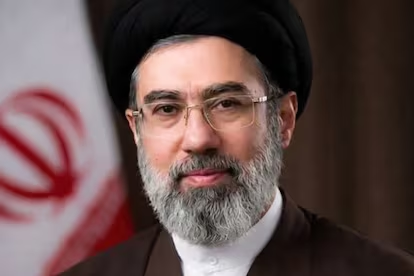
Iran’s long-time supreme leader Ali Khamenei’s son and successor, Mojtaba Khamenei,(pictured) has delivered a stark and confrontational message to the United States and its allies across the Middle East, in the turbulent days following the assassination of his father, who reigned by force for decades .
In his first public statement since assuming power, Mojtaba Khamenei warned that Iran would continue attacking American military installations across the region and demanded that all U.S. bases in neighbouring countries be closed immediately. The declaration comes amid the escalating regional war that erupted after a joint U.S.–Israeli strike killed his father and several members of the ruling clerical family, triggering vows of revenge from Tehran.

AD: Capeesh Restaurant
Khamenei , not seen in public since his father Ayatollah Ali Khamenei was killed on 28 February –vowed to seek revenge after the Minab school attack, in which Iran says 175 people, mostly children, were killed.
The statement, broadcast on Iranian state media, and attributed to the new supreme leader, frames the ongoing conflict not merely as retaliation but as a defining moment in the survival and expansion of the Islamic Republic. According to the remarks, Iran will pursue its confrontation with Washington until the United States withdraws its military presence from the region and ceases attacks against the country.
At the same time, Mojtaba Khamenei signalled that Tehran believes it still has friends and sympathetic partners throughout the Gulf region. In a passage interpreted by analysts as a message to governments and political factions across the Arab world, he suggested that supporters in neighbouring countries—including Kuwait—were willing to assist the revolutionary project that has defined Iran’s political identity since 1979. The new leader’s rise to power came under extraordinary circumstances. On 28 February 2026, a coordinated airstrike carried out by the United States and Israel targeted a leadership complex in Tehran in what analysts described as a “decapitation strike.” The operation killed Ali Khamenei, who had ruled the Islamic Republic since 1989 and had been one of the most influential figures in the Middle East for more than three decades.

AD: Oysterian Sea Food Restaurant And Bar
The attack was intended to weaken Iran’s leadership structure at the start of what has become a rapidly expanding regional war. According to Iranian state media and multiple international reports, the strike did not only kill the supreme leader but also members of his extended family who were present at the compound at the time.
Among those reported killed were his daughter, his son-in-law, and his granddaughter, as well as other relatives connected to the inner circle of the ruling clerical establishment.
Further reports indicated that Mojtaba Khamenei’s own wife, Zahra Haddad‑Adel, also died in the attack along with a child and several in-laws. These deaths elevated the strike from a purely strategic military action to what Iranian officials have framed as an attack on the leadership family itself.
Iranian authorities quickly declared the victims “martyrs,” invoking the language of revolutionary sacrifice that has shaped the ideology of the Islamic Republic since its founding.
The assassination triggered a period of national mourning inside Iran and raised fears across the region that Tehran would respond with massive retaliation. Instead of paralyzing the political system, the strike accelerated the succession process that had long been expected but never openly acknowledged.
Within days, the clerical body responsible for choosing the supreme leader—the Assembly of Experts—announced that Mojtaba Khamenei had been selected to replace his father.
Unlike his father, Mojtaba Khamenei had never held formal elected office before assuming Iran’s highest position. Yet for years he had been widely viewed as one of the most powerful figures behind the scenes in the Islamic Republic.
Born in 1969, he spent much of his career working closely with Iran’s powerful Revolutionary Guard and conservative clerical networks. His influence expanded during the final years of his father’s rule, when observers increasingly described him as a central figure in decision-making inside the regime.
Despite his influence, Mojtaba Khamenei remained largely absent from public life. He rarely gave speeches and avoided the political spotlight, reinforcing his reputation as a shadowy strategist rather than a public leader. The war and the assassination of his father abruptly forced him into the center of global attention.
A Message of Retaliation
In his first statement as supreme leader, Mojtaba Khamenei emphasized that Iran would not retreat from confrontation with the United States and Israel. Instead, he portrayed the war as proof that the Islamic Republic must intensify its resistance.
The statement warned that American military installations across the Middle East would remain legitimate targets as long as they continue operating.
“All U.S. bases in the region must be closed,” the message said, adding that if they remain open they will face attacks by Iranian forces or allied groups.
The new leader also indicated that Iran views those bases as the primary platforms from which the strikes against its leadership were launched. For that reason, he suggested, the United States should expect continued retaliation until its regional presence is dismantled.
Such threats carry significant implications for countries hosting American forces, including several Gulf states that have served as strategic hubs for U.S. operations for decades.
One of the most intriguing elements of the statement was a reference to Iran’s relationships with neighbouring countries.
While condemning governments that host American forces, Mojtaba Khamenei simultaneously emphasized that Tehran seeks friendly ties with its neighboUrs. In that context, he suggested that sympathetic forces in countries such as Kuwait support the continuation of Iran’s revolutionary project.
Analysts believe the message was directed at political factions and networks across the Gulf that maintain ties with Iran or share ideological affinities with the Islamic Republic.
The comments come at a time when Kuwait has already become entangled in the widening conflict. Since the start of the war, Iranian missiles and drones have targeted American and allied assets within Kuwaiti territory as part of Tehran’s retaliatory campaign. Those attacks have injured civilians and damaged infrastructure, further raising fears that the conflict could engulf multiple Gulf states.
The language used by Mojtaba Khamenei also reflects a central doctrine of the Iranian political system- the concept of spreading or defending the ideals of the Islamic Revolution.
Since the revolution of 1979 led by Ruhollah Khomeini, Iranian leaders have often spoken about the need to inspire similar movements elsewhere in the Muslim world. The idea is not necessarily about direct conquest but about encouraging resistance against Western influence and authoritarian governments aligned with foreign powers.
Iran’s leadership frequently refers to this as “exporting the revolution,” meaning that the success of the Islamic Republic serves as a model for other societies seeking independence from Western dominance.
Mojtaba Khamenei’s remarks suggest that he intends to continue this ideological mission even as Iran confronts an escalating military confrontation.
Iranian forces and allied groups have already launched missile and drone attacks across the region, targeting Israeli territory, Gulf shipping lanes, and American military installations. Meanwhile, Israel and the United States have continued bombing Iranian military infrastructure, energy facilities, and command centers.
The confrontation has also triggered a global economic shock. Oil prices have surged as shipping through the Strait of Hormuz—the narrow waterway through which a large portion of the world’s oil supply passes—has been disrupted by attacks and blockades.
Mojtaba Khamenei has indicated that maintaining pressure on the strait is a strategic tool intended to force Western powers to reconsider their military campaign against Iran.
The war for Khamenei has become both a personal and political turning point. The strike that killed his father also killed members of his own family, transforming the conflict into a deeply personal struggle. Iranian officials have repeatedly emphasized this point in state media, portraying Mojtaba Khamenei as a leader who has directly suffered the consequences of foreign attacks.
Such narratives are likely to strengthen his position among hard-line factions within the Iranian political system, many of whom view the deaths as proof that the country must respond with maximum force.
At the same time, questions remain about the new leader’s health and whereabouts. Some reports have suggested he may have been injured during the early stages of the conflict and is currently operating from a secure location. Regardless of those uncertainties, his statements signal a clear strategic direction.
By declaring U.S. bases legitimate targets and hinting at support networks in neighbouring states, the new leader has effectively broadened the conflict into a regional confrontation that could involve multiple governments and armed groups. The United States maintains military installations across the Gulf, including in countries such as Kuwait, Bahrain, Qatar, and the United Arab Emirates. These bases serve as key hubs for air operations, logistics, and intelligence.
If Iranian forces continue attacking those facilities—or if allied militias expand their operations—the conflict could quickly escalate into a wider war involving several states.
Image: GOBIERNO DE IRÁN

AD: Heritage And Restaurant Lounge Bar