
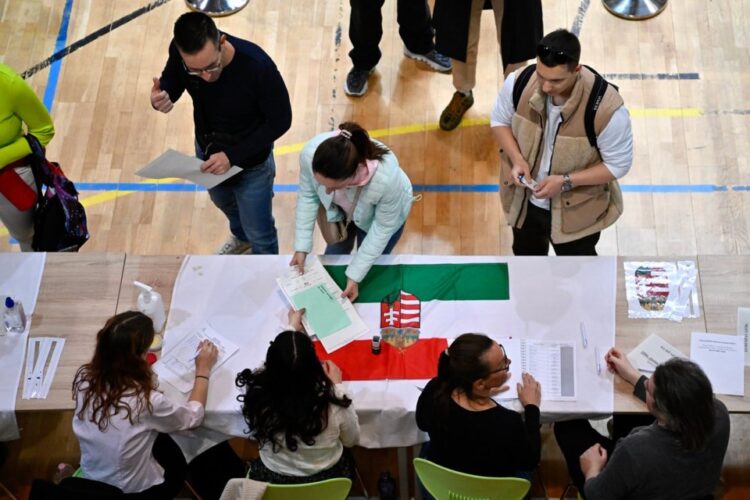
Hungary awoke to a dramatically altered political landscape Sunday night as early election results showed the opposition Tisza party surging ahead of Prime Minister Viktor Orbán’s long-governing Fidesz, raising the prospect of the most significant shift in power the country has seen in more than a decade
With just under a third of ballots counted, opposition leader Péter Magyar appeared on course for a breakthrough victory, with early figures suggesting his party had secured around half of the vote compared to roughly 40 percent for Fidesz.
The scale of the lead, while still preliminary, has stunned observers and energized supporters who gathered in Budapest awaiting confirmation of a result that could end Orbán’s 16-year hold on power.

AD: Capeesh Restaurant
Turnout reached nearly 78%, one of the highest levels in Hungary’s post-communist history, underscoring the intensity of public engagement in what many voters described as a defining national moment. The election has been widely framed as a choice between continuity under a nationalist government and a pivot toward a more European-aligned political direction.
Early constituency-level data further highlighted the opposition’s strength, with Tisza reportedly leading in a large majority of districts counted so far. Urban areas, particularly the capital, delivered strong margins for Magyar, though even in regions traditionally loyal to Fidesz, early returns suggested erosion in the ruling party’s support.
“The scale of the opposition’s early advantage reflects a political transformation that has unfolded with unusual speed. Just two years ago, the Tisza party was a marginal force. Today, it stands on the brink of power, propelled by widespread dissatisfaction with economic conditions, governance, and allegations of entrenched corruption.”

AD: Oysterian Sea Food Restaurant And Bar
Magyar, a former insider within Orbán’s political orbit, has emerged as the central figure in that shift. His break with the government and subsequent rise have reconfigured Hungary’s opposition, consolidating support that had long been fragmented among smaller parties.
Polling in the final days before the election had already indicated that Tisza was leading, with projections suggesting it could secure a commanding number of parliamentary seats. Early results now appear to be validating those forecasts, though final outcomes remain uncertain as counting continues.
The campaign itself was marked by stark contrasts. Tisza positioned itself as a reformist, anti-corruption force promising to restore institutional checks and improve Hungary’s relationship with the European Union. Orbán, by contrast, emphasised stability, national sovereignty, and resistance to what he has characterised as external pressure from Brussels and Western allies.
Economic concerns also played a central role. Years of rising living costs and stagnation have weighed heavily on voters, particularly younger Hungarians and urban residents, many of whom turned out in large numbers.
A Referendum on Orbán’s Era and Europe’s Future
The election has taken on the character of a referendum on Orbán’s broader political project. Since returning to office in 2010, he has reshaped Hungary’s constitutional and institutional framework, drawing both strong domestic support and sustained criticism from European partners.
His government has frequently clashed with the European Union over rule-of-law concerns, media freedom, and judicial independence, while also maintaining a more conciliatory stance toward Russia than many of Hungary’s allies.
The possibility of an opposition victory carries implications far beyond Hungary’s borders. A Tisza-led government could shift the country’s alignment within the EU, potentially easing longstanding tensions and altering the balance of political forces within the bloc.
The path ahead remains uncertain. Hungary’s electoral system, which combines constituency races with proportional representation, means that early vote shares do not always translate directly into final seat totals. Analysts caution that late-reporting districts could still narrow the gap, and that official results may take hours or longer to fully confirm.
There are also deeper structural questions. Even if the opposition secures a governing majority, dismantling the political and institutional framework built during Orbán’s tenure would likely prove complex and gradual.
Still, the symbolism of the early results is unmistakable. After years of political continuity, Hungarian voters appear to have opened the door to change, creating a moment of uncertainty that could redefine the country’s trajectory.
In Budapest, crowds gathered near party headquarters and public squares, watching live updates flicker across large screens and mobile phones.
The atmosphere carried a mix of anticipation and restraint. Supporters of opposition leader Péter Magyar reacted to each incremental update with quiet optimism rather than celebration, aware that Hungary’s electoral system can still produce late shifts.
Across the city, government supporters remained equally watchful, with officials from Fidesz urging patience until more rural districts reported their results.
Prime Minister Viktor Orbán had not immediately conceded ground, and senior figures within his party signaled that internal data differed from public projections. In past elections, Fidesz has benefited from late-counted votes, particularly from smaller towns and villages.
That history has shaped the cautious tone emerging from both camps, even as early figures suggest a narrowing of what was once an unassailable political advantage.
Beyond Hungary’s borders, European leaders and institutions are following developments closely. Officials in European Union institutions have long grappled with Orbán’s policies on judicial independence, media regulation, and migration.
A shift in leadership could open the door to a recalibration of relations, particularly on frozen EU funds and ongoing rule-of-law disputes. Diplomats, however, are careful not to read too much into partial results, noting that Hungary’s political trajectory has surprised observers before.
Financial markets have also shown early signs of sensitivity. The Hungarian forint experienced modest fluctuations in overnight trading, reflecting investor uncertainty about potential policy changes. Analysts say a transition of power could bring shifts in fiscal priorities, foreign investment strategies, and Hungary’s positioning within broader European economic frameworks.
At the same time, political analysts caution against overstating the immediacy of any transformation. Even if the opposition secures a governing mandate, the institutional legacy of Orbán’s years in power will remain deeply embedded.
Key appointments across the judiciary, regulatory bodies, and state institutions are not easily reversed, meaning that any new administration would likely face a complex and gradual process of reform. With voters,, the symbolism of the moment carries its own weight. In a country where election outcomes have long seemed preordained, the mere possibility of a competitive and uncertain result represents a departure from recent history.

AD: Heritage And Restaurant Lounge Bar