
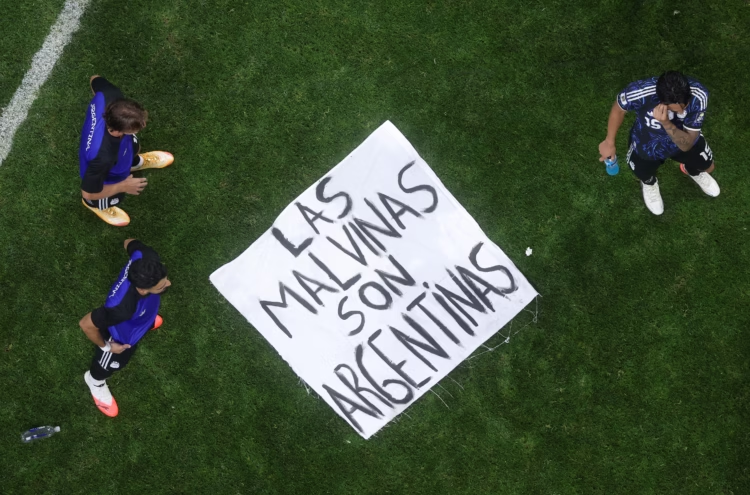
A banner displayed during an Argentina football match has placed FIFA at the center of a renewed dispute over politics, history and the limits of national expression in the world’s most watched sport. The governing body of international football has opened an investigation into whether Argentina breached its regulations after supporters displayed a message referring to the Falkland Islands, a territory claimed by both Argentina and the United Kingdom.
The controversy emerged after Argentina players displayed a banner reading “Las Malvinas son Argentinas” (“The Falkland Islands are Argentinian”) during celebrations following their World Cup victory over England.
The message refers to the Falkland Islands, a British overseas territory that Argentina has long claimed as its own, with the dispute remaining one of the most sensitive issues in relations between the two countries. FIFA is now examining whether the display breached its rules prohibiting political messages, banners or symbols at football events.

AD: Capeesh Restaurant
DW News reported that the banner appeared to conflict with FIFA’s Stadium Code of Conduct, which restricts political, offensive or discriminatory material, while The reports noted that Argentina could face disciplinary action if football’s governing body determines that regulations were broken. The incident has revived memories of the 1982 Falklands War and highlighted how historical disputes can follow nations onto the world’s biggest sporting stages.
The issue immediately attracted attention because the Falklands dispute remains one of the most sensitive historical conflicts between Argentina and the United Kingdom. The two countries fought a 74-day war in 1982 after Argentine forces invaded the British-controlled islands, triggering a military response from Britain that ended with Argentina’s surrender and the restoration of British administration.
Although the conflict ended more than four decades ago, Argentina has continued to press its sovereignty claim through diplomatic channels, while the United Kingdom maintains that the islands’ status is protected by the principle of self-determination for residents.

AD: Oysterian Sea Food Restaurant And Bar
FIFA’s rules aim to prevent political disputes from taking over football competitions. The organisation bans political, ideological and offensive messages or displays during matches, but each case is reviewed based on its context and circumstances. FIFA’s investigation into the Argentina Falklands banner will determine whether the display crossed the line set by its regulations.
The investigation does not mean Argentina has already been found guilty of wrongdoing. FIFA’s disciplinary bodies will review reports from match officials and assess whether the banner represented a violation. Possible consequences could range from fines to other disciplinary measures, depending on the outcome of the review.
However, the message represents more than a political statement. The Falklands issue has become deeply connected to national identity, particularly within Argentine football culture. References to the islands have appeared regularly among fans, players and officials over the decades, reflecting a broader national sentiment that extends beyond sport.
Football has frequently served as a stage where national emotions are displayed. From flags and chants to historical references, supporters often use stadiums as places to express cultural and political beliefs. But FIFA has repeatedly attempted to draw a line between passionate support and political messaging, arguing that international football should remain a space focused on competition rather than geopolitical disputes.
The latest controversy highlights the difficult balance FIFA faces. While the organisation promotes football as a global force capable of bringing people together, it must also manage the reality that matches between countries often carry political histories that cannot simply be separated from sport.
A Rivalry That Outlives The Final Whistle
The Falklands dispute has remained unresolved for more than 40 years, continuing to affect relations between Argentina and the United Kingdom. Although the two countries restored diplomatic ties after the 1982 war, Argentina still claims sovereignty over the islands, while Britain maintains that Falkland Islanders have the right to decide their own future.
Argentina, meanwhile, continues to argue that the islands were unlawfully taken from it in the 19th century and has repeatedly called for negotiations over sovereignty. The issue remains a major part of Argentine political discourse, with governments across the political spectrum maintaining the country’s claim.
Because of that history, even a simple banner at a football match can carry decades of meaning. What may appear to be a supporter display to some audiences can represent a powerful political statement to others. FIFA’s investigation therefore goes beyond a question of stadium behaviour; it touches on how international sport handles unresolved conflicts between nations.
The case also reflects a broader challenge for football’s governing bodies. FIFA has faced similar controversies involving political messages, national symbols and supporter behaviour at major tournaments. The organisation has often argued that political neutrality is necessary to protect football’s international appeal, but critics have questioned whether complete separation between sport and politics is realistic.
In Argentina, reactions to the investigation have been shaped by the country’s deep emotional connection to the Falklands issue. Many supporters view references to the islands as expressions of national memory rather than political provocation. The banner’s appearance during an international match reflects how football can become a powerful platform for collective identity.
However, critics argue that international competitions require clear boundaries to prevent matches from becoming extensions of political conflicts. FIFA’s responsibility is to apply its rules consistently, regardless of the countries involved or the historical significance behind a particular message.
The investigation comes at a time when football continues to navigate increasingly complex political issues. Major tournaments bring together nations with different histories, rivalries and social debates, creating challenges for organisers seeking to maintain an atmosphere of unity.
The decision will require careful consideration for FIFA. A strict response could be viewed by some Argentine supporters as ignoring cultural history, while a limited response could raise questions about whether political messages are being treated consistently across international football.
The outcome may also influence how future disputes are handled inside stadiums. Supporters around the world frequently use football matches to highlight causes, commemorate historical events or express national pride. Determining where those expressions cross into prohibited political messaging remains one of the sport’s most difficult questions.
FIFA reviews the incident, the Falklands banner has become another example of how football rarely exists in isolation from the world around it. The match may have lasted 90 minutes, but the debate surrounding the display carries the weight of decades of history.
With Argentina and the United Kingdom, the Falklands remain a diplomatic disagreement. While FIFA, the banner represents a test of its ability to enforce neutrality while recognising the powerful emotions that international football can inspire. The final decision will determine not only whether Argentina breached football rules, but also how the sport continues to manage the complicated relationship between national identity, politics and the beautiful game.

AD: Heritage And Restaurant Lounge Bar