
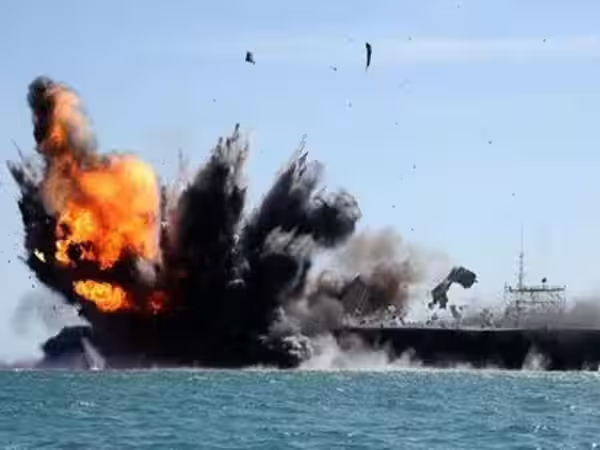
Iran launched new missile attacks against US-allied nations in the Middle East, including Qatar, a key mediator in the war.

Meanwhile, a tanker came under attack traveling through the Strait of Hormuz taking the route closest to Oman, the UK military said.
The report from the United Kingdom Maritime Trade Operations (UKMTO) centre said the attack involved a projectile hitting the vessel.

AD: Capeesh Restaurant
The UKMTO said the ship sustained minor damage to its port side.
“All crew are safe and accounted for, no environmental impact has been reported and the vessel is continuing to its next port of call,” the UKMTO said.

AD: Oysterian Sea Food Restaurant And Bar
Iran has been attacking tankers travelling on the route near Oman but did not immediately acknowledge any attack.
Iranian officials say US strikes have killed dozens of people and wounded hundreds of others, with new casualties reported in Friday’s strikes.
When the US and Israel launched the war on Iran on February 28, Tehran effectively closed the strait to shipping traffic, a move that sent the price of oil soaring and gave Iran major leverage in negotiations.
Speaking in a primetime address to the American public, Mr Trump insisted the war was going well.
“We are likewise winning big in Iran, and you will see the fruits of that labour very, very shortly,” Mr Trump said.
The US airstrikes hit bridges overnight into Friday in Iran’s southern Hormozgan province, killing at least seven people, Iranian state television reported.
The attacks hit Bandar Khamir, a city on Iran’s coast on the Strait of Hormuz.
The US military’s Central Command said it hit dozens of targets in its latest airstrikes, which concluded at dawn Friday, the sixth night in a row of American attacks.
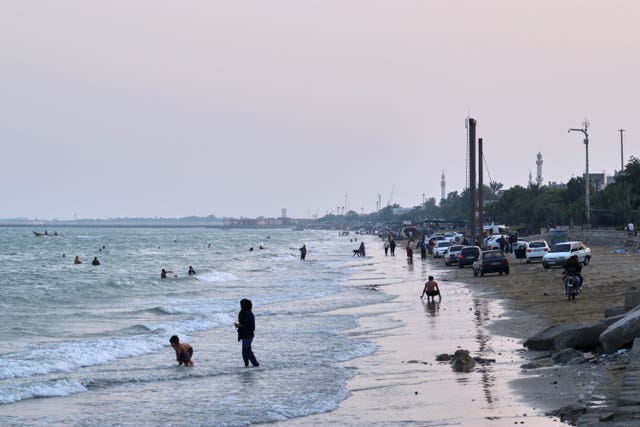
The strikes also appeared to have collapsed a tower at Iran’s Chabahar port on the Gulf of Oman, a key trade route for landlocked, neighbouring Afghanistan.
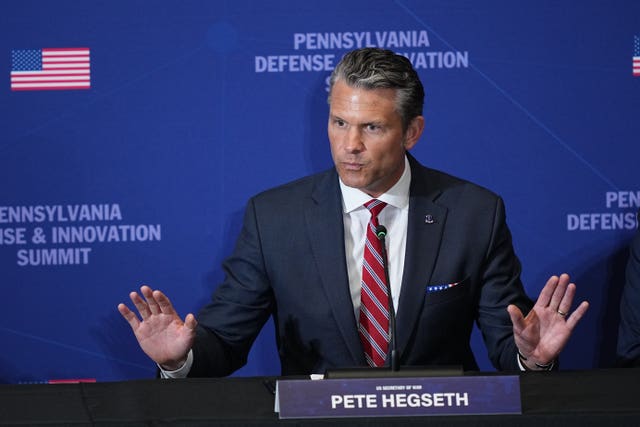
US defence secretary Pete Hegseth shared the image of the surveillance tower appearing to collapse. That image had circulated social media via activists prior to Hegseth sharing it.
Chabahar port, which Iran had been running with support from India, has been a repeated target of American airstrikes.
Iranian state media acknowledged a third round of strikes on the facility without immediately acknowledging the tower’s collapse.
Iran described the tower as overseeing commercial traffic into the port. However, Iran’s paramilitary Revolutionary Guard also operates at ports across the country.
On Friday, Qatar twice warned the public to take shelter as a barrage of Iranian missiles targeted the nation. People heard explosions overhead as air defences fired to intercept the missiles.
Qatar’s Interior Ministry said falling debris wounded a child.
Qatar is a key mediator with Pakistan in trying to reach an end to the Iran war. But talks have broken down over Iran’s chokehold on the Strait of Hormuz.
Iran also targeted Bahrain and Kuwait early on Friday.
Explosions also could be heard Friday morning in Irbil and Sulaymaniyah in northern Iraq’s semi-autonomous Kurdish region as air defences targeted incoming fire. There was no immediate word on any damage.
Mr Trump has returned in recent days to his threats to target Iranian power stations and bridges to try to compel Iran to loosen its hold on the strait, through which about a fifth of all oil and natural gas traded once passed in peacetime.
The US also reimposed a naval blockade on Iranian ports to halt its shipments of crude oil.
Week-to-week cargo shipments through the strait dropped by almost a quarter at the beginning of the month, according to Maritime data firm Lloyd’s List Intelligence. And that was before the recent surge in tit-for-tat attacks. Given the risks, some oil shippers are transiting the strait with their location devices turned off, but many are just staying put, Lloyd’s said on Thursday.
A growing amount of the region’s energy is being shipped through pipelines, but not nearly enough to offset the decline in shipping through the strait.
US forces have redirected three commercial vessels trying to run the blockade, disabled one that did not comply and boarded another “to ensure full compliance,” the U.S. military’s Central Command said in a post on X.

AD: Heritage And Restaurant Lounge Bar