
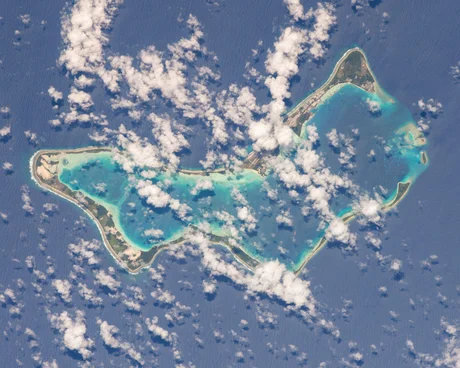
By James Simons-
A long-trailed treaty between the United Kingdom and Mauritius over the future of the Chagos Islands has effectively collapsed after a senior UK minister said it had become “impossible to agree at political level”, marking a dramatic setback for one of Britain’s most sensitive foreign policy negotiations in years.
Foreign Office minister Stephen Doughty told Parliament that the deal to transfer sovereignty of the Indian Ocean archipelago could no longer proceed in its current form after the withdrawal of United States backing, a development he said had fundamentally altered the diplomatic landscape.

AD: Capeesh Restaurant
The agreement, which would have seen the UK cede sovereignty to Mauritius while retaining a long-term lease over the strategic Diego Garcia military base, was initially negotiated with close US involvement and support, according to the government.
The collapse of the political consensus effectively means the treaty will not complete its parliamentary passage, ending months of uncertainty over a deal that had already faced legal, political and international scrutiny.
The decision also underscores the fragility of agreements tied to Diego Garcia, a key joint UK–US military facility at the heart of wider geopolitical competition in the Indian Ocean region.

AD: Oysterian Sea Food Restaurant And Bar
Officials had hoped the arrangement would resolve a decades-long sovereignty dispute between London and Port Louis while ensuring continued Western military access to Diego Garcia under a long-term lease arrangement of up to 99 years.
The deal was structured to allow the United Kingdom to transfer sovereignty of the Chagos Islands to Mauritius while retaining operational control of the strategically significant base through leasing agreements, a model widely reported in coverage of the negotiations.
However, the agreement’s viability has been repeatedly undermined by shifting US political positions, particularly under President Donald Trump, whose stance on the deal changed multiple times across 2025 and 2026.
At various points, Trump both approved and later criticised the arrangement, warning it could weaken Western strategic interests and describing the transfer as a “big mistake,” contributing to uncertainty over US backing.
While US support is considered essential due to the joint UK–US operation of the Diego Garcia base, Washington’s wavering position left London unable to secure the necessary trilateral alignment between the UK, Mauritius and the United States.
This ultimately stalled progress on finalising the treaty and cast doubt over whether the sovereignty transfer and leaseback framework could be implemented as originally intended.
The announcement represents a significant diplomatic reversal. Only months earlier, ministers had described the deal as a carefully balanced compromise, designed to meet international legal pressures while preserving strategic defence interests. Instead, it has now become a symbol of how external powers particularly Washington can determine the viability of UK overseas territory negotiations.
At the centre of the collapse is the withdrawal of US support, which British officials now say made it impossible to update the 1966 UK–US arrangements governing Diego Garcia’s use. According to Doughty, the original treaty framework had been “tested thoroughly” across multiple administrations and initially found to be robust, but subsequent political shifts in Washington undermined that consensus.
The US reversal is understood to have followed concerns raised by President Trump, who criticised the proposed handover and warned against changes to the status quo at the strategically important base. Without Washington’s endorsement, UK ministers concluded that any treaty implementation would be legally and operationally unworkable, given the base’s reliance on joint UK–US defence cooperation.
The breakdown has left Mauritius insisting it will continue pursuing sovereignty claims through international legal and diplomatic channels, while UK officials now face renewed questions over how to stabilise long-term arrangements for the Chagos Archipelago.
The Diego Garcia base remains central to US military operations across the Indo-Pacific and Middle East, and any uncertainty over its governance is expected to draw continued attention from defence planners in both London and Washington.
Domestically, the collapse of the treaty has triggered renewed political debate, with critics arguing that the government misjudged the likelihood of securing US backing and underestimated the fragility of the agreement. Some MPs have called for the plan to be abandoned entirely, while others argue that negotiations should be restarted under new geopolitical conditions.
Opposition figures have framed the development as evidence of poor diplomatic coordination, pointing to earlier warnings that US approval was essential to the treaty’s success. Supporters of the government, however, maintain that the attempt to resolve the sovereignty dispute was a necessary step in line with international legal expectations and long-standing UN pressure over the territory.
The wider context includes continued international scrutiny of the UK’s administration of the Chagos Islands, as well as ongoing claims by Mauritius that the archipelago should be returned in full. The International Court of Justice has previously advised that Britain’s continued administration of the islands is unlawful, though its opinions are not directly enforceable.
Despite the treaty’s collapse, officials have not ruled out future negotiations. However, with US backing now uncertain and political consensus fractured, any renewed attempt is likely to require a fundamentally different framework.
While the government’s conclusion is stark: without aligned support from Washington and a stable political agreement, the Chagos Islands treaty in its current form is no longer viable, leaving one of Britain’s most strategically sensitive territories in renewed diplomatic limbo.
The breakdown reflects not only the fragility of the specific negotiations but also the wider structural dependence of the United Kingdom on United States backing when it comes to the governance of Diego Garcia, a military installation that sits at the heart of Indo-Pacific security planning.
Without a unified position across London, Washington and Port Louis, the carefully constructed legal and diplomatic framework underpinning the proposed sovereignty transfer has effectively unravelled. The immediate consequence is a return to prolonged uncertainty over the future of the archipelago, where Britain has administered the islands since the late 1960s following their separation from Mauritius.
That arrangement has long been contested internationally, with Mauritius maintaining its claim and receiving advisory support from the International Court of Justice, which found that the UK’s continued administration of the territory was unlawful.
However, despite mounting legal and diplomatic pressure, no enforceable mechanism has yet compelled a transfer of sovereignty, leaving negotiations as the primary avenue for resolution.
With the collapse of the treaty also raises broader questions about the sustainability of its overseas territory policy, particularly where strategic defence interests intersect with international legal challenges.
Diego Garcia remains a critical hub for US and UK military operations across the Middle East and Asia, meaning any instability in its governance arrangement carries wider geopolitical implications. The absence of an agreed framework now risks prolonging tensions with Mauritius while also creating uncertainty for defence planners reliant on uninterrupted access to the base.
With no immediate pathway forward, officials are expected to reassess their diplomatic strategy, though any future agreement will likely require a renewed alignment of political will across all three parties. Until then, the Chagos Islands remain in a state of unresolved status, suspended between legal contention, strategic necessity and stalled diplomacy.

AD: Heritage And Restaurant Lounge Bar