
By Kenneth Williams-
The fragile ceasefire between the United States and Iran is facing its most serious test yet after a series of Iranian missile and drone strikes on the United Arab Emirates and commercial vessels in the Strait of Hormuz. Despite the escalation, U.S. Defense Secretary Pete Hegseth has insisted the truce remains intact, characterising the attacks as provocations that fall short of reigniting full-scale war.
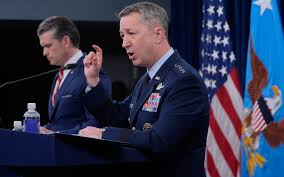
Speaking from Washington, Hegseth said the agreement, brokered in early April after weeks of intense conflict, had not collapsed even as violence persists across the Gulf. “The ceasefire is not over,” he stated, emphasising that the United States remains prepared to defend its forces and international shipping if Iran escalates further.

AD: Capeesh Restaurant
The remarks come amid mounting concern from regional governments and global markets, as renewed instability threatens one of the world’s most critical energy corridors. The Strait of Hormuz, through which roughly a fifth of global oil passes, has become the focal point of a tense standoff involving naval manoeuvres, drone interceptions, and competing claims over control of maritime routes.
Rising tensions in the gulf test fragile struggle
Iranian forces have launched multiple attacks in recent days, including missile and drone strikes targeting infrastructure in the UAE and harassment of commercial shipping vessels navigating the Gulf. Emirati officials confirmed that their air defences intercepted several projectiles, marking the second consecutive day of such assaults.

AD: Oysterian Sea Food Restaurant And Bar
U.S. officials say Iranian units have engaged in repeated confrontations with American naval forces and targeted merchant ships, contributing to a climate of uncertainty and risk for global trade. According to U.S. military assessments, there have been at least several incidents since the ceasefire began, including attacks on U.S. personnel and maritime assets.
Yet Washington has deliberately avoided framing these incidents as a breach severe enough to nullify the ceasefire. Pentagon officials argue that the strikes, while dangerous, remain below the threshold of “major combat operations” that would formally end the truce.
This distinction is central to the Biden administration’s and former President Donald Trump’s current strategy, which seeks to contain the conflict while maintaining pressure on Tehran. Military leaders describe Iran’s actions as “harassment” rather than outright warfare, suggesting that both sides are calibrating their responses to avoid a return to full-scale hostilities.
The United States has responded by launching a naval operation aimed at reopening the Strait of Hormuz to commercial traffic. The mission, known as “Project Freedom,” involves escorting vessels through contested waters and establishing a security corridor to ensure safe passage.
Only a limited number of ships have successfully transited the strait under U.S. protection, highlighting the ongoing risks. More than 1,500 vessels remain stranded in the region, creating a backlog that continues to disrupt global supply chains and energy markets.
Strategic restraint or looming escalation
Hegseth’s insistence that the ceasefire is still in effect reflects a broader effort by Washington to project control over an increasingly volatile situation. Through maintaining that the truce holds, U.S. officials aim to prevent panic in financial markets and reassure allies in the Gulf, even as conditions on the ground deteriorate.
However, argue that the distinction between “minor provocations” and outright violations is becoming increasingly tenuous. Iranian strikes on sovereign territory such as the UAE as well as repeated attacks on commercial shipping would traditionally be seen as acts of war, raising questions about how long the current framework can hold.
Iran, for its part, has denied responsibility for some of the attacks while warning that it will respond forcefully to any perceived violations of its sovereignty. Tehran has also accused the United States of undermining the ceasefire through its naval operations and blockade measures, which it views as aggressive and unlawful.
Diplomatic efforts are continuing in parallel with military manoeuvres, with several countries offering to mediate between Washington and Tehran. With progress being slow, and both sides appear entrenched in their positions. While Iranian officials have signalled openness to negotiations, they have also emphasised their willingness to continue military resistance if necessary.
The broader regional context adds further complexity. The UAE, which has been targeted in the latest strikes, is a key U.S. ally and hosts American military facilities. Iran has previously justified attacks on Gulf states by accusing them of supporting U.S. operations, framing such actions as defensive measures within a wider conflict.
Meanwhile, global powers including the United Kingdom, India, and Pakistan have expressed concern over the escalating situation, with some calling for restraint and renewed diplomatic engagement. The potential for miscalculation remains high, particularly in the crowded and strategically vital waters of the Gulf.
The ceasefire exists in a state of ambiguity neither fully intact nor definitively broken. It is a precarious balance, sustained by mutual caution as much as by formal agreement.
Hegseth’s message underscores that reality: the United States is not seeking a return to war, but it is prepared for one if necessary. Whether that stance can hold in the face of continued attacks will likely determine the next phase of the conflict.

AD: Heritage And Restaurant Lounge Bar
While vessels navigate through disputed seas and missiles keep launching, the issue isn’t if the ceasefire is being tested, but rather how much longer it can last. Each new incident, whether a drone intercepted over Gulf airspace or a commercial tanker forced to reroute, adds another layer of strain to an already fragile agreement.
What began as a temporary halt to open hostilities is increasingly resembling a managed standoff, where both sides probe limits without fully crossing into declared war.
U.S. officials continue to frame the situation as one of controlled escalation, arguing that neither Washington nor Tehran has taken the decisive step that would collapse the truce entirely.
This calibration carries its own risks. Military analysts warn that repeated “below-threshold” attacks can quickly spiral, especially in a congested theatre like the Strait of Hormuz, where naval forces operate in close proximity and split-second decisions can have far-reaching consequences.
Insurance premiums for shipping companies have already surged, and some firms are reconsidering routes altogether, underscoring the economic ripple effects of the instability.
Energy markets remain highly sensitive, with even minor disruptions triggering price fluctuations that extend well beyond the region. With Gulf states, the stakes are equally high, as continued strikes threaten not only infrastructure but also investor confidence.
Diplomatically, the window for de-escalation may be narrowing. Backchannel communications are reportedly ongoing, but trust between the parties remains minimal. Each side appears intent on projecting strength while avoiding blame for ending the ceasefire outright.
This delicate balancing act may hold in the short term, but it depends heavily on restraint in an environment where miscalculation is increasingly likely.
The ceasefire’s survival hinges less on formal commitments and more on the willingness of both sides to absorb provocations without escalating them. However, is not infinite and with every passing day of tension, it is being steadily eroded.