
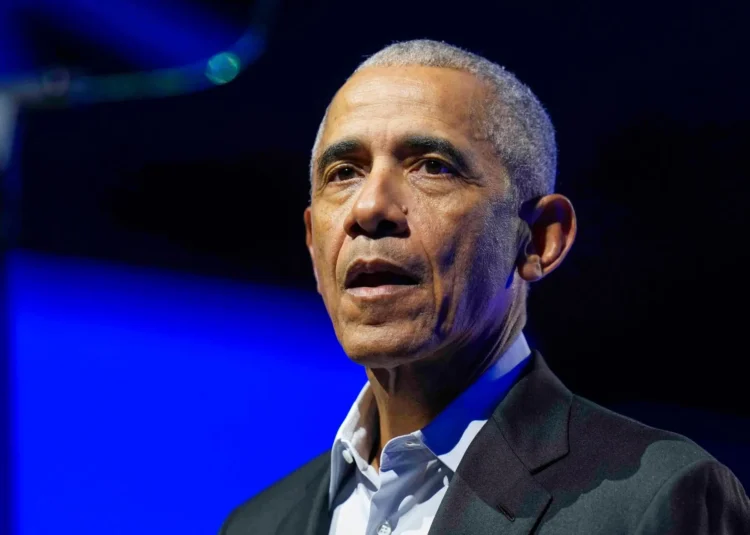
By Aaron Miller-
U.S. former President Barack Obama(pictured) has ignited a global conversation about extra-terrestrial life over the weekend when he appeared on a widely listened-to podcast hosted by political commentator Brian Tyler Cohen.
During the episode—which ranged across politics, culture, and public trust—Obama was asked a seemingly light-hearted but deeply resonant question: “Are aliens real?” Without hesitation, he replied, succinctly: “They’re real, but I haven’t seen them.”

AD: Capeesh Restaurant
His remarks were brief, came during a rapid-fire segment, and were framed with a tone of humour. But within hours, that single line was trending across social media platforms and plastered across major news outlets worldwide—turning what could have
Within minutes of the podcast dropping online, snippets of Obama’s response spread like wildfire. Clips posted to video and social platforms amassed millions of views.
Hashtags relating to “alien life” and “Obama disclosure” trended in multiple countries.

AD: Oysterian Sea Food Restaurant And Bar
Discussions erupted across forums from scientific communities to conspiracy-centric corners of the internet.
What might have been a passing remark quickly snowballed into headlines because it tapped into a longstanding and deeply popular fascination: the mystery of what—or who—might exist beyond Earth.
Public interest in aliens and unidentified aerial phenomena (UAPs) has grown throughout the last decade. Government agencies, particularly in the United States, have declassified numerous videos and reports of objects in the sky that remain unexplained.
That backdrop prepared the ground for any high-profile comment on the topic to reverberate far beyond its original context.
Hours after the interview released, Obama took to Instagram to explain the context behind his now-viral answer.
In his clarification, he acknowledged the statistical likelihood of life existing somewhere in the vast universe, but emphasized that he had no direct evidence of aliens making contact with Earth either during or after his presidency. He reiterated that during his eight years in the Oval Office he had not seen convincing proof of extraterrestrial visitation.
In his own words:
“Statistically, the universe is so vast that the odds are good there’s life out there. But the distances between solar systems are so great that the chances we’ve been visited by aliens is low, and I saw no evidence during my presidency that extraterrestrials have made contact with us.”
He also dismissed one of the most persistent conspiracies surrounding aliens in American popular culture—that extra-terrestrials are being hidden at the government’s secretive Area 51 military base in Nevada. Obama pointed out with a laugh that for such a conspiracy to be real, it would have to be so tightly guarded that even he, as Commander-in-Chief, was never briefed on it.
The Public’s Fascination with Extraterrestrial Life
Obama’s comments reverberated for multiple reasons—and understanding the public reaction requires looking at scientific, cultural, and psychological layers that shape the way we view life beyond Earth.
In recent years, the conversation about extraterrestrial life has moved from fringe to mainstream. High-profile scientific projects scanning for Earth-like planets, videos of unexplained aerial phenomena released by military agencies, and increased funding for UAP research have all contributed to a narrative in which discussing aliens is no longer dismissed as purely science fiction.
Obama’s statement wasn’t just about reports or rumours—it invoked a deeper question about humanity’s place in the cosmos. Even if no physical evidence has been shared publicly, the very possibility that life could exist elsewhere has become a topic of legitimate scientific inquiry.
During Obama’s presidency and in the years since, the U.S. government has gradually released more information about unidentified objects and aerial phenomena. In 2023, Congress passed the Unidentified Anomalous Phenomena Disclosure Act, mandating the release of certain data collected by military and intelligence agencies.
These efforts encouraged transparency and fueled public interest. While these disclosures have not confirmed alien contact, they have acknowledged the existence of unexplained sightings—and that’s significant.
Because Obama as president had access to the highest national security briefings, even a playful comment from him carries weight in the public imagination. Whether or not his line was intended as a literal assertion, it speaks to the broader cultural moment in which even high-level leaders are now comfortable discussing what was once taboo.
Another reason Obama’s comment spread so quickly is the well-established culture of conspiracy theories on the internet. Entities like Area 51, government cover-ups, and secret alien technology have thrived online for decades—even leading to large scale memes and movements like the 2019 “Storm Area 51” event. Obama himself has had to address some of those claims before and did so again in the podcast by dismissing them.
But in the age of short clips and rapid sharing, nuance often gets lost. On platforms like Reddit and X (formerly Twitter), users dissected every syllable of Obama’s response—some reading it as cautious, others framing it as confirmation, and still others using it to bolster conspiracy beliefs.
At its core, the response to Obama’s remark also reflects a basic human instinct: we want to know what’s out there.
For centuries, humans have gazed at the night sky and asked, “Are we alone?” Whether through religion, philosophy, science, or fiction, this question has endured across cultures and eras. When a figure like Obama—who once led the most powerful nation on Earth—utters a line about extraterrestrial life, it taps into that centuries-old curiosity.
News organisations from multiple countries gave the story front-page treatment. Headlines ranged from straightforward summaries of his remarks to more speculative interpretations.
Some focused on the clarification he issued afterward; others simply highlighted the initial soundbite that had millions talking.
Analysts note that even when world leaders discuss the possibility of extraterrestrial life in scientific terms, it tends to draw substantial attention because extraterrestrials remain one of the great unknowns of modern discourse.
On social platforms, users’ interpretations variedSkeptics emphasised that Obama made no claim of direct evidence.
Believers interpreted his words as a sign that the government has knowledge not publicly disclosed.
Casual observers criticised the way media outlets amplified the remark far beyond its original context.
Some commentators joked about how a single sentence could overshadow months of policy discussion on other topics in the podcast. Others drew connections to ongoing scientific missions scanning for life on distant exoplanets.
It wasn’t always common for political leaders to address extraterrestrial life publicly, for much of the 20th century, UFOs were treated as fringe. But by the early 2020s, things changed:
The Pentagon and other institutions established offices to investigate unexplained aerial phenomena.
Legislators in major countries passed laws encouraging transparency on UAP research.
And yet, despite all this, no clear evidence has ever indicated that extraterrestrial beings have visited Earth. Most scientists point out that while the universe is vast and may well contain life, distances between stars and galaxies make travel or contact unlikely—at least with current understanding of physics.
Obama’s comments—brief and conversational though they were reveal a key shift in societal discourse:
Discussions about life beyond Earth are no longer relegated to fringe groups. and public figures can address the topic seriously without immediate ridicule.
Governments and scientific communities are more open about unexplained phenomena.
What remains to be seen is whether this moment will prompt new investigations, greater public demand for transparency, or simply fade as another viral soundbite of the digital age.

AD: Heritage And Restaurant Lounge Bar