
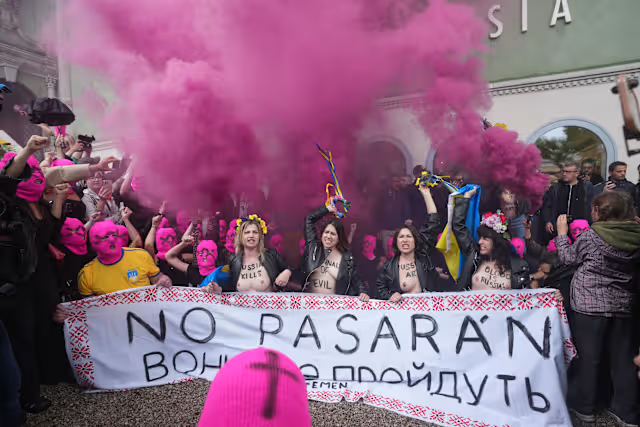
A dramatic protest unfolded at the 61st Venice Biennale on Wednesday as activists wearing bright pink balaclavas swarmed Russia’s national pavilion, releasing clouds of coloured smoke and chanting slogans denouncing Moscow’s participation in one of the world’s most prestigious art exhibitions.
The demonstration, led by members of the feminist protest collectives Pussy Riot and FEMEN, quickly became one of the most striking moments of this year’s event, highlighting how deeply geopolitics has permeated the global art world.
According to reports, around 50 protesters gathered outside the Russian pavilion in the Giardini, many wearing the group’s signature pink balaclavas while waving Ukrainian flags and setting off flares that filled the air with pink, blue and yellow smoke. The protest temporarily disrupted access to the pavilion, with security and police moving in to contain the demonstration as chants echoed across the Biennale grounds.

AD: Capeesh Restaurant
The action was aimed squarely at Russia’s return to the Biennale after its absence following the 2022 invasion of Ukraine. Activists argue that allowing Russia to participate in an international cultural platform risks legitimising the country’s political actions through what they describe as “soft power.”
Protesters held banners with messages such as “Russia kills, biennale exhibits” and “Blood is Russia’s art,” underscoring the anger among artists and activists who see the pavilion as incompatible with the ongoing war.
The demonstration is part of a wider wave of unrest that has overshadowed this year’s Biennale, often described as the “Olympics of the art world.” Even before opening, the exhibition was engulfed in controversy, including the resignation of its jury and threats from the European Union to withdraw funding over Russia’s inclusion.

AD: Oysterian Sea Food Restaurant And Bar
The spectacle at the Russian pavilion was not only a political statement but also a form of performance art in itself, blurring the boundaries between activism and artistic expression. Groups like Pussy Riot have long used visual spectacle, symbolism, and public disruption as part of their practice, and their intervention at the Biennale echoed that tradition.
Witnesses described the scene as both chaotic and theatrical. Protesters moved in coordinated waves, filling the space with colour and sound, while some attempted to approach or enter the pavilion before being stopped by police. Pink smoke drifted through the Giardini, contrasting sharply with the otherwise polished and curated environment of the international exhibition.
The protest also amplified ongoing criticism from artists and cultural figures who argue that the Biennale’s national pavilion structure is increasingly at odds with a globalised art world. The inclusion of Russia and separately Israel has triggered boycotts, open letters, and demonstrations from artists who say the event cannot remain politically neutral in the face of international conflict.
Pussy Riot’s Nadya Tolokonnikova, a prominent voice behind the protest, has argued that European institutions risk enabling propaganda by offering cultural platforms to states engaged in war. Activists have instead called for greater representation of dissident and imprisoned artists, positioning their protest as a defence of artistic freedom rather than an attack on culture itself.
Organisers of the Biennale have defended their decision, insisting that the exhibition is a space for dialogue rather than judgment. Biennale president Pietrangelo Buttafuoco stated that the event “is not a court,” emphasising that participation is tied to the ownership of national pavilions rather than political endorsement. That distinction has done little to quell criticism, as tensions between cultural exchange and political accountability continue to intensify.
A global art event shaped by conflict
The protest at the Russian pavilion is only one episode in a broader crisis that has come to define this year’s Biennale. The exhibition has been shaped by mounting geopolitical pressure, with disputes over national participation spilling into institutional decision-making and public debate.
The event, which runs through November, has been marked by an unusual level of political turbulence, as organisers grapple with criticism, funding concerns, and divisions within the art world over the inclusion of Russia and Israel.
The same report details how the Biennale’s international jury excluded both countries from top prizes, a move that underscored the depth of internal conflict and raised questions about neutrality and governance within the exhibition.
These developments point to an event increasingly defined not only by contemporary art, but by institutional strain, political dispute, and the broader global conflicts shaping its context.
Russia’s participation is particularly contentious given the ongoing war in Ukraine, which continues to shape international relations and cultural discourse. Ukrainian officials and artists have strongly opposed the pavilion’s presence, arguing that it undermines efforts to isolate Russia diplomatically and culturally.
The Russian pavilion itself has taken on a more limited and symbolic form. Reports indicate it is not fully open to the public and operates under constraints linked to sanctions and political pressure, further highlighting the uneasy compromise at the heart of its inclusion.
With the Biennale continues, further demonstrations are expected, reflecting the depth of feeling surrounding the issues at stake. What was once primarily an exhibition of contemporary art has become a stage for global debate, where questions of ethics, representation, and responsibility are as central as the works on display.
In that sense, the events at the Russian pavilion may prove to be one of the defining images of this year’s Biennale not just for their spectacle, but for what they reveal about the evolving relationship between culture and politics in an increasingly divided world. The sight of masked protesters filling a national pavilion with coloured smoke underscored how art spaces are no longer insulated from geopolitical realities, but instead function as stages where those tensions are publicly negotiated.
In many years, the Venice Biennale has presented itself as a forum for global exchange, yet moments like this expose the limits of neutrality in a time when cultural institutions are increasingly expected to take ethical positions.
The protest also highlighted how artists and activists are redefining the boundaries of artistic expression, using disruption itself as a medium to challenge power structures and institutional decisions. In doing so, they force audiences and organisers alike to confront uncomfortable questions about representation, responsibility, and complicity.
Discussions persist regarding who to be included, excluded, or showcased; the Biennale transforms into more than just an exhibition, acting as a mirror that reveals the divisions of the larger world, where culture and politics have merged into intertwined influences that shape public conversation.

AD: Heritage And Restaurant Lounge Bar