
By Isabelle Wilson
The execution of a Florida prisoner who deliberately killed his cellmate to secure a death sentence exposes a disturbing contradiction at the heart of American capital punishment.
America’s death penalty is confronting an uncomfortable question: what happens when the punishment intended to deter murder becomes the very thing a murderer seeks? The execution of James Robertson in Florida on 13 October 2026 has brought that question into sharp focus, strengthening the argument that the United States must reconsider its reliance on state-sanctioned killing.

AD: Capeesh Restaurant
Robertson, 63, was executed by lethal injection after pleading guilty to murdering his cellmate, Frank Hart, in 2008. Hart was reportedly just eight days away from release when Robertson strangled him. The circumstances were particularly disturbing because Robertson told authorities he had committed the murder to secure a death sentence rather than spend the rest of his life in prison.
Asked for his final words, he reportedly replied, “Nah, I’m straight.” His apparent composure offered a chilling end to a case that challenges conventional arguments about punishment and deterrence.
For supporters of capital punishment, the execution may appear to represent justice delivered. Hart’s life was brutally taken, and his family had every reason to demand accountability. No serious abolitionist argument should minimise their loss or suggest that Robertson’s crime deserved anything less than the gravest condemnation. But the question is whether executing another human being genuinely serves justice, protects society or prevents future violence.

AD: Oysterian Sea Food Restaurant And Bar
Robertson’s case exposes the weakness of the deterrence argument. If a prisoner was prepared to murder precisely because he wanted to be executed, the threat of capital punishment plainly failed to prevent that killing. Indeed, the prospect of execution appears to have influenced his decision in the opposite direction. This does not mean every offender responds similarly, but it makes a powerful case against presenting the death penalty as a reliable solution to violent crime.
The timing is especially significant. Robertson’s execution came amid international scrutiny of America’s execution practices following a botched attempt in Tennessee involving Christa Pike. Reports that Pike survived the attempt after receiving lethal doses of pentobarbital have intensified questions about whether supposedly controlled executions can guarantee a peaceful death. When the state undertakes an irreversible punishment, even a small possibility of procedural failure carries enormous moral consequences.
There is also a fundamental problem of human fallibility. American courts are not infallible, police investigations can be flawed, witnesses can be mistaken, and prosecutors can pursue unreliable evidence. A prison sentence can be reconsidered when new evidence emerges. An execution cannot be undone. The possibility of executing an innocent person is therefore not a minor administrative concern; it is an argument against granting the state an irreversible power that no judicial system can exercise perfectly.
The punishment also raises questions about equality. Critics have long argued that capital cases are shaped by race, poverty, geography and the quality of legal representation available to defendants. The severity of a crime alone does not explain why some defendants receive death sentences while others convicted of comparable offences do not. A punishment that depends partly on where a crime occurs and the resources available to the accused risks undermining the principle that justice should be blind.
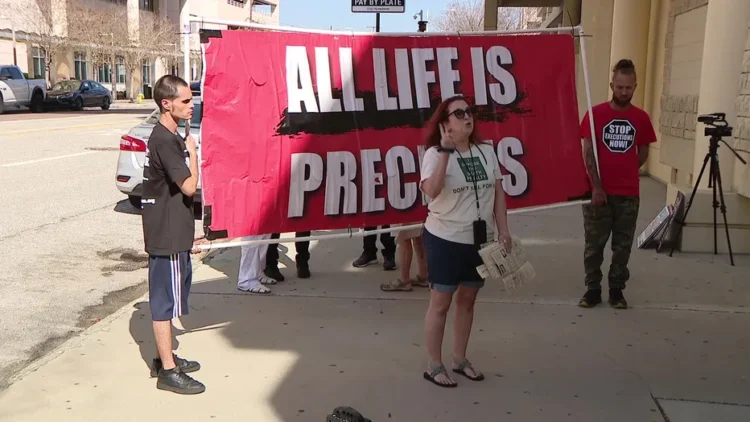
These concerns are gaining renewed attention among activists, faith leaders and victims’ relatives. In July 2026, campaigners gathered outside the US Supreme Court for the annual “Starvin’ for Justice” protest, marking 50 years since the Supreme Court’s Gregg v. Georgia decision restored the modern death penalty. Some participants had endured murder within their own families, yet opposed execution in the names of their loved ones. Their position challenges the assumption that victims’ families must necessarily support the death penalty.
Political developments also demonstrate that abolition is not an unrealistic ambition. Twenty-three American states have abolished capital punishment, while four others maintain moratoriums, according to reporting on the abolition movement. In June, Ohio Governor Mike DeWine, a Republican who helped write his state’s death penalty law decades ago, publicly called for abolition after years of concern over execution methods. Such developments suggest that opposition is no longer confined to a narrow ideological camp.
None of this requires society to excuse murder or abandon victims. Life imprisonment, effective policing, improved mental health services and meaningful support for bereaved families can provide accountability without requiring the government to kill. Justice should be measured not by how convincingly a state can take a life, but by whether it prevents violence, treats people fairly and protects the innocent.
Robertson’s execution cannot restore Frank Hart to his family. Nor can it erase the failures that allowed Hart to be killed while in state custody. What it can do is force America to confront the limits of a punishment that failed to deter the very crime it was supposed to prevent.
The question now is whether lawmakers will listen. Every execution presents the same irreversible decision, but Robertson’s case makes the contradiction unusually clear. If the state’s ultimate punishment can become a motive for murder, America must ask whether capital punishment delivers justice—or merely perpetuates the violence it promises to end.

AD: Heritage And Restaurant Lounge Bar