
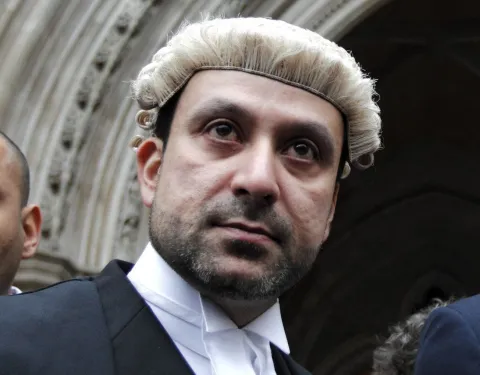
By Tony O’Reilly-
Convicted barrister, Rasib Ghaffar has been disbarred after being convicted of conspiring to defraud the legal aid fund, adding to a series of cases in which barristers have lost their right to practise following findings of dishonesty.
An independent disciplinary tribunal concluded that his conduct undermined public confidence in the legal profession. Rasib Ghaffar, who was called to the Bar by Lincoln’s Inn in July 1995, was convicted of conspiracy to commit fraud by false representation and sentenced to three years’ imprisonment at Southwark Crown Court in June 2024.

AD: Capeesh Restaurant
The case centred on four claims relating to the legal costs of four defendants who had been acquitted. The claims totalled £1,856,584, of which £469,477 was paid out from the legal aid fund.
Ghaffar was found to have been responsible for a fee note submitted in his name for £184,000, covering more than 350 hours of work. However, he had been instructed in the case only seven days before its conclusion, raising serious questions about the claimed work and the circumstances surrounding the payment request.
An independent disciplinary tribunal subsequently found one charge of professional misconduct proved. The five-person panel concluded that Ghaffar had acted in a manner likely to diminish the trust and confidence the public places in him or the legal profession, or which could reasonably be seen as undermining his integrity.

AD: Oysterian Sea Food Restaurant And Bar
The Bar Standards Board (BSB), which regulates barristers in England and Wales, said the decision reflected the seriousness of his conduct.
“Mr Ghaffar’s conduct in defrauding the legal aid fund led to a criminal conviction for dishonesty and falls well below the standards that the public expect of barristers. The order to disbar him reflects this,” a spokesperson said.
The tribunal concluded its proceedings on 8 October 2026, with its findings remaining subject to appeal. The decision comes against a backdrop of continuing disciplinary action against members of the Bar. Official BSB figures show that 10 barristers were disbarred in 2024/25, the same number recorded in 2023/24. In 2022/23, nine barristers were disbarred.
The figures demonstrate that disbarment remains an important sanction available to the regulator where the seriousness of misconduct warrants removal from the profession. However, they cover all grounds for disbarment and do not represent fraud cases alone.
The BSB’s 2023/24 regulatory decisions report also found that 20 of the 30 barristers subject to proved findings of professional misconduct before disciplinary tribunals faced charges relating to dishonesty and/or acting without integrity. That represented approximately 67% of those cases, highlighting the prominence of integrity-related allegations in serious disciplinary proceedings during that year.
Other barristers disbarred over dishonest conduct
Ghaffar’s case is not the only recent example of a barrister being removed from the profession following findings involving fraud or financial dishonesty.
In February 2024, barrister Lewis Robert Tresman was ordered to be disbarred after a disciplinary tribunal found that he had knowingly allowed his chambers to invoice his professional fees with VAT despite knowing he was not registered for VAT.
The tribunal heard that approximately £150,000 had been paid improperly by the Legal Aid Agency, alongside around £18,000 from private clients. The conduct had continued over a period of years. The tribunal concluded that the seriousness of the dishonesty made disbarment the appropriate sanction.
In another case, Farzana Akram, an unregistered barrister who had been registered at the time of the conduct, was ordered to be disbarred in February 2024 following findings relating to fraudulent evasion of income tax, VAT and National Insurance contributions over the period from April 2007 to March 2017.
Akram had pleaded guilty to the offences and was convicted in March 2022, receiving a two-year suspended prison sentence in June that year. The tribunal also considered her failure to report her criminal conviction to her regulator. The cases illustrate how dishonesty involving public money, taxation or clients’ funds can have consequences extending beyond criminal punishment to professional exclusion.
Protecting public confidence in the legal profession
Legal aid is intended to help eligible people obtain legal representation and access justice. Fraudulent claims threaten the proper use of public resources and risk undermining confidence in a system on which vulnerable individuals depend.
The Ghaffar case also highlights the distinction between criminal proceedings and professional discipline. The criminal court imposed a prison sentence for the conspiracy offence, while the disciplinary tribunal separately considered whether his conduct was compatible with continuing to practise as a barrister.
Disbarment is among the most serious sanctions available within professional discipline because it removes an individual’s right to practise at the Bar. The sanction reflects the importance placed on honesty and integrity in a profession whose members are entrusted with handling clients’ affairs and upholding the administration of justice.
Cases of this nature reinforce the need to maintain professional standards and take action where misconduct is incompatible with continued practice. For the public, they underline the consequences barristers can face when criminal dishonesty is accompanied by conduct that damages confidence in the profession.

AD: Heritage And Restaurant Lounge Bar