
By Tony O’Reilly-
The Duke of Sussex and six other high-profile claimants have lost their landmark High Court legal battle against the publisher of the Daily Mail and Mail on Sunday, after a judge ruled they had failed to prove allegations of unlawful information gathering despite the seriousness of the claims. In a significant judgment delivered after months of evidence and legal argument, Mr Justice Nicklin dismissed the claims brought against Associated Newspapers Limited (ANL), the publisher of the two newspapers. The action had been brought by Prince Harry alongside a group of prominent public figures, including Sir Elton John, Baroness Lawrence, actresses Elizabeth Hurley and Sadie Frost, campaigner Doreen Lawrence, and former Liberal Democrat deputy leader Simon Hughes. Together, they alleged that ANL had engaged in unlawful methods to obtain private information over many years.
The ruling marks a major victory for Associated Newspapers, which consistently denied all allegations throughout the proceedings. The publisher described the claims as “preposterous” and argued that the claimants were “clutching at straws” in attempting to establish a pattern of unlawful conduct.

AD: Capeesh Restaurant
Mr Justice Nicklin acknowledged that the allegations made against the newspaper group were exceptionally serious, alleging what the claimants described as “grave breaches of privacy”. However, he concluded that accusations of such gravity required compelling and convincing evidence before they could be upheld by the court. Having examined the evidence presented during the lengthy trial, the judge found that the claimants had failed to prove that Associated Newspapers had engaged in unlawful information gathering as alleged. The case centred on claims that journalists and private investigators acting on behalf of the publisher had employed illegal techniques to obtain confidential information. The alleged practices included the use of private investigators, deception, unlawful access to private records and other intrusive methods said to have breached the claimants’ privacy rights. ANL vigorously rejected every allegation, maintaining that its journalists operated lawfully and ethically.
The trial, which lasted several months earlier this year, attracted considerable public attention because of the high-profile individuals involved and the wider questions it raised about media ethics and the boundaries of investigative journalism. Among the most closely watched moments was Prince Harry’s appearance in the witness box, where he gave deeply personal evidence about the impact he said press intrusion had had on his family. The Duke told the court that reporting by Associated Newspapers had caused his wife, Meghan, Duchess of Sussex, “absolute misery”. He described what he believed to be a sustained campaign of intrusive reporting and argued that repeated publication of stories based on private information had caused significant distress. His evidence formed part of his broader campaign against sections of the British press, which has resulted in multiple legal actions over alleged unlawful newsgathering practices.
Prince Harry has become one of the most litigious members of the Royal Family in modern times, pursuing several claims against newspaper publishers over allegations of phone hacking, unlawful information gathering and breaches of privacy. In recent years he has secured important legal victories against some media organisations, including obtaining damages from Mirror Group Newspapers after a judge found he had been the victim of unlawful phone hacking on numerous occasions. He has also reached settlements with other publishers while continuing to pursue claims in separate proceedings involving alleged historical misconduct within parts of the newspaper industry.

AD: Oysterian Sea Food Restaurant And Bar
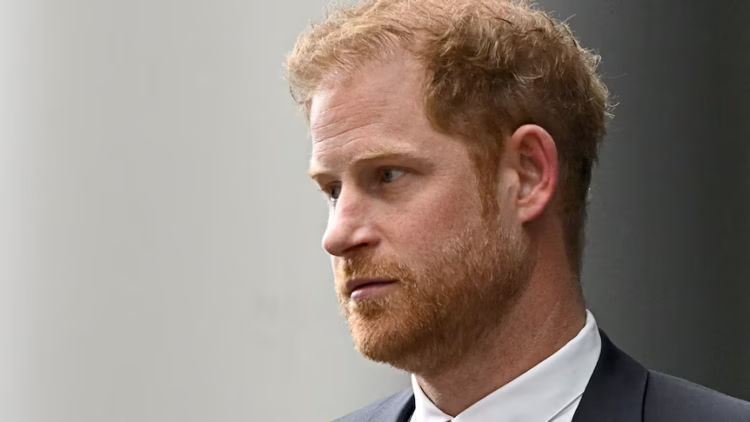
Prince Harry has lost his case against Associated Newspapers for alleged unlawful hacking Image: Reuters: Toby Melville
The case against Associated Newspapers, however, was distinct from the phone-hacking litigation that has dominated much of the UK’s media law landscape over the past two decades. Instead, the claimants alleged a broader range of unlawful information-gathering techniques, contending that their private lives had been systematically exploited through improper methods over many years. The proceedings also represented another chapter in the long-running debate over press freedom and individual privacy, an issue that has shaped British media law since the exposure of widespread phone hacking more than a decade ago. The revelations surrounding the now-defunct News of the World led to the Leveson Inquiry into the culture, practices and ethics of the press, prompting significant reforms within the newspaper industry and encouraging a wave of civil litigation by public figures who claimed to have been victims of unlawful journalistic practices.
Since then, courts have repeatedly been asked to balance two competing principles: the right of newspapers to investigate and publish stories in the public interest, and the right of individuals to respect for their private and family life under Article 8 of the European Convention on Human Rights. Media organisations, meanwhile, continue to rely on the equally important protection afforded by Article 10, which safeguards freedom of expression and the role of a free press in holding powerful individuals and institutions to account. The latest judgment underlines that, while allegations of unlawful conduct by journalists are capable of succeeding where supported by sufficient evidence, the courts will require a high evidential threshold before making findings of serious wrongdoing against newspaper publishers. Mr Justice Nicklin made clear that the seriousness of the allegations demanded correspondingly persuasive proof, and he concluded that threshold had not been met in this case.
The judgment represents a significant legal and reputational victory for The Associated Newspapers after years of vigorously contesting the claims. The publisher has consistently maintained that the proceedings were without merit and that its journalists acted lawfully throughout the periods in question. The ruling would be a disappointing set back for prince Harry and his fellow claimants; this being one of the most closely followed privacy cases in recent years. Although the Duke has achieved notable successes in separate litigation against other newspaper groups, this ruling demonstrates that each case ultimately turns on the strength of the evidence presented rather than the wider history of press misconduct in the United Kingdom.
The judgment is also likely to be viewed as an important precedent for future privacy litigation. It reinforces the principle that serious allegations against media organisations will be carefully scrutinised and must be supported by compelling evidence before liability can be established. At the same time, it highlights the continuing legal tension between investigative journalism and the protection of personal privacy—a balance that remains one of the defining issues in modern media law. Whether the claimants will seek permission to appeal remains to be seen. For now, however, the High Court’s ruling brings to an end another major chapter in Prince Harry’s ongoing legal campaign against elements of the British press, while reaffirming the demanding evidential standard that must be satisfied before allegations of unlawful information gathering can succeed in the courts.

AD: Heritage And Restaurant Lounge Bar