
By James Simons-
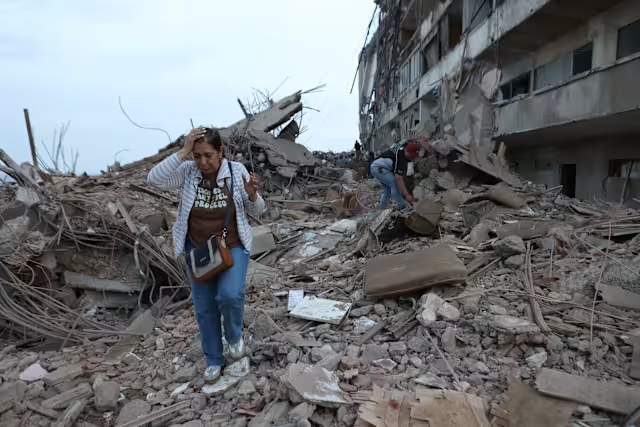
Rescue teams across Venezuela continued working through damaged neighbourhoods and collapsed buildings on Tuesday as the death toll from a powerful earthquake rose to 235, with over 50,ooo people still missing. Emergency officials warning that the number of victims could increase further as search operations progress. Thousands of residents have been displaced, while hospitals, schools, and public infrastructure in several affected communities sustained extensive damage.
Rescuers continued to search through mounds of rubble after tremors of magnitude 7.2 and 7.5 struck within 39 seconds of each other west of the capital Caracas.The tremors measuring a magnitude 7.2 and 7.5, is now said to have killed at least 235 people, injured nearly 1,000. with over 50,00 people still missing.

AD: Capeesh Restaurant
The number of dead and injured is expected to rise with thousands reported missing after the 7.2- and 7.5-magnitude earthquakes that struck Wednesday evening, which was among the strongest in Venezuela in more than a century and was felt throughout the region. Thousands were reported missing and buildings were evacuated as far away as Brazil’s Amazon. Beyond the human toll, seismologists focused on something more unusual: the quakes formed what is known as a seismic “doublet,” a rare phenomenon in which two similarly strong earthquakes occur close together in time and space, rather than a single mainshock followed by weaker aftershocks. The second quake struck just seconds after the first, turning what might have been interpreted as a standard earthquake sequence into something far more complex and more dangerous. Venezuela sits on a restless tectonic boundary where the Caribbean Plate slides eastward past the South American Plate. This is not a smooth motion. Instead, it happens through a network of locked faults that accumulate stress over time before releasing it suddenly in violent bursts.
The recent earthquakes occurred along a shallow strike-slip fault system west of Caracas, an area already known for seismic activity. These types of faults move horizontally, but they often fracture in segments rather than all at once. That segmentation is key to understanding why a doublet can happen. The earthquake, which struck during the early hours of the day, sent strong tremors across a wide area, prompting panic among residents who fled homes and workplaces in search of open ground. Witnesses described scenes of chaos as buildings shook violently, roads cracked, and electricity and communications were temporarily disrupted in some regions. Emergency sirens echoed through several cities as first responders rushed to areas reporting collapsed structures.
Authorities said search-and-rescue teams, supported by firefighters, police officers, military personnel, and volunteers, have been working around the clock to locate survivors trapped beneath debris. Heavy machinery has been deployed to clear rubble, while specially trained rescue dogs are assisting crews in identifying signs of life. Temporary shelters have also been established to provide food, clean water, medical care, and accommodation for families forced to leave damaged homes. Hospitals in the affected areas have reported treating hundreds of people for injuries ranging from minor cuts and fractures to life-threatening trauma. Medical personnel have appealed for blood donations and additional medical supplies as healthcare facilities continue to receive a steady stream of patients. Authorities have also warned residents to remain cautious because of the possibility of aftershocks, which could further weaken already damaged buildings.

AD: Oysterian Sea Food Restaurant And Bar
Government officials declared a state of emergency in the hardest-hit regions and pledged to mobilize additional resources to support relief operations. Emergency management agencies are conducting structural assessments to determine which buildings remain safe for occupation, while engineers inspect roads, bridges, and public utilities for damage. Schools in several districts have been closed until safety inspections are completed. International humanitarian organizations and neighbouring countries have expressed solidarity with Venezuela and offered assistance, including emergency supplies, medical equipment, and technical support for rescue operations. Aid agencies have emphasized the urgent need for shelter materials, sanitation facilities, and essential medicines as displaced communities begin the difficult process of recovery.
Residents described the emotional toll of the disaster, with many spending hours searching for missing relatives or waiting anxiously outside hospitals and emergency shelters for news. Others have begun clearing debris from their homes despite ongoing safety concerns, hoping to recover personal belongings and important documents. Community volunteers have organized food distribution centers and temporary kitchens to support those affected. Seismologists noted that earthquakes of this magnitude can produce significant structural damage, particularly in areas where older buildings were not designed to withstand strong ground shaking. Experts cautioned that aftershocks may continue for days or even weeks, underscoring the importance of avoiding unstable structures and following guidance issued by emergency authorities.
Officials have urged the public to rely on verified information and to cooperate with emergency responders working in hazardous conditions. With many communities still awaiting a full assessment of the destruction, attention remains focused on locating survivors, providing assistance to displaced families, and restoring essential services. Authorities have indicated that casualty figures and damage estimates are likely to be revised as additional information becomes available from the affected areas.
The number of dead and injured is expected to rise with thousands reported missing after the 7.2- and 7.5-magnitude earthquakes that struck Wednesday evening, which was among the strongest in Venezuela in more than a century and was felt throughout the region. Thousands were reported missing and buildings were evacuated as far away as Brazil’s Amazon. Beyond the human toll, seismologists focused on something more unusual: the quakes formed what is known as a seismic “doublet,” a rare phenomenon in which two similarly strong earthquakes occur close together in time and space, rather than a single mainshock followed by weaker aftershocks. In this case, the second quake struck just seconds after the first, turning what might have been interpreted as a standard earthquake sequence into something far more complex and more dangerous. Venezuela sits on a restless tectonic boundary where the Caribbean Plate slides eastward past the South American Plate. This is not a smooth motion. Instead, it happens through a network of locked faults that accumulate stress over time before releasing it suddenly in violent bursts. The recent earthquakes occurred along a shallow strike-slip fault system west of Caracas, an area already known for seismic activity. These types of faults move horizontally, but they often fracture in segments rather than all at once. That segmentation is key to understanding why a doublet can happen.
A seismic doublet occurs when the first rupture does not fully relieve the built-up stress in the region. Instead, it redistributes pressure to a nearby fault segment that is already close to failure. That second segment then collapses, producing another large quake shortly after the first. The result is two earthquakes that are geologically linked but not identical in behaviour to a typical mainshock-aftershock pattern.Scientists emphasised that the Venezuelan sequence fits this definition closely, with both quakes releasing comparable amounts of energy in rapid succession. The US Geological Survey classified the event as a true doublet rather than a single quake followed by aftershocks. This distinction matters because it changes how energy is distributed underground—and how danger unfolds on the surface. Seismologists often describe earthquake doublets as a kind of stress relay system. When the first rupture occurs, it alters the stress field around it. Some nearby faults are relieved, but others are pushed closer to failure. In Venezuela’s case, that chain reaction appears to have happened almost instantly.
The second quake struck within roughly a minute of the first, suggesting a tightly connected fault network where stress transfer was immediate and efficient. The U.S. Geological Survey has long noted that such interactions are common in complex fault zones, particularly where multiple strands of a fault system run parallel or intersect. The northern Venezuelan coast is one of those regions, shaped by long-term interaction between major tectonic plates and smaller fault branches that accommodate motion in uneven steps.
The result is not a single clean break in the Earth’s crust, but a cascade of failures. In a doublet, that cascade compresses into a short window of time, making it feel as though the Earth has struck twice with intent. That perception is not just psychological. The second quake often causes disproportionate damage because structures weakened by the first shock are suddenly hit again before repairs or inspections can begin. Emergency services, still responding to the initial disaster, may find themselves overwhelmed by a second wave of collapse. Earthquake doublets are rare enough that they often become case studies in seismic science. They challenge the simple narrative of a “main earthquake” followed by “aftershocks,” showing instead that the Earth sometimes releases energy in paired bursts that are nearly equal in strength. The broader implications are significant. If a region is prone to doublets, emergency planning cannot assume that the danger ends after the first major shock. Buildings already damaged may be at greater risk from a second rupture, and evacuation decisions become more complicated.
In Venezuela, the impact of the doublet has been magnified by the country’s dense coastal population centres and vulnerable infrastructure. Hospitals are overwhelmed , and disrupted transport systems across the northern region compounds an already devastating situation. Scientists also stress that doublets highlight how incomplete human understanding of fault behaviour still is. While models of stress transfer and fault segmentation explain much of what happened, predicting when and where the next linked rupture will occur remains extremely difficult. These events are not random noise, but are structured releases of energy along systems that behave more like interconnected networks than isolated fracture lines. Rescue teams continue to search through debris in Venezuela, the scientific significance of the event is emerging alongside its human cost. The doublet serves as a reminder that earthquakes do not always follow a single, predictable script.
Instead, they can arrive in pairs one rupture setting the stage for another, both shaped by the same invisible tensions deep beneath the surface. With seismologists, the Venezuelan quake sequence adds another data point to the global understanding of how fault systems behave under extreme stress. Each doublet helps refine models of how strain builds and releases along complex boundaries like the Caribbean Plate and the South American Plate, where motion is not smooth but fragmented across multiple fault strands.
In these environments, one rupture can redistribute stress just enough to trigger another, producing near-simultaneous earthquakes that blur the line between mainshock and aftershock. These sequences are important as they uncover the hidden links of fault networks. They show that energy does not always dissipate gradually but can “jump” between adjacent segments, questioning basic seismic prediction models. Each recorded doublet improves hazard assessments and helps recalibrate expectations for how quickly damage can escalate in densely populated regions like northern Venezuela. However, the experience is far less abstract. It is the shock of stability arises from the disaster occurring in rapid succession. The first earthquake alone is destabilizing, but the second removes any sense that the event has passed. Buildings already weakened fail completely, evacuation becomes chaotic, and response teams are forced to restart their efforts under renewed danger. What remains is a memory not of a single rupture, but of repetition an Earth that did not stop shaking when expected, but returned again before anyone could fully recover.

AD: Heritage And Restaurant Lounge Bar