
By Kenneth Williams-
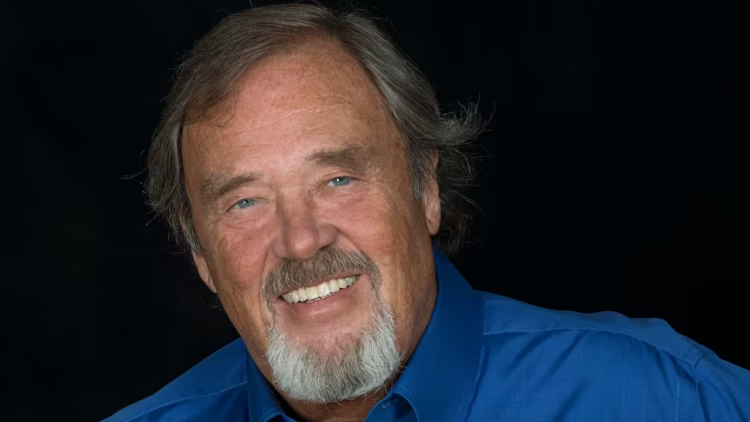
David Clayton-Thomas, the commanding lead singer of Blood, Sweat & Tears, has died at the age of 84. The publicist of the outstanding Canadian vocalist confirmed he passed away peacefully in Toronto on Wednesday, June 24, 2026. No cause of death was disclosed.
Millions of listeners in the late 1960s and early 1970s, his voice was the band’s defining instrument urgent for millions of listeners in the late 1960s and early 1970s, soulful, and edged with a gritty emotional force that could cut through a full horn section without losing its humanity. Songs like “Spinning Wheel,” “You’ve Made Me So Very Happy,” and “And When I Die” became not just hits, but cultural markers of a genre-blending moment in American popular music. Clayton-Thomas joined Blood, Sweat & Tears in 1968, stepping into a lineup already experimenting with jazz instrumentation in a rock framework. His arrival shifted the band’s identity. What might have remained a sophisticated studio experiment became a mainstream force, propelled by his ability to bend blues phrasing into pop accessibility without losing intensity.

AD: Capeesh Restaurant
The self-titled 1969 album- his first with the group- became a phenomenon spending weeks at the top of the Billboard charts and eventually earning Grammy recognition, including Album of the Year in 1970, beating even The Beatles’ “Abbey Road.” That victory was more than symbolic. It confirmed that the jazz-rock fusion sound, once considered too complex for mass audiences, had found its voice and that voice belonged, unmistakably, to Clayton-Thomas.
Born David Henry Thomsett in England in 1941, Clayton-Thomas moved to Canada as a child, growing up in Toronto amid instability and hardship. Reports of his early life consistently describe a turbulent adolescence marked by estrangement from his father, periods of homelessness, and time spent in juvenile institutions. It was during those years, according to biographical accounts, that music became both escape and discipline. He taught himself guitar while in detention and absorbed the language of blues records that would later shape his vocal identity gravelly, emotionally direct, and unafraid of volume or vulnerability.In the mid-1960s, he was performing in Toronto’s club scene, gradually building a reputation that reached beyond Canada. A pivotal moment came when folk singer Judy Collins recommended him to Blood, Sweat & Tears’ drummer Bobby Colomby, leading to an audition that would permanently alter the trajectory of both artist and band. Clayton-Thomas himself later described that meeting as immediate chemistry an instinctive musical alignment between his voice and the band’s brass-heavy arrangements. What followed was a rapid ascent: sold-out tours, festival appearances including Woodstock-era circuits, and international recognition that placed the group at the center of late-60s musical experimentation.
But the same success carried tension after internal disagreements over direction and exhaustion from touring led him to leave in 1972. He would later return intermittently, continuing to perform and record with the band in later decades while also pursuing a solo career spanning multiple albums and television work in Canada.

AD: Oysterian Sea Food Restaurant And Bar
Clayton-Thomas’s importance cannot be separated from the moment he helped define. Blood, Sweat & Tears was among the earliest successful bands to fully integrate brass and jazz improvisation into rock structure, a fusion that would influence later acts across multiple genres. His voice acted as the anchor. Where horns added complexity and keyboards added texture, he delivered emotional immediacy. Critics often described his singing as both “soaring” and “earthy,” capable of shifting from controlled restraint to near-shouted conviction within a single phrase. That duality made songs like “Spinning Wheel” especially resonant. Written by Clayton-Thomas himself, the track combined lyrical ambiguity with rhythmic precision, becoming one of the band’s signature hits and a defining radio staple of its era. The song’s success also underscored a broader shift in popular music: audiences were ready for complexity, so long as it arrived with a human voice guiding it.
The band’s achievements also extended beyond charts, and became one of the few rock groups of their time to win major Grammy recognition in multiple categories, cementing their place in the mainstream while still retaining a reputation for musical sophistication. While his peak fame belonged to the late 1960s, Clayton-Thomas remained active for decades. He released solo material, performed internationally, and participated in Canadian broadcasting projects, including hosting television work with the CBC. He also became involved in youth advocacy and charitable initiatives, particularly those focused on at-risk young people. In later years, he was recognized with honours in Canada, including induction into the Canadian Music Hall of Fame and a star on Canada’s Walk of Fame, affirming his status not only as an international rock figure but as a cultural icon within his adopted country.

David Clayton-Thomas in 1973. Image: Central Press/Hutton Achives/Getty images
With his burly physique and snarling, bluesy tenor, he stood out in Blood, Sweat & Tears, an ensemble that was filled with jazz- and conservatory-trained musicians.
The band’s meteoric rise to international prominence which included headlining major venues and performing at festivals including Woodstock in 1969 won them several plaudits from fans and commentators. That same period saw global touring and an expansion of their orchestral rock approach, with horn arrangements becoming central to their identity. In 1970, Blood, Sweat & Tears became the first rock group to tour Eastern Europe under a US State Department initiative, a decision later examined for its political implications.
His death concludes an era of on one of the most commercially successful and stylistically influential men of the late 1960s and early 1970s, a period when Blood, Sweat & Tears helped redefine mainstream popular music through its fusion of brass arrangements and rock instrumentation. Despite the accolades, his legacy remained most closely tied to a handful of songs that continue to circulate on classic rock radio playlists and streaming platforms. They are recordings that preserve a specific kind of vocal authority one that feels both of its time and strangely resistant to aging. News of his death prompted tributes from fans and musicians who emphasised the uniqueness of his voice often described as instantly recognisable within seconds of a recording beginning. Social media reactions echoed the same sentiment-one of admiration for a singer who brought emotional urgency to a genre often defined by technical complexity. In an era where musical identities are increasingly fragmented across platforms and genres, Clayton-Thomas represented something more singular: a frontman whose voice alone could define a band’s identity.
His passing goes beyond not just closing a chapter in reshaping the demarcations between rock, jazz, and soul music, in the history of Blood, Sweat & Tears, but also in the broader story of late-20th-century rock innovation a period when boundaries between jazz, rock, and soul were not just blurred, but actively dismantled. He is survived by his daughters, and his legacy continues through recordings that remain fixtures of classic rock history. The wheel, it seems, keeps turning but the voice that once gave it motion has fallen quiet. Even in silence, Clayton-Thomas’ presence lingers in the grooves of vinyl and the endless cycles of radio airplay, where “Spinning Wheel” still arrives with the same brass-bright urgency it carried more than half a century ago. His songs remain woven into the fabric of a period when popular music was expanding its boundaries, refusing to stay neatly within genre lines. His voice is inseparable from the emotional architecture of Blood, Sweat & Tears’ most defining era a sound that fused jazz complexity with rock immediacy and soul-driven conviction. That blend did not merely entertain the world.
It also reshaped expectations of what a rock frontman could sound like. Even now, younger generations encountering the band for the first time often describe a sense of surprise at how modern and alive those arrangements still feel. Clayton-Thomas’ influence persists not only in memory but in method, echoed by artists who continue to experiment with brass, rhythm, and vocal intensity. Though the stage lights have dimmed, the recordings endure as a living archive, carrying forward a voice that once turned musical innovation into something unmistakably human.

AD: Heritage And Restaurant Lounge Bar