
By Tim Parsons-
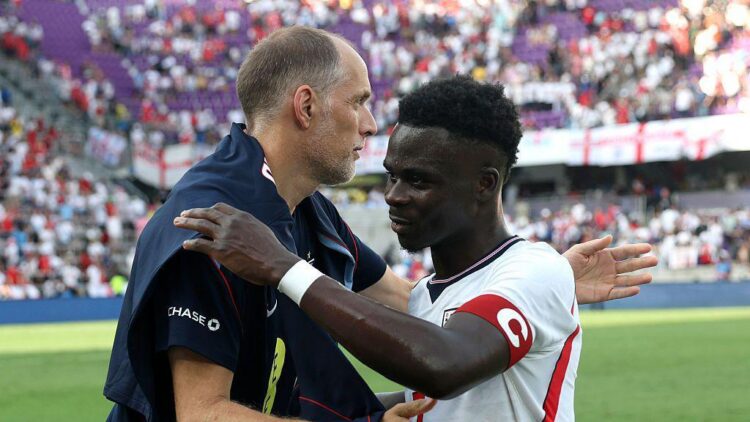
As England’s World Cup campaign gathers momentum, a familiar challenge has emerged for manager Thomas Tuchel. The question is no longer whether the Three Lions possess enough talent to compete with the world’s best, but whether they can carefully manage one of their most influential players without compromising their ambitions.
At the center of the issue stands Bukayo Saka, whose fitness concerns have created a dilemma that could shape England’s path through the tournament. England entered the World Cup with high expectations, carrying a squad rich in attacking talent and guided by a manager renowned for tactical discipline and adaptability. Early performances have suggested that Tuchel’s side possesses both the quality and resilience required to challenge for football’s biggest prize.

AD: Capeesh Restaurant
Even the most promising campaigns can be disrupted by injury concerns, and the situation surrounding Saka has quickly become one of the tournament’s most closely watched stories.
The Arsenal winger has become indispensable for club and country over the past several years. His ability to stretch defences, create opportunities, and deliver in crucial moments has transformed him into one of England’s most reliable attacking weapons.
Any uncertainty regarding his availability naturally raises questions about how Tuchel will approach upcoming matches and whether the manager will prioritize caution over immediate gains. Reports emerging from the England camp indicate that Saka has been dealing with a physical issue that requires close monitoring. While the injury is not believed to be severe, tournament football offers little room for error. Every decision carries consequences, particularly when the schedule is condensed and recovery periods are limited.

AD: Oysterian Sea Food Restaurant And Bar
England supporters will remember previous tournaments in which injuries to key players altered the trajectory of a campaign. Tuchel, who has built his reputation on meticulous preparation, now faces the delicate task of balancing risk and reward. The temptation would be simple. Just play your best players whenever possible and worry about the consequences later. Tuchel, however, has rarely approached football in such a straightforward manner.
Throughout successful spells at Chelsea, Bayern Munich and Paris Saint-Germain, Tuchel has built a reputation for making difficult selection calls, often prioritising tactical balance and long-term team performance over individual status. With Bukayo Saka’s fitness under scrutiny, the England manager may once again be forced into a decision that tests both his pragmatism and patience.
If Saka is deemed fit enough to start, England would naturally benefit from his pace, creativity, and growing leadership qualities. Defenders fear his direct running, while teammates trust his ability to deliver under pressure. His partnership with England’s attacking unit has become one of the team’s greatest strengths.
However, tournament football is often a marathon disguised as a sprint. Pushing a player through discomfort in a group-stage encounter or early knockout match could lead to more significant problems later in the competition. Tuchel must consider whether preserving Saka for decisive fixtures may ultimately increase England’s chances of success.
Fortunately for England, squad depth provides alternatives. With Bukayo Saka’s Achilles injury being carefully managed by Thomas Tuchel and England’s medical staff, the winger is unlikely to start and finish every match during the tournament. England possesses a range of attacking options capable of filling wide roles, including Noni Madueke, Anthony Gordon, Marcus Rashford and Morgan Rogers, each offering different tactical qualities.
Tuchel has repeatedly emphasised the healthy competition within his squad, praising the contributions of his attacking players and highlighting the strength in depth available to him. His challenge is not a shortage of options but determining which combination can best replicate Saka’s influence when rotation becomes necessary.
The uncertainty has also fuelled discussion among supporters and analysts. Some argue that England should exercise maximum caution, particularly if qualification objectives remain within reach. Others believe that removing one of the team’s most dangerous players could disrupt rhythm and momentum at a critical stage.
Inside the camp, the focus remains on daily assessments and medical evaluations. Modern sports science has significantly improved player management, but predicting how an injury will respond under the pressures of elite competition remains far from exact. Each training session passes, attention naturally turns toward Tuchel’s next team selection. Every appearance by Saka on the training pitch is scrutinised. Every comment from coaching staff is analysed for clues.
While Saka’s condition dominates headlines, England’s broader outlook remains encouraging. The Three Lions have demonstrated tactical flexibility throughout the tournament, adapting to different opponents while maintaining a clear identity.
Tuchel’s influence is increasingly visible. England have appeared organised without the ball, dangerous in transition, and capable of controlling possession when required. Those attributes have reinforced optimism that the team can finally end decades of World Cup frustration.
The manager has repeatedly emphasized collective responsibility rather than dependence on individual stars. That philosophy may now be tested more than ever. If Saka is unavailable or restricted, England’s ability to share creative responsibilities across the squad will become essential.
Several senior players have already stepped forward during key moments of the campaign, easing pressure on younger teammates and demonstrating the maturity expected of genuine contenders. Such contributions could prove invaluable as the tournament progresses and physical demands intensify.
Saka himself, the situation presents a frustrating interruption during what many expected to be a defining tournament. The winger has consistently delivered on major stages, earning admiration for both his performances and professionalism. His desire to contribute will undoubtedly be strong, but players and medical staff alike understand that long-term health must remain a priority.
England’s supporters, meanwhile, continue to dream. Every World Cup revives memories of near misses and what-ifs. This squad was assembled with the belief that it can go further than previous generations. The blend of youth, experience, and tactical sophistication has created genuine confidence across the country.
Whether Saka starts the next match, appears from the bench, or is rested entirely, the spotlight will remain fixed on Tuchel’s decision-making. Great tournament managers are often defined not only by tactical brilliance but by their ability to navigate moments of uncertainty. Knowing when to take risks and when to show restraint can determine whether a campaign ends in glory or disappointment.
England prepare for the next chapter of their World Cup journey, the Saka dilemma serves as a reminder of the fine margins that separate success from failure. Tuchel must weigh immediate needs against long-term ambitions, balancing the demands of the present with the promise of what lies ahead.
The coming days will reveal whether England’s star winger is ready to resume his central role. Until then, anticipation continues to build, and one question hangs over the Three Lions’ camp: how much risk is worth taking when the ultimate prize remains within reach?

AD: Heritage And Restaurant Lounge Bar