
By Kenneth Williams-
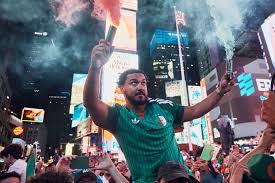
In the college town of Lawrence, Kansas, the atmosphere during World Cup match days has taken on an unusual international flavour. Flags not typically associated with the American Midwest green, white, and red banners bearing the crescent and star of Algeria have appeared in bar windows, student housing common rooms, and on storefront televisions tuned into live matches.
What began as curiosity has developed into a modest but visible local tradition. A section of the town rallying behind the Algerian national team. Lawrence, Kansas, is frequently described in University of Kansas and local institutional materials as a “bustling college town” and an “epicenter of culture for the Midwest,” where the presence of a major research university strongly shapes civic life and gives the city a distinctive cultural and social identity .

AD: Capeesh Restaurant
The University of Kansas highlights that Lawrence hosts a large and diverse student population, including thousands of international students from over 100 countries, reinforcing a campus environment that is explicitly framed as welcoming and globally connected.
This blend of domestic and international students, along with more than 600 student organisations and frequent public cultural programming, contributes to a city structure where campus and community life are closely intertwined, with shared spaces such as downtown Lawrence and university venues regularly serving as gathering points for events and entertainment.
Within this context, KU emphasises that student life in Lawrence extends beyond academics into communal experiences of sport, arts, and public events, reflecting a broader culture of participation and collective engagement that helps explain why international sporting events such as the World Cup often generate viewing gatherings that go beyond traditional U.S. national-team loyalties (The University of Kansas).

AD: Oysterian Sea Food Restaurant And Bar
A small but vocal group of residents and students, Algeria has become a focal point of support part sporting admiration, part social identity, and part solidarity with friends and classmates from North Africa. At a downtown sports bar near Massachusetts Street, patrons describe match days as something closer to communal ritual than casual entertainment. Conversations shift between English, French, and Arabic.
Jerseys of European clubs where many Algerian players compete professionally sit alongside homemade banners reading messages of encouragement. The sense of connection, locals say, is less about geography and more about narrative: underdog spirit, diaspora pride, and the global reach of football.
Sports sociologists note that such affiliations are increasingly common in global tournaments like the FIFA World Cup, where fans adopt national teams outside their country of origin due to personal relationships, club allegiances, or shared cultural experiences.
According to FIFA, the World Cup has become the most widely followed sporting event in the world, with billions tuning in across continents, making cross-border fandom a normal feature of modern football culture.
In Lawrence, some of this support stems from Algerian students studying in the United States, as well as second-generation diaspora families who have settled in the Midwest. Others are drawn in through social media clips, Premier League broadcasts, or the visibility of Algerian stars in European leagues. Over time, these threads have converged into a localised expression of global sport. Yet beneath the flags and celebrations lies a more complicated conversation one that extends far beyond Kansas.
Human rights scrutiny in Algeria casts a longer shadow
While Algeria’s national team often serves as a source of pride for supporters abroad, the country’s domestic human rights record continues to draw scrutiny from international organisations.
Groups such as Amnesty International and Human Rights Watch have documented concerns ranging from restrictions on freedom of expression to limitations on peaceful assembly, particularly in the context of political dissent and the legacy of the Hirak protest movement that began in 2019.
Amnesty International has reported that Algerian authorities have, in recent years, increased prosecutions linked to online expression and protest activity, raising concerns about shrinking civic space. Human Rights Watch has similarly highlighted cases involving journalists, activists, and protesters facing legal pressure under broadly defined security or defamation laws.
These issues have not gone unnoticed in global sports discourse. The awarding of major tournaments to countries with contested human rights records has become a recurring point of debate within football governance. FIFA, which oversees the World Cup, has faced criticism from rights organisations and some member associations over host selection processes and the extent to which human rights considerations should factor into sporting decisions.
FIFA itself has introduced human rights frameworks in recent years, stating that it expects host nations and participating associations to respect international standards. However, critics argue that enforcement mechanisms remain limited and inconsistently applied.
In Lawrence, these broader debates occasionally surface in quieter corners of the same venues where match-day celebrations take place. Some supporters express discomfort when political questions are raised, preferring to keep football separate from governance. Others argue that the visibility of a national team on the world stage should not be isolated from the realities faced by people living under its flag.
That duality celebration paired with critique is increasingly common in global sports culture. Football, with its vast audiences and national symbolism, often becomes a stage where political narratives are projected even when participants prefer to focus on the game itself.
Some residents in Lawrence consider the Algeria fandom not to be an endorsement of any government, but rather an expression of solidarity with individuals and communities they know personally. A local café owner who hosts match screenings described it as “supporting people, not politics,” emphasising friendships formed through university ties and shared cultural exchange.
Still, the presence of human rights concerns complicates that distinction. Scholars of international relations note that sport often functions as a form of soft power, allowing nations to project identity and prestige globally, even as domestic issues remain contested. In this sense, Algeria’s visibility at the World Cup becomes part of a broader global narrative that includes both athletic achievement and political scrutiny.
However, match days continue in their familiar rhythm. When Algeria scores, the room erupts regardless of background. When the final whistle blows, conversations drift from tactics to travel stories, family histories, and memories of past tournaments. The geopolitical weight of the conversation does not disappear, but it is often set aside in favour of shared experience.
This balancing act between local enthusiasm and global awareness reflects the modern reality of international sport. A town in the American Midwest can simultaneously celebrate a North African team’s performance while remaining aware of the complex debates surrounding the country it represents. In Lawrence, that contradiction is not necessarily seen as a problem to be solved. Instead, it is part of what makes the experience meaningful: football as a bridge, even when the world on either side of it remains complicated.

AD: Heritage And Restaurant Lounge Bar