
By Ben Kerrigan-
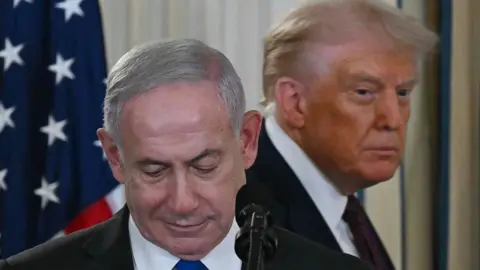
Israeli Prime Minister Benjamin Netanyahu publicly acknowledged growing differences with U.S. President Donald Trump on Monday, saying the two leaders “don’t always see eye to eye,” even as he insisted that Israel’s security threats remain unresolved despite a newly announced U.S.-brokered peace framework with Iran.
The unusually candid remark, delivered during a press conference in Jerusalem, comes at a delicate diplomatic moment. Washington has just finalised a high-stakes agreement with Tehran aimed at halting open hostilities and stabilising regional tensions, a deal that has already triggered political friction with Israel’s leadership and unease across the Middle East.

AD: Capeesh Restaurant
Netanyahu’s comments reflected a careful balancing act: affirming cooperation with the United States while signalling that Israel will not fully align itself with every element of Trump’s evolving Middle East strategy.
The Israeli leader emphasised that while the U.S.-Iran agreement may represent a diplomatic milestone for Washington, Israel still views the broader regional threat landscape as active and potentially escalating.
“We have removed the threat of immediate annihilation,” Netanyahu said, referring to Israel’s recent military campaign against Iranian capabilities. “But the fight is not over.”

AD: Oysterian Sea Food Restaurant And Bar
His remarks underscore a widening gap between two leaders who, for years, were often portrayed as closely aligned on Iran policy. According to multiple reports, Trump has recently expressed frustration with Israel’s continued military operations in Lebanon and questioned Netanyahu’s strategic approach in private discussions.
The backdrop to Netanyahu’s statement is a rapidly shifting geopolitical landscape shaped by the newly announced U.S.-Iran peace agreement, which aims to de-escalate direct conflict and open a pathway for broader negotiations over nuclear activity and regional security guarantees.
The deal has been hailed by the White House as a breakthrough in stabilising one of the world’s most volatile confrontations, with provisions including phased ceasefires and renewed diplomatic channels.
However, in Israel, the agreement has landed far more controversially. Senior officials argue that the deal does not sufficiently address Iran’s ballistic missile program or its network of regional allies, including Hezbollah in Lebanon. Critics within Israel’s political and security establishment warn that easing pressure on Tehran could allow it to rebuild influence across the region.
Netanyahu himself stopped short of directly condemning the agreement but made clear that Israel had not been fully briefed on its contents. He reiterated that Israel retains the sovereign right to act independently if it perceives an imminent threat.
“Whether there is an agreement or not, Iran will never have nuclear weapons,” he said, framing Israel’s position as non-negotiable.
Behind the diplomatic language, however, lies a more complicated reality. The United States and Israel, once closely synchronised in their Iran strategy, are now navigating diverging priorities: Washington appears focused on containment and de-escalation, while Jerusalem continues to emphasise preemption and sustained military pressure.
That divergence is now being openly acknowledged at the highest levels. Netanyahu’s statement that he and Trump do not always see eye to eye signals not only tactical disagreement, but a broader recalibration of a relationship long considered central to Israel’s security doctrine.
Netanyahu attempted to frame the partnership as resilient, describing it as one between “partners who sometimes disagree but ultimately share common goals.”
Still, diplomatic observers note that tone matters as much as content. The public acknowledgment of disagreement paired with Trump’s reported private criticism of Israeli strikes in Lebanon suggests a relationship entering a more transactional and less predictable phase.
Israel’s Security Calculus in a Changing Regional Order
Even as diplomatic attention focuses on the U.S.-Iran agreement, Netanyahu has sought to redirect the conversation toward what he describes as ongoing and evolving threats. Chief among them is the situation along Israel’s northern border, where tensions with Hezbollah remain high despite repeated ceasefire efforts.
Israeli officials maintain that their military presence in designated security zones in southern Lebanon will continue indefinitely, citing the need to deter cross-border attacks and prevent militant rearmament. This stance highlights one of the key contradictions emerging from the broader peace framework: while Washington pushes for de-escalation, Israel insists that battlefield realities in Lebanon and Syria require sustained operational flexibility.
Netanyahu used Monday’s press conference to reinforce that message, arguing that Israel’s recent military campaign had significantly degraded Iran’s ability to directly threaten the country. Yet he warned that the underlying networks of regional militias remain intact and capable of renewed escalation. “We saved Israel from immediate danger,” he said, “but the strategic challenge has not disappeared.”
His comments reflect a broader Israeli concern that the U.S.-led diplomatic push may freeze rather than resolve regional conflicts pausing active warfare without eliminating the structures that fuel it. That concern is echoed across Israeli political discourse, where critics of the agreement argue that it risks empowering Iran indirectly by easing economic and diplomatic pressure.
International reporting has similarly highlighted Israeli unease, noting that many officials believe the deal could constrain Israel’s operational freedom at a critical moment in its confrontation with Iran-backed groups in Lebanon.
Netanyahu faces domestic political pressure. With elections looming, his government is under scrutiny over whether its hardline approach has delivered lasting security gains or simply prolonged cycles of conflict without a decisive end-state.
The tension between strategic patience and immediate security demands is now shaping Israel’s foreign policy messaging. On one hand, Netanyahu insists that Israel has achieved significant deterrence gains. On the other, he warns that complacency would be dangerous.
The result is a dual narrative: one of partial success paired with unresolved threat. With Washington, the challenge is equally complex. Trump’s administration has positioned the Iran agreement as a cornerstone of a broader regional stabilisation effort, but it risks alienating a key ally whose cooperation remains essential for enforcement and intelligence-sharing.
Analysts say the visible strain between Trump and Netanyahu is not necessarily a rupture, but it does represent a shift toward a more conditional alliance one where shared interests no longer guarantee aligned tactics.
Both leaders appear committed to maintaining public unity while privately navigating disagreements. But Netanyahu’s blunt acknowledgement that they “don’t always see eye to eye” suggests that the era of seamless coordination may be giving way to something more uncertain. And in a region where perception often shapes reality, that uncertainty may be as consequential as any signed agreement.

AD: Heritage And Restaurant Lounge Bar