
By Rim Parsons-
In decades they lived in the shadows of football royalty, overlooked by wealthier rivals and dismissed as outsiders in their own cities. Now, Crystal Palace and Rayo Vallecano stand one match away from rewriting their histories as the two unlikely finalists prepare to meet in the UEFA Conference League final in Leipzig.
The final, set for Wednesday night at Leipzig Stadium, will crown a first-time European champion and guarantee one of Europe’s most fiercely loyal fan bases a moment that once seemed unimaginable.

AD: Capeesh Restaurant
Neither club has previously appeared in a major European final, and both arrive carrying the identity of underdogs shaped by years of financial limitations, uneven league campaigns and life beside footballing superpowers.
With Crystal Palace, the journey to Leipzig represents the culmination of a remarkable rise under manager Oliver Glasner. The south London club spent much of its modern history battling relegation concerns and searching for stability while neighbours Chelsea and Arsenal dominated headlines, trophies and transfer markets.

AD: Oysterian Sea Food Restaurant And Bar
Rayo Vallecano’s path has been even more improbable. Based in the working-class Madrid neighborhood of Vallecas, the club has long existed in the enormous shadow of Real Madrid and Atlético Madrid. Unlike their glamorous city rivals, Rayo built its reputation not on trophies or global branding but on community identity, political activism and survival against the odds.
Their modest Estadio de Vallecas, squeezed tightly into the surrounding streets, has become symbolic of a club that embraces struggle rather than hiding from it.
The Conference League itself was originally created to provide clubs outside Europe’s traditional elite with a realistic opportunity for continental success. This season’s final may represent the competition’s clearest fulfillment of that vision.
Instead of billion-dollar giants or serial Champions League contenders, the tournament’s climax features two clubs whose supporters spent generations dreaming simply of belonging on nights like these.
UEFA described the final as a meeting between “fellow first-time European finalists,” highlighting how unusual this occasion is in a sport increasingly dominated by financial concentration and established superclubs.
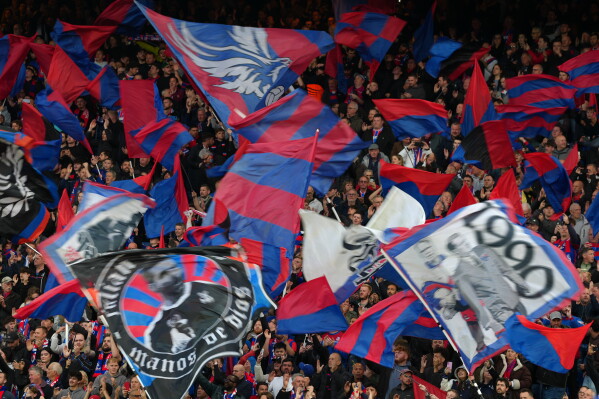
The atmosphere surrounding Leipzig has already reflected the emotional significance of the occasion. Thousands of supporters from south London and Vallecas traveled across Europe this week, filling fan zones with songs, scarves and disbelief at what their clubs have achieved.
Reuters photographs from the city showed Rayo fans posing with giant replica trophies while Palace supporters gathered around banners celebrating the club’s first continental final.
Two Clubs Built on Survival and Identity
Crystal Palace’s route to the final has reflected the unpredictability that now defines the club. Palace entered Europe after winning the FA Cup in 2025, only to be controversially demoted from the Europa League to the Conference League because of UEFA’s multi-club ownership regulations involving shareholder John Textor and French side Lyon. Rather than collapsing under frustration, Palace embraced the tournament and gradually became its most dangerous attacking team.
Statistics underline their dominance. Palace have scored 25 goals during the competition, more than any other club, while generating the tournament’s highest expected goals figure. Their attacking football, driven by the pace and directness of Ismaila Sarr and Jean-Philippe Mateta, overwhelmed opponents including Fiorentina and Shakhtar Donetsk during the knockout rounds.
Yet the club’s emotional connection with supporters may be just as important as its tactical growth. Selhurst Park has long been regarded as one of English football’s loudest stadiums despite Palace rarely competing for major honors. That atmosphere followed the team across Europe this season, helping transform an inexperienced continental side into genuine contenders.
Manager Oliver Glasner has become central to that transformation. The Austrian coach, who confirmed earlier this year that he will leave after the final, already delivered Palace’s first major trophy through the FA Cup triumph and now has the opportunity to complete what many supporters view as the greatest period in club history.
“Fairytale” has become the word most frequently associated with Palace’s season, though Glasner has consistently resisted romanticizing his team’s achievements. Instead, he has emphasized discipline, structure and belief. Ahead of the final, he argued that victory would validate Palace’s place among Europe’s emerging clubs and secure a deserved Europa League berth for next season.
Across from them stands a Rayo Vallecano side carrying a very different but equally powerful narrative. Rayo’s identity is inseparable from Vallecas itself, a historically working-class district known for political activism, immigrant communities and anti-establishment culture.
Supporters often describe the club as representing ordinary Madrid residents excluded from the glamour associated with Spain’s football aristocracy.
That culture has shaped the team’s reputation across Europe. While Real Madrid symbolize wealth and global dominance, Rayo are celebrated for authenticity and resistance. Fans frequently display anti-racist and anti-fascist banners inside the stadium, and the club’s supporters have repeatedly clashed with ownership over ticket pricing, commercial decisions and infrastructure neglect.
The footballing journey has been similarly turbulent. Rayo spent decades oscillating between divisions, suffering financial crises and enduring uncertainty over their future. Their modest resources forced them to rely on player development, smart recruitment and emotional intensity rather than star power. Even this season, few analysts expected them to survive deep into European competition.
Under manager Iñigo Pérez, however, Rayo developed into one of the tournament’s most disciplined and efficient teams. Reuters described them as a “working-class club defying the odds,” while UEFA praised their tactical organization and fearless pressing style.
Rayo’s progression through the knockout rounds included victories over AEK Athens and Strasbourg, culminating in a tense semifinal triumph that secured the club’s first European final appearance. Their performances may not have generated the attacking numbers posted by Palace, but analysts have repeatedly highlighted their efficiency and ability to maximize limited opportunities.
The matchup itself has intrigued observers because of the similarities between the clubs despite their different national contexts. Both teams are deeply rooted in local identity, both emerged from neighbourhoods traditionally overlooked by football elites, and both cultivated reputations for passionate supporters rather than financial dominance.
One British tabloid even described the teams as “mirror images” of one another, emphasising their shared histories of struggle, relegation battles and outsider status.
The final carries significance extending beyond football. It represents validation for communities that often feel marginalized within modern elite sport. In an era increasingly shaped by sovereign wealth ownership, global marketing strategies and billion-euro transfer fees, the sight of Crystal Palace and Rayo Vallecano contesting a European trophy feels unusually human.
The winner will secure not only silverware but also a place in next season’s Europa League, potentially altering the financial and competitive trajectory of the club for years to come.
Regardless of the result, both sides have already changed perceptions. Palace are no longer merely London’s spirited outsiders, while Rayo have demonstrated that a club from one of Madrid’s humblest neighbourhoods can compete on the continental stage.
Kickoff approaches in Leipzig, supporters from south London and Vallecas are united by a rare feeling: the realisation that for one unforgettable night, football’s outsiders are no longer living in anyone else’s shadow.

AD: Heritage And Restaurant Lounge Bar