
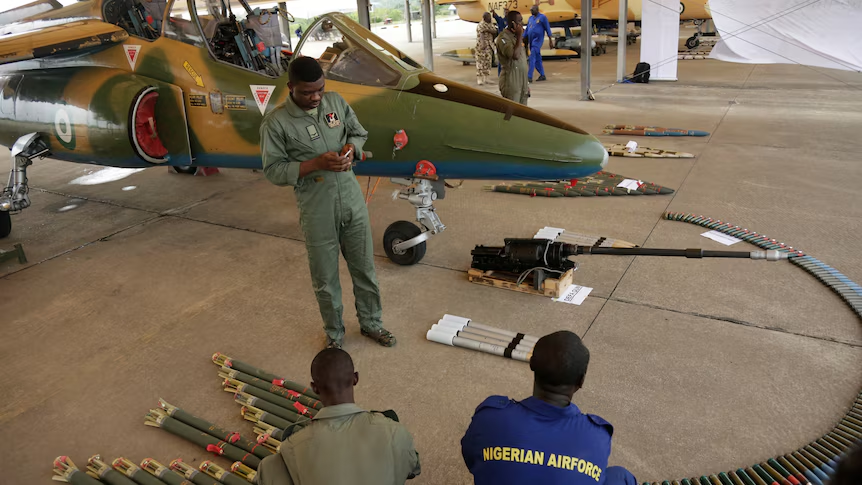
Nigeria’s military has denied allegations that one of its airstrikes killed around 100 civilians in a market in the country’s northwest, as renewed attention falls on the government’s long-running war against armed groups and the growing human cost of aerial operations in conflict-hit regions.
The controversy erupted after Amnesty International accused the Nigerian military of carrying out a deadly strike on Sunday in Tumfa, a community in Zamfara state, where civilians were reportedly gathered in a local market.
According to the rights organisation, the attack resulted in mass casualties, many of them women and children, intensifying concerns about repeated military errors in areas already devastated by years of insecurity.

AD: Capeesh Restaurant
Amnesty International Nigeria said local witnesses and community members described scenes of devastation after the strike, with dozens of bodies recovered from the area. Isa Sanusi, the organisation’s director in Nigeria, alleged that entire families had been wiped out and insisted there was no evidence that those killed were members of armed groups.
“In one village alone, 80 people were buried and there is no evidence that any of those people killed is a bandit,” Sanusi told The Associated Press. “They are all civilians. The majority of them are young girls and small boys.”

AD: Oysterian Sea Food Restaurant And Bar
The claims have once again thrust Nigeria’s counterinsurgency strategy into the spotlight, exposing the increasingly difficult balance between pursuing heavily armed militant groups and protecting civilian populations trapped in the middle of a complex conflict.
Nigeria’s military confirmed that an air operation had taken place in the area but strongly rejected allegations that civilians had been deliberately or recklessly targeted. Military spokesperson Major General Michael Onoja said no verified evidence had emerged proving that civilians were killed in the strike and insisted operations were continuing against armed groups active in the region.
“Civilians are not the target, and everything is being done to avoid civilian casualties,” Onoja said in a statement to reporters, adding that investigations and military assessments were ongoing.
The conflicting narratives have fuelled fresh tensions between human rights organisations and Nigerian security forces, a pattern that has become increasingly common during the country’s prolonged security crisis.
Rights groups have repeatedly accused the military of failing to adequately distinguish between civilians and armed fighters during aerial bombardments, while military officials maintain that insurgents frequently operate among civilian populations, making precision targeting extraordinarily difficult.
The latest allegations come at a particularly sensitive time for Nigeria’s armed forces. Only weeks earlier, another accidental military strike reportedly killed around 100 people, renewing criticism of operational coordination and intelligence gathering within the country’s air campaign.
Analysts say the frequency of such incidents has raised troubling questions about command structures, surveillance capabilities and communication between forces on the ground and air force units conducting strikes.
Nigeria has battled multiple armed groups for many decades across its northern regions, including Boko Haram and its offshoot Islamic State West Africa Province (ISWAP), alongside heavily armed criminal networks commonly referred to locally as “bandits.” These groups have carried out mass kidnappings, village raids, killings and attacks on security personnel, contributing to one of the most severe humanitarian crises in West Africa.
Zamfara state has become one of the epicentres of that violence. Once known primarily for agriculture and rural trade, the state has in recent years been transformed by escalating insecurity, with armed gangs establishing camps in remote forests and launching repeated attacks on villages and highways.
Thousands of residents have been displaced, schools have been shut down in some districts and local economies have been devastated by fear and instability.
The Nigerian government has increasingly relied on air power to target armed groups operating in difficult terrain where ground offensives are often dangerous and logistically challenging. Military commanders argue that airstrikes remain one of the few effective tools available to disrupt militant networks hidden in forests stretching across northern Nigeria.
However, critics warn that aerial operations have also produced a growing number of civilian casualties, undermining trust in the military and deepening resentment among affected
A network error occurred. Please check your connection and try again. If this issue persists please contact us through our help center at help.openai.com.

AD: Heritage And Restaurant Lounge Bar
-
Share On
- Categories
- Date