
By Aaron Miller-
President Donald Trump’s ambitious “Golden Dome” missile defence project is facing growing scrutiny after a new Congressional Budget Office estimate projected the system could cost as much as $1.2 trillion over two decades dramatically eclipsing the president’s original claim that it could be built for roughly $175 billion.
The revised estimate has intensified debate in Washington over the feasibility, strategic necessity, and long-term financial burden of one of the administration’s most expansive defense initiatives.

AD: Capeesh Restaurant
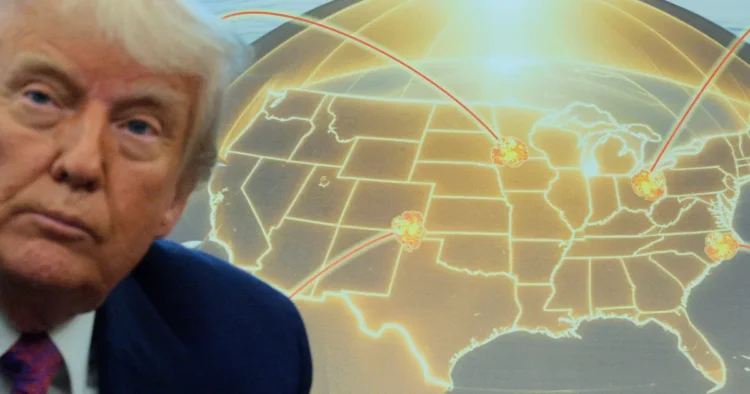
The Golden Dome initiative, first introduced shortly after Trump returned to office, is designed as a massive multilayered missile defence shield intended to protect the United States against ballistic, hypersonic, and cruise missile attacks.
Inspired in part by Israel’s Iron Dome system but envisioned on a far broader scale, the proposal combines ground-based interceptors with advanced satellite networks and space-based tracking systems capable of detecting and potentially neutralising threats before they reach American territory.
Trump has repeatedly described the project as essential to national security, arguing that the United States faces increasing threats from adversaries such as China, Russia, Iran, and North Korea. During previous public remarks, he promised the system would be operational before the end of his term and insisted it could be completed at a comparatively modest cost.

AD: Oysterian Sea Food Restaurant And Bar
However, defence analysts and lawmakers from both parties have long questioned those estimates, warning that the technological scale and infrastructure requirements of the program would likely push costs into the hundreds of billions or even trillions of dollars.
The latest Congressional Budget Office analysis now appears to validate many of those concerns. According to the report, the projected $1.2 trillion figure includes research, development, deployment, maintenance, and operational costs spread over approximately 20 years.
Analysts cautioned that even this estimate remains uncertain because the Pentagon has yet to publicly release a finalised architecture or comprehensive technical blueprint for the system.
Rising Costs Fuel Bipartisan Concern In Washington
The enormous projected price tag has quickly become a flashpoint on Capitol Hill, where lawmakers are already debating a proposed $1.5 trillion defence budget for fiscal year 2027. Critics argue that the Golden Dome initiative risks becoming an open-ended financial commitment at a time when the federal government is already facing mounting deficits and competing national priorities.
Democratic lawmakers have been especially critical, describing the proposal as an unrealistic and politically motivated expansion of the defence budget that could funnel billions toward military contractors without guaranteeing technological success.
Senator Jeff Merkley of Oregon recently characterised the project as a “blank check” for defence companies, while others questioned whether the system’s underlying technology is even mature enough to justify such large-scale spending.
Some Republicans have also expressed concerns, though many within the party continue to support the initiative as a strategic response to evolving global threats. Defense hawks argue that advancements in hypersonic missile technology by China and Russia require a dramatic modernization of U.S. missile defenses, particularly as traditional systems struggle to intercept faster and more maneuverable weapons.
The Pentagon has defended the broader goals of the project while acknowledging that final costs remain uncertain. Space Force General Michael Guetlein, who oversees major components of the initiative, said earlier this year that expanding space-based capabilities and accelerating satellite infrastructure contributed to rising estimates, which had already climbed to $185 billion before the new Congressional Budget Office analysis was released.
Defense officials insist that the Golden Dome is not intended to replicate existing missile defence systems but instead create a fully integrated architecture capable of responding to next-generation threats in real time.
The project would rely heavily on advanced satellite constellations, artificial intelligence-assisted tracking systems, and potentially even orbital interceptors capable of targeting missiles from space. Those elements, however, represent some of the most expensive and technologically challenging aspects of the proposal.
Industry interest in the initiative has grown rapidly despite the uncertainty surrounding funding. Major defense contractors including Lockheed Martin, RTX, Northrop Grumman, and several emerging aerospace firms are reportedly competing for portions of the program, particularly contracts related to satellite tracking networks and missile interception technologies.
Further financial implications, the Golden Dome proposal has reignited broader debates about the future of U.S. military strategy and the militarisation of space.
Supporters argue that the initiative represents a necessary evolution in national defence, particularly as geopolitical tensions with China and Russia continue to intensify. Critics, however, warn that deploying extensive missile defense systems in orbit could trigger a new international arms race and destabilize existing deterrence frameworks.
Some analysts have compared the initiative to President Ronald Reagan’s “Strategic Defense Initiative” from the 1980s, commonly known as “Star Wars,” which similarly sought to create a space-based missile shield but was ultimately limited by technological and financial constraints.
Like Reagan’s program, Trump’s Golden Dome proposal has generated both enthusiasm among defence advocates and skepticism among scientists and arms control experts.
The Congressional Budget Office noted that the Defense Department has released only limited public details about the proposed architecture, making it difficult to calculate precise costs or evaluate the project’s operational feasibility.
The office described its $1.2 trillion estimate as illustrative rather than definitive, emphasising that actual expenditures could vary substantially depending on the final design and scope of the system.
Foreign policy experts have also raised concerns about how rival powers may respond if the United States moves aggressively toward constructing a global missile shield. Some security analysts argue that China and Russia could expand their nuclear arsenals or accelerate the development of hypersonic weapons specifically designed to evade missile defences, potentially escalating global military competition.
Supporters within the administration maintain that failing to modernise missile defences would leave the United States vulnerable to rapidly evolving threats. Trump has repeatedly framed the Golden Dome as a historic national security investment comparable to major Cold War-era defense initiatives, arguing that the cost of inaction could ultimately prove far greater than the price of the system itself.
Political analysts say the debate surrounding the Golden Dome is likely to intensify as Congress enters negotiations over future defense spending bills. While lawmakers from both parties broadly support strengthening national missile defence capabilities, the scale of the projected costs may complicate efforts to secure long-term bipartisan backing.
The issue could also become a defining topic in upcoming election campaigns, particularly as voters weigh concerns over national security against broader economic pressures. With inflation, federal debt, and military spending all under increasing scrutiny, the administration may face mounting pressure to justify both the technological practicality and financial sustainability of the project.
The Golden Dome remains more concept than completed system, with major questions still unresolved about how it would function, how quickly it could be deployed, and whether Congress is willing to fund it at the scale now projected.
Despite the uncertainty, the proposal has already reshaped conversations about the future of American defence strategy and ignited one of the largest debates over military spending in years.

AD: Heritage And Restaurant Lounge Bar