
By Theodore Brown-
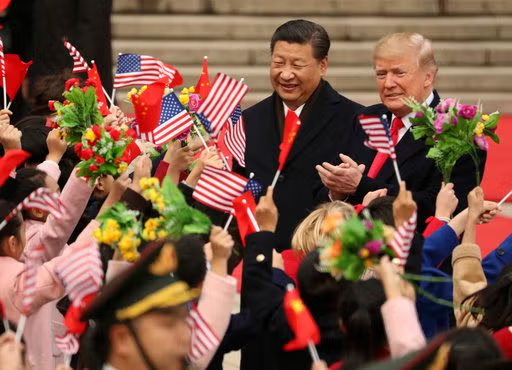
President Donald Trump’s upcoming trip to China was once expected to echo the spectacle and symbolism of his 2017 state visit to Beijing, when Chinese President Xi Jinping welcomed him with military pageantry, a lavish banquet inside the Forbidden City and promises of multibillion-dollar trade deals.
Nearly a decade later, the geopolitical climate has shifted dramatically, and the renewed conflict involving Iran now threatens to make the diplomatic encounter far colder than the White House had anticipated.

AD: Capeesh Restaurant
Trump is scheduled to meet Xi in Beijing this week amid heightened tensions in the Middle East, fragile ceasefire negotiations involving Iran and unresolved economic disputes between Washington and Beijing.
Analysts say the summit will likely be shaped less by ceremony and more by strategic mistrust, with both leaders navigating a complicated global landscape defined by war, energy security and growing competition between the world’s two largest economies.
The Iran conflict has become an especially sensitive issue because China remains one of Iran’s most important economic partners and a major buyer of Iranian oil.

AD: Oysterian Sea Food Restaurant And Bar
While Washington has sought stronger international pressure on Tehran and greater cooperation in stabilising shipping routes near the Strait of Hormuz, Beijing has resisted aligning fully with U.S. policy. Chinese officials instead have called for restraint, ceasefire negotiations and diplomatic mediation.
Trump has publicly maintained that his relationship with Xi remains strong. In recent remarks before the trip, he described the Chinese president as “respectful” and downplayed suggestions that the Iran war could seriously derail summit talks. Yet diplomatic observers say the atmosphere surrounding the visit differs sharply from the optimism that characterized Trump’s first-term outreach to China.
During Trump’s 2017 visit, Beijing rolled out what many analysts described as “state theater diplomacy,” seeking to build a personal relationship with the American president while avoiding direct confrontation over trade disputes that were only beginning to intensify. The two sides announced roughly $250 billion in nonbinding commercial agreements at the time, and Trump openly praised Xi’s leadership.
However, U.S.-China relations are weighed down by years of tariff battles, export restrictions, military rivalry in the Indo-Pacific and tensions surrounding Taiwan. The Iran crisis has added another layer of complexity, particularly as both countries attempt to secure energy supplies and influence diplomatic outcomes in the Gulf region.
China’s balancing act has become increasingly delicate. Beijing has attempted to position itself as a stabilising diplomatic force while also protecting its long-standing economic relationship with Tehran. Chinese officials recently hosted Iranian Foreign Minister Abbas Araghchi in Beijing, where discussions focused on reopening shipping routes and preventing wider regional escalation ahead of Trump’s arrival in China.
Trump’s administration has pressed Beijing to exert more influence over Iran, particularly regarding maritime security in the Strait of Hormuz. Roughly one-fifth of the world’s oil supply passes through the narrow waterway, making any disruption a major threat to global markets and inflation-sensitive economies.
Even before the Iran conflict escalated, expectations for Trump’s China visit had already been tempered by lingering economic disputes between the two governments.
Trump’s first presidency fundamentally reshaped U.S.-China economic relations through sweeping tariffs and aggressive trade negotiations aimed at reducing America’s dependence on Chinese manufacturing. Although both sides later reached temporary agreements, many of the deeper structural disagreements were never resolved.
The administration’s latest efforts to tighten restrictions on advanced technology exports to China have further strained relations. Beijing, meanwhile, has expanded investment in artificial intelligence, electric vehicles and semiconductor production while reducing reliance on Western suppliers.
Analysts say Trump now enters Beijing in a weaker negotiating position than during his first-term visit because the geopolitical environment has become more fragmented and unpredictable. The Iran war has also exposed divisions between Washington and several allies, creating opportunities for Beijing to present itself as a steadier global actor.
Recent reports suggest Chinese officials remain skeptical that the summit will produce major breakthroughs. Instead, the meeting is expected to focus on managing tensions rather than resolving them. Economic cooperation, energy security and military communication channels are all likely to dominate discussions behind closed doors.
Trump has nevertheless framed the trip as an opportunity to secure practical benefits for the United States, particularly in trade and manufacturing. The White House is reportedly seeking commitments from Beijing related to agriculture purchases, industrial exports and rare earth mineral access.
But China’s leverage has grown significantly since Trump’s first term. The ongoing instability in the Middle East has increased Beijing’s importance in global energy markets, while China’s manufacturing dominance in green technology and industrial supply chains has expanded its international influence.
Some foreign policy experts argue that Beijing could use the Iran issue strategically during summit negotiations. Through emphasising its diplomatic communication with Tehran and its influence over energy routes, China may seek concessions from Washington in exchange for broader cooperation on Middle East stability.
“There’s a recognition now in Washington that China cannot simply be isolated from global crisis management,” one Brookings Institution analysis noted in discussing the summit dynamics.
The summit also arrives at a politically sensitive moment for Trump domestically. Polling tied to the Iran conflict has shown growing concern among American voters about rising energy prices and the economic costs of prolonged military tensions.
That domestic pressure could increase the White House’s urgency to demonstrate diplomatic progress in Beijing, even if substantive policy agreements remain limited. Some analysts believe Trump may prioritise symbolic announcements or narrowly focused trade deals that can be marketed as victories back home.
A broader atmosphere surrounding the trip reflects how profoundly U.S.-China relations have changed since 2017. The era of highly choreographed optimism has largely given way to strategic rivalry shaped by competing visions of global leadership.
Observers say symbolism during the summit will matter almost as much as policy outcomes. Every public gesture between Trump and Xi from the tone of joint statements to the scale of ceremonial events will be closely analysed for clues about the future direction of the relationship.
Already, some signs point to a more restrained approach by Beijing compared with Trump’s first state visit. Chinese officials appear focused on projecting stability and discipline rather than lavish spectacle, reflecting both economic caution and geopolitical uncertainty.
Meanwhile, Trump has continued to insist that diplomacy can still prevail regarding Iran. Speaking earlier this week, he said there was a “very good chance” of reaching a broader understanding before or shortly after his arrival in Beijing. Whether that optimism survives direct talks with Xi remains uncertain.
What is clear is that Trump’s return to China will unfold under conditions far more tense than those of his first term. Instead of celebrating expanding ties between Washington and Beijing, both leaders now confront a world shaped by war, economic fragmentation and deepening strategic suspicion.
All the anticipated handshakes and diplomatic choreography, the Iran conflict has already transformed the tone of the summit before it even begins.

AD: Heritage And Restaurant Lounge Bar