
By Samantha Jones–
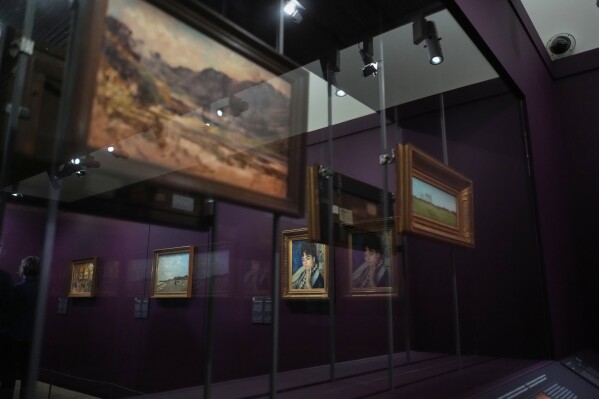
A new permanent gallery, in Paris opened this week, is dedicated to artworks looted, forcibly sold, or displaced under Nazi rule during the Second World War. It represents one of France’s most visible attempts yet to confront the fate of thousands of cultural objects that passed through Nazi hands and never fully returned to their original owners.
Visitors in Paris are now being invited to look at paintings in a way few museums have ever encouraged: from the back

AD: Capeesh Restaurant
Stretched canvasses n a softly lit room at the Musée d’Orsay, are turned away from the viewer, revealing stamped inventory numbers, faded transport labels, and cryptic markings left behind during one of Europe’s darkest chapters.
A new permanent gallery, opened this week, is dedicated to artworks looted, forcibly sold, or displaced under Nazi rule during the Second World War. It represents one of France’s most visible attempts yet to confront the fate of thousands of cultural objects that passed through Nazi hands and never fully returned to their original owners.
The exhibition features 13 so-called “orphaned masterpieces,” part of a broader state-held collection known as Musées Nationaux Récupération (MNR). These works were recovered after 1945 from Germany and Austria but were never claimed or successfully restituted. Today, around 2,200 such pieces remain in French museum custody, with ownership still unresolved.

AD: Oysterian Sea Food Restaurant And Bar
The gallery’s opening reflects a growing willingness in France to address not only the history of art theft, but also the country’s complicated role in it. During the Nazi occupation, Jewish collectors in France were systematically dispossessed, and the Paris art market became a key channel for the movement of looted works across Europe.
Unlike traditional museum spaces that emphasise aesthetic experience, the Musée d’Orsay’s new room is structured around uncertainty. Each painting is accompanied by detailed provenance research panels that outline what is known and often what is not about its wartime journey.
Among the works on display, visitors enter a space where familiar names such as Pierre-Auguste Renoir and Edgar Degas sit alongside lesser-known artists whose paintings were drawn into the machinery of Nazi acquisition and confiscation across occupied Europe.
The entrée into this collection is not purely aesthetic but archival, with each work carrying traces of disrupted ownership and wartime movement. One Degas painting, for instance, can be linked to a Jewish collector whose collection was dispersed during the occupation, with artworks circulating through Nazi-era networks of seizure, forced sale, and post-confiscation resale.
In other cases, works by Renoir and his contemporaries were sold under conditions now widely understood by historians and restitution researchers as coercive, shaped by antisemitic policies and economic pressure that undermined any genuine notion of voluntary exchange. These paintings form an entry point into a broader history in which both celebrated and lesser-known artists were swept into systems of displacement, where provenance was fractured and ownership obscured by war.
The museum’s approach is deliberately investigative. Visitors are not only asked to observe the artwork but also to engage with the gaps in its history. In some cases, the only remaining traces of ownership are numbers painted on the back of canvases or labels from wartime transport crates.
France’s Ministry of Culture estimates that more than 100,000 cultural objects were looted or forcibly sold across Europe during the Nazi era, with tens of thousands later recovered by Allied forces. Around three-quarters of recovered works have been returned to heirs, but thousands remain unclaimed or unidentified.
Delayed reckoning With Cultural Theft And Money
The Musée d’Orsay initiative is widely seen as part of a broader shift in how France confronts its wartime past. For decades after 1945, many recovered artworks were quietly held in state collections or sold off when ownership could not be determined. Only in recent decades has systematic provenance research become a priority for French museums.
The new gallery is closely tied to a dedicated research unit tasked with tracing potential heirs of MNR works. That effort involves international archival cooperation, digitised records, and cross-border legal inquiries that often span several countries and generations.
Officials say the goal of the Musée d’Orsay initiative is not only restitution where possible, but also transparency where certainty is not, reflecting a broader institutional commitment to making unresolved histories visible to the public.
The gallery is designed as a space where works connected to Nazi-era looting are displayed alongside ongoing research into their provenance, allowing visitors to see both the artworks and the gaps in their documented histories.
Within this framework, museum researchers emphasise that many of these objects remain in a suspended state between past and present, neither fully attributed nor fully returned, but actively under investigation as part of a continuing effort to trace ownership and identify heirs.
This approach reflects a shift in museum practice toward openness, where uncertainty is not hidden in storage but instead presented as part of the historical record, underscoring how these works continue to carry the imprint of disrupted lives and unresolved ownership.
The opening also comes amid renewed attention across Europe to restitution debates, as museums reassess collections acquired during wartime and colonial periods. In France, recent policy discussions have expanded legal frameworks to speed up the return of looted cultural property, signalling a broader institutional acknowledgment of historical responsibility.
With visitors, the experience is often less about resolution than confrontation. Labels such as “unknown owner” or “provenance uncertain” are not placeholders but central features of the display. They reflect a past that remains partially unrecovered, even as research continues.
France bringing these works into public view, the Musée d’Orsay’s new gallery stands as both exhibition and inquiry an attempt to make visible what was long kept in storage, and to acknowledge that for many of these artworks, the story is still unfinished.
The display reframes the museum not simply as a place of aesthetic appreciation, but as an active site of historical investigation, where provenance research is ongoing and often inconclusive.
Each painting is presented with documentation that highlights what is known about its wartime journey, but also what remains uncertain, including gaps created by destroyed archives, lost inventories, and the deaths or displacement of original owners.
In doing so, the gallery reflects a broader shift in French museum practice toward transparency, where uncertainty is not treated as a deficiency but as part of the historical record itself. Visitors encounter artworks that exist in a kind of suspended state, neither fully restored nor fully resolved, underscoring the enduring legacy of Nazi-era looting and forced transfers. It also therefore functions as a space of collective memory as much as cultural display, inviting reflection on how cultural heritage can be fragmented by war and how institutions today attempt, however incompletely, to reconstruct those interrupted histories for the public.

AD: Heritage And Restaurant Lounge Bar