
By Isabelle Wilson-
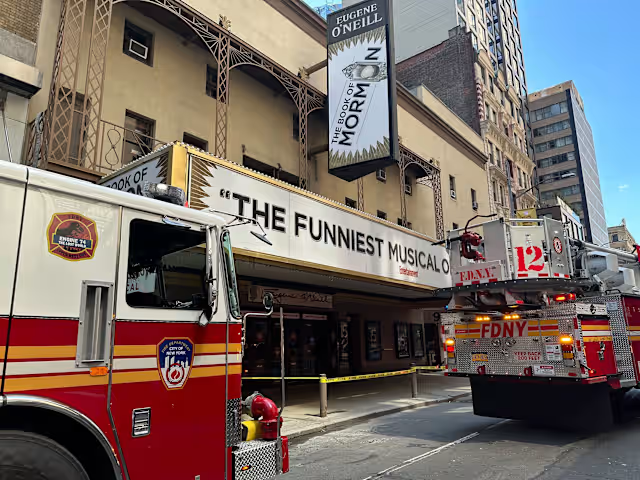
A sudden electrical fire at one of Broadway’s most iconic venues has forced the closure of the Eugene O’Neill Theatre, home to the long-running musical The Book of Mormon, raising fresh concerns about safety, infrastructure, and the fragility of live theatre operations in New York’s famed entertainment district.
The blaze broke out Monday morning inside an electrical room within the theatre, quickly escalating into a three-alarm fire that required a large-scale response from the New York City Fire Department.

AD: Capeesh Restaurant
Fire officials said the flames spread through areas dense with lighting equipment and stage rigging, making it difficult to contain and forcing firefighters to battle the blaze from multiple angles, including the roof.
Despite the intensity of the fire, all staff and personnel were safely evacuated from the building, and only one firefighter suffered minor injuries during the operation. The incident, has left the historic venue temporarily out of service, with significant damage reported to upper floors and backstage areas critical to production operations.
The theater’s owner confirmed that performances have been suspended indefinitely while authorities assess the structural and electrical damage. It remains unclear how long repairs will take, though early indications suggest that reopening may not be immediate.

AD: Oysterian Sea Food Restaurant And Bar
Audiences and performers alike, the disruption is particularly striking given the prominence of the production housed within the venue. Since its debut in 2011, The Book of Mormon has become one of Broadway’s most successful and enduring shows, with thousands of performances and multiple awards cementing its place in theatrical history.
Initial investigations indicate that the fire originated in a complex electrical system located between the fourth and fifth floors, an area that houses key technical infrastructure including lighting rigs and chandelier systems integral to the theater’s productions. The flames then spread toward the roof, where access challenges slowed containment efforts.
Fire officials described the incident as “deep-seated,” a term often used when flames penetrate structural or mechanical systems, making them harder to extinguish. The presence of catwalks, rigging, and tightly packed equipment hallmarks of Broadway stage design further complicated the response.
In addition to fire damage, water used to extinguish the blaze has affected other parts of the building, potentially compounding the scale of repairs needed. Authorities from the city’s Department of Buildings are expected to conduct a thorough inspection before any timeline for reopening can be established.
The closure also underscores the vulnerability of historic performance venues. Opened in 1925, the Eugene O’Neill Theatre has hosted a wide range of productions over the decades and remains one of Broadway’s most recognisable stages. Its age and architectural complexity, while part of its charm, can also present challenges when modern electrical systems are integrated into older structures.
With the production team behind The Book of Mormon, the interruption presents logistical and financial challenges. Broadway shows operate on tightly coordinated schedules involving cast, crew, ticketing, and tourism flows. Even a short-term closure can have ripple effects across the industry, from lost revenue to rescheduling difficulties for audiences.
The timing is particularly notable as the musical continues to mark major milestones, including its recent anniversary celebrations and sustained popularity among both domestic and international audiences. The show’s longevity has made it a cornerstone of Broadway’s commercial success, drawing visitors from around the world and contributing significantly to New York City’s cultural economy.
Local businesses surrounding the theater district may also feel the impact. Broadway performances drive foot traffic to nearby restaurants, hotels, and retail outlets, meaning any prolonged shutdown of a major venue can have broader economic implications.
City officials have emphasized that safety inspections will take precedence over any effort to resume performances quickly. While no timeline has been confirmed, stakeholders across the theater community are expected to collaborate closely to ensure both structural integrity and audience safety before reopening.
The incident has also prompted renewed discussion about infrastructure investment across Broadway venues. Many theatre’s, though regularly maintained, rely on aging frameworks that must accommodate increasingly sophisticated stage technologies.
Electrical systems, in particular, are under growing scrutiny given their central role in modern productions and their potential as ignition points in fire-related incidents.
What is clear that the fire has interrupted more than just a performance schedule; it has momentarily dimmed one of the brightest fixtures in New York’s cultural landscape. Whether the shutdown proves brief or prolonged, the incident serves as a stark reminder of the delicate balance between preserving historic venues and ensuring they meet the demands of contemporary theatre.
That tension is the Eugene O’Neill Theatre itself, a nearly century-old building that embodies both the legacy and the limitations of Broadway’s infrastructure.
Like many historic playhouses in the Broadway district, it was not originally designed to accommodate the complex electrical loads, digital lighting systems, and advanced stage mechanics that modern productions such as The Book of Mormon require.
Retrofitting these systems into older structures can introduce vulnerabilities, particularly when wiring, access points, and ventilation systems are constrained by architecture that predates current safety standards.
The incident is likely to prompt wider industry reflection. Theater owners, producers, and city regulators may face renewed pressure to accelerate upgrades, conduct more frequent inspections, and invest in fire prevention technologies that are tailored to performance spaces.
While Broadway has long maintained strict safety codes, events like this highlight how quickly a localized fault can escalate into a major disruption.
There is also a human dimension to the shutdown that extends beyond infrastructure. Cast members, stagehands, musicians, and front-of-house staff now find themselves navigating uncertainty, even if temporarily. Broadway is not just a workplace but a community built on continuity and routine both of which have been abruptly interrupted.
Yet if history is any guide, the theatre district has proven remarkably resilient. Past fires to economic downturns and global crises, Broadway has repeatedly found ways to recover and adapt. The challenge now will be to ensure that when the curtain rises again at the Eugene O’Neill Theatre, it does so on a stage that is not only restored, but strengthened for the future.

AD: Heritage And Restaurant Lounge Bar