
By Aaron Miller-
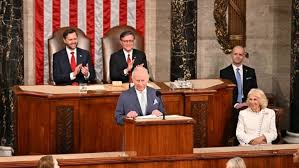
King Charles III drew repeated applause and a standing ovation during a historic address to the United States Congress in Washington, after praising the American constitutional principle of “checks and balances” and its role in limiting executive power.
The moment, which briefly electrified the chamber, came as part of a carefully choreographed state visit intended to reinforce the UK–US alliance at a time of political strain and global instability.

AD: Capeesh Restaurant
The King’s remarks, delivered on the second day of his four-day visit, referenced the shared legal and democratic heritage between Britain and the United States.
But it was his explicit acknowledgement of the constitutional separation of powers especially the idea that presidential authority is constrained by institutional oversight that triggered the strongest reaction from lawmakers, many of whom rose to their feet in applause.
According to live reporting from the chamber, members of Congress responded enthusiastically when the King stated that executive authority in the United States is “subject to checks and balances,” a principle he linked to Magna Carta and the evolution of English common law.

AD: Oysterian Sea Food Restaurant And Bar
The speech, delivered in front of a joint session of Congress, marked only the second time a reigning British monarch has addressed the US legislature, following Queen Elizabeth II’s visit in 1991. The moment was widely described by lawmakers as both ceremonial and symbolic, reinforcing diplomatic ties while acknowledging the long and complex history between the two nations.
Historic
The address was carefully framed around themes of shared history, democratic evolution, and institutional resilience. King Charles referred to the American Revolution as a defining moment that emerged from what he called “shared democratic values” between Britain and its former colonies, particularly disputes over representation and governance.
He noted that while the United States broke away from the British Crown, it inherited many of the legal and constitutional traditions that continue to shape its political system today. That argument resonated strongly in the chamber, where members from both parties frequently applauded references to the Magna Carta, the US Constitution, and the evolution of parliamentary democracy.
At one point, the King described the separation of powers as part of a “great inheritance” passed from Britain to the United States, prompting visible reactions across the chamber. Lawmakers were seen standing and applauding as he emphasised that executive authority must remain constrained by law and institutional oversight.
The White House and congressional leadership had coordinated closely on the tone of the speech, which was intended to be celebratory rather than political.
However, the reference to constitutional limits on executive power inevitably carried contemporary resonance in Washington, where debates over presidential authority remain sharply contested.
The speech also placed the current US–UK relationship in a broader historical frame, positioning it as a partnership that has evolved from former adversaries to close allies bound by shared democratic principles.
King Charles highlighted cooperation in global conflicts, intelligence sharing, and economic ties, while noting that the modern world presents challenges too complex for any single nation to address alone.
The address took place against a backdrop of strained geopolitical conditions, including disagreements between Washington and London over foreign policy priorities and ongoing instability in the Middle East. Despite these tensions, both governments have sought to present the visit as a reaffirmation of the so-called “special relationship.”
Recent reporting from Washington highlighted how the King’s visit is being used as a diplomatic reset moment, with President Donald Trump hosting the monarch at the White House and publicly praising the historic ties between the two countries.
The state visit has also been framed as a symbolic effort to reinforce unity at a time when Western alliances are under pressure. In his speech, King Charles acknowledged that the global landscape is “more volatile and more dangerous” than at the time of his mother’s 1991 address, reflecting growing concerns about conflicts and shifting international alignments.
The visit has included a series of high-profile diplomatic engagements, including a White House reception, a state banquet, and bilateral meetings focused on defence cooperation and economic ties. The itinerary also includes commemorative events linked to the 250th anniversary of American independence, underscoring the historical significance of the visit.
In Washington, officials and commentators broadly framed King Charles’s congressional address as a clear example of successful soft diplomacy, highlighting the unusually warm bipartisan response as evidence of continued goodwill toward the British monarchy despite periodic political disagreements between the two governments.
Chinese state news agency described the visit as a moment that “underscored the enduring importance of the US–UK alliance” and emphasised the monarch’s role in reinforcing diplomatic stability through ceremonial influence and shared historical ties, rather than formal policy-making .
Its similarly reported that the speech “captivated both Republican and Democratic lawmakers,” noting multiple standing ovations and a rare moment of unity in a deeply divided Congress, which officials interpreted as a strong signal of bipartisan respect for the UK’s symbolic role in the relationship .
Meanwhile, The Sun highlighted the emotional reaction inside the chamber, describing “howls of applause” and repeated standing ovations as King Charles referenced democratic principles such as checks and balances, reinforcing the perception that the visit successfully strengthened transatlantic goodwill at a sensitive geopolitical moment .
Analysts noted that the King’s remarks were carefully balanced to avoid direct political commentary while still acknowledging the institutional foundations of American democracy. The emphasis on constitutional checks and balances was seen as a neutral but powerful affirmation of shared democratic norms.
The reaction inside Congress underscored the continued symbolic influence of the British monarchy in international diplomacy. While the King holds no political authority over US affairs, his ability to evoke historical continuity and constitutional principles remains a notable feature of modern royal diplomacy.
While the state visit continues, attention will now turn to how both governments translate ceremonial goodwill into practical cooperation on defence, trade, and global security challenges. But for a brief moment in the House chamber, applause for “checks and balances” reflected not just historical reflection, but a reaffirmation of democratic ideals shared across the Atlantic.

AD: Heritage And Restaurant Lounge Bar