
By Isabelle Wilson-
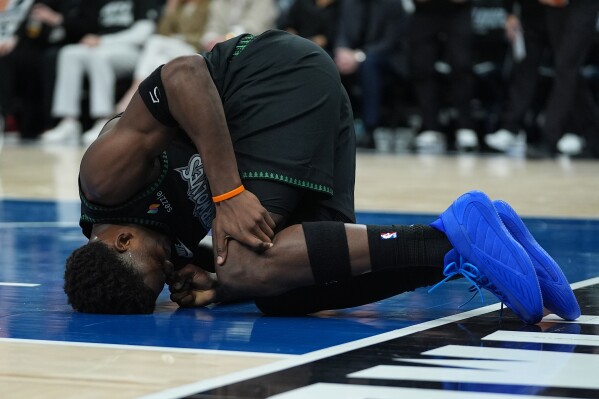
The Minnesota Timberwolves have confirmed that star guard Anthony Edwards has avoided structural damage in his left knee following a worrying injury scare, but he will still be sidelined for at least one week as he recovers from a bone bruise and hyperextension.
The announcement, made on Monday, brings a sense of relief to the franchise and its supporters, even as it creates immediate questions about how the team will navigate a crucial stretch of their season without their leading scorer.

AD: Capeesh Restaurant
Edwards suffered the injury during Game 4 of Minnesota’s first-round playoff series against the Denver Nuggets, when he landed awkwardly in the second quarter while driving to the basket. He briefly remained in the game before heading to the locker room for evaluation.
Subsequent medical imaging, including an MRI scan, confirmed that while the injury is painful and requires rest, there is no ligament or structural damage, significantly reducing concerns over a long-term absence.
The Timberwolves officially diagnosed the injury as a left knee hyperextension accompanied by a bone bruise, categorising Edwards as week-to-week. While the timeline is relatively short in the context of knee injuries, the team has been cautious in framing expectations, emphasising that recovery will depend on how the knee responds to treatment and rest over the coming days.

AD: Oysterian Sea Food Restaurant And Bar
With Minnesota, the news is a mixed outcome. On one hand, avoiding structural damage such as ligament tears or meniscus complications is a major positive, particularly during the high-intensity environment of the NBA playoffs. On the other, losing Edwards even temporarily removes a primary offensive engine at a time when every possession carries heightened importance.
Inside the Timberwolves organisation, there is cautious optimism that Edwards’ absence will be limited. Team officials have stressed that his condition is being evaluated daily, and the expectation remains that he could return as early as next week if recovery progresses without setbacks. Still, his availability for the remainder of the current series and potentially the early stages of the next round remains uncertain.
Head coach Chris Finch and the medical staff are believed to be prioritising long-term health over short-term urgency, especially given Edwards’ history with knee-related issues earlier in his career. The decision to rule out structural damage has eased immediate fears, but the franchise is clearly aware that rushing a return could risk aggravating the injury.
Veteran guard Mike Conley acknowledged the balance the team must strike between competitiveness and caution, noting that while Edwards’ presence is crucial, his health takes precedence. The sentiment reflects a broader understanding within the organisation that postseason success cannot come at the expense of the franchise cornerstone’s long-term durability.
Anthony Edwards has firmly established himself as the engine of the Minnesota Timberwolves’ offence, carrying the team with elite scoring production and a rapidly expanding all-around game. The 24-year-old guard is averaging 28.8 points per game this season, placing him among the NBA’s top scorers and reinforcing his status as the focal point of Minnesota’s attack.
His consistent offensive output has been central to the Timberwolves’ success, with the team averaging 118.6 points per game when he is on the court, underscoring just how heavily their system relies on his presence and shot creation.
Edwards’ combination of explosive athleticism, downhill pressure, and perimeter scoring has made him one of the most difficult matchups in the league, regularly drawing the opposition’s top defenders and forcing constant defensive adjustments.
With his ability to generate offence both on and off the ball, he has evolved into not only Minnesota’s leading scorer but also its emotional and tactical centrepiece during a pivotal stage of the season.
Without him, the Timberwolves are expected to lean more heavily on their supporting cast, including Karl-Anthony Towns and veteran contributors who will need to shoulder additional offensive responsibility. The team’s depth will be tested, particularly against a Denver squad that has already demonstrated resilience in the series.
NBA analysts have pointed out that Minnesota’s offensive structure may need to become more ball-movement oriented in Edwards’ absence, with fewer isolation possessions and a greater emphasis on perimeter shooting and interior efficiency. While this adjustment could initially disrupt rhythm, it may also offer opportunities for other players to step into expanded roles.
The timing of the injury is particularly challenging given the intensity of playoff competition. Reports by multiple outlets, Edwards’ status will continue to be updated on a week-to-week basis, meaning his return could align with a critical juncture in the series or potentially the start of the next round if Minnesota advances.
Despite the setback, there is a clear sense within the organisation that the worst-case scenario has been avoided. A bone bruise and hyperextension, while painful and limiting in the short term, typically carry a significantly better prognosis than ligament damage or fractures. That distinction has shaped the cautious optimism surrounding his recovery timeline.
The Timberwolves must prepare to compete without their brightest offensive star, even as they hope his absence proves brief. The next week will be decisive not just for Edwards’ recovery, but for Minnesota’s ability to maintain momentum in one of the most demanding stretches of their season.
Without his scoring punch and ability to bend defences, the responsibility will shift across a reshaped core that now includes Julius Randle, Rudy Gobert, Mike Conley, Jaden McDaniels, Naz Reid and Donte DiVincenzo, each of whom will need to elevate their impact in different ways.
Randle is expected to take on a larger burden as a secondary shot creator, especially in half-court possessions where Edwards typically generates advantages off the dribble. Conley’s experience and control will become even more important in organising the offence and managing tempo, particularly in late-game situations where Minnesota can no longer rely on Edwards’ isolation scoring.
McDaniels and DiVincenzo will be tasked with increasing perimeter aggression, both in terms of scoring and defensive pressure, while Gobert’s interior presence becomes central to maintaining efficiency around the rim on both ends of the floor. Naz Reid, often a spark off the bench, may also see expanded minutes as the team searches for additional offensive versatility.
Defensively, the Timberwolves may remain stable, but offensively the margin for error narrows significantly without Edwards’ explosive creation. That means cleaner execution, smarter shot selection, and improved ball movement will be essential if Minnesota is to weather this short-term setback. The coming games will test not only depth, but the team’s ability to adapt its identity on the fly.

AD: Heritage And Restaurant Lounge Bar