
By Theodore Brown-
New York City is set to transform into a citywide celebration hub for the 2026 FIFA World Cup, with officials announcing a series of free fan events spread across all five boroughs.
The initiative, unveiled jointly by city and state leaders alongside the tournament’s New York–New Jersey host committee, is designed to bring live match screenings, cultural programming, and community festivities directly into neighbourhoods ensuring residents can experience the global tournament without paying stadium-level prices.

AD: Capeesh Restaurant
The announcement comes as anticipation builds for one of the largest sporting events ever hosted in the region, with MetLife Stadium in nearby New Jersey scheduled to stage multiple matches, including the final.
City officials say the borough-based fan events will serve as a parallel experience, giving millions of New Yorkers access to the atmosphere of the World Cup in familiar public spaces.
The planned events will be distributed across iconic locations in each borough, including major public spaces and cultural landmarks. According to city officials, Queens will host one of the largest gatherings at the USTA Billie Jean King National Tennis Center, while Manhattan’s Rockefeller Center will become a central hub for late-stage matches.

AD: Oysterian Sea Food Restaurant And Bar
Brooklyn Bridge Park, Bronx Terminal Market, and Staten Island’s community park system will also host live screenings and related programming throughout the tournament period.
Officials say the programming will extend across much of the tournament window, creating a continuous public viewing experience that spans nearly six weeks. The fan zones are expected to feature large outdoor screens showing live matches, food vendors, musical performances, and cultural events reflecting the city’s diverse communities.
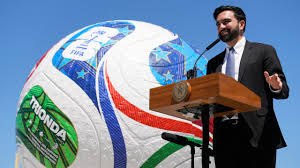
City leaders have framed the initiative as both a cultural and economic opportunity. Speaking at the announcement, Mayor Zohran Mamdani said the goal is to ensure that “every fan should be able to watch the greatest tournament on Earth without having to dip into their savings,” highlighting concerns about rising ticket and travel costs for stadium matches.
Governor Kathy Hochul added that the World Cup is expected to bring more than one million visitors to the region and generate billions in economic activity, with the fan events intended to spread that impact beyond stadium zones into local neighbourhood economies.
While the free events are being celebrated as a major step toward accessibility, officials acknowledge that hosting such large-scale public gatherings across multiple boroughs presents significant logistical challenges. Security planning is expected to be a major focus, particularly given the scale of crowds anticipated for key matches and the international profile of the tournament.
Transportation is also expected to play a critical role in how successfully the events operate. With millions of additional visitors expected across the metropolitan area, officials are preparing for pressure on transit systems, particularly during peak match days when fan zones may reach capacity.
Despite these challenges, city leaders argue that distributing events across all five boroughs will ease congestion compared to a single centralised fan festival. Through spreading programming across Queens, Brooklyn, Manhattan, the Bronx, and Staten Island, officials say the city can ensure that no single location becomes overwhelmed while still maintaining a unified citywide celebration.
The initiative is also being framed as part of a broader effort to make the World Cup more inclusive. Officials say previous host cities have sometimes been criticised for limiting access to ticketed venues or centralised fan zones that exclude local communities.
New York’s approach, they argue, is designed to avoid that outcome by embedding the tournament experience directly into neighbourhood public spaces.
Further details on programming schedules, security arrangements, and participating performers are expected in the coming weeks as city agencies refine what is shaping up to be one of the largest public event operations New York has ever hosted.
Planning teams are working through logistics that range from crowd flow and transit coordination to emergency response capacity, with officials signalling that each borough’s fan zone will be tailored to its available public space and expected attendance levels.
Organisers are also expected to release staggered match schedules so that peak fixtures can be distributed across different locations, reducing pressure on any single gathering point while still maintaining a unified citywide experience.
Security planning is likely to remain a central focus as the event draws closer. City officials have indicated that coordination between local police, state authorities, and federal partners will be necessary to manage large, open-access viewing areas over an extended period.
Past international tournaments have shown that fan zones can attract both highly celebratory crowds and unpredictable surges in attendance, particularly for knockout-stage matches, requiring adaptable policing strategies and real-time monitoring systems.
Transport agencies are also expected to play a significant role, with contingency planning underway for subway congestion, road closures, and pedestrian crowd control around major screening sites.
Organisers are working to ensure that the cultural programming reflects New York’s diversity. Early planning discussions suggest that fan zones will not only focus on live match screenings but also include music performances, food festivals, and community-led events designed to engage residents who may not typically attend sporting events.
This broader approach is intended to position the World Cup as both a global sporting spectacle and a citywide cultural festival, reinforcing New York’s identity as a hub for international communities.
Economic expectations are also beginning to take shape, with local businesses anticipating increased foot traffic across retail, hospitality, and entertainment sectors during the tournament period.
However, officials have also acknowledged the need to balance economic opportunity with public safety and quality of life for residents, particularly in densely populated neighbourhoods where large gatherings could affect daily routines.
Despite the complexity of the planning process, the overarching message from city officials remains consistent. When the World Cup arrives in 2026, New York City is expected to temporarily transform beyond its role as a host city and instead function as a vast, interconnected viewing arena.
Waterfront parks to landmark plazas and neighbourhood hubs, the tournament will extend far beyond stadium walls, turning everyday public spaces into shared stages for a global sporting event watched in real time by millions.

AD: Heritage And Restaurant Lounge Bar