
By Aaron Miller-
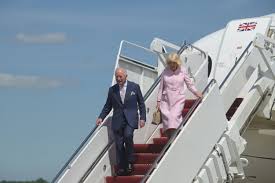
King Charles III has arrived in the United States on what is being widely described as one of the most delicate diplomatic missions of his reign, with the four-day state visit aimed at reinforcing the increasingly strained relationship between London and Washington.
The visit, which coincides with the 250th anniversary of American independence, carries both symbolic weight and political urgency as tensions between the two allies continue to surface.

AD: Capeesh Restaurant
The King, accompanied by Queen Camilla, landed in Washington to a formal reception marked by ceremony but overshadowed by a complex geopolitical backdrop.
Relations between the United Kingdom and the United States have been tested in recent months, with disagreements over foreign policy particularly concerning military tensions involving Iran contributing to friction between Prime Minister Keir Starmer and President Donald Trump.
Despite these tensions, the visit has been framed by both governments as an opportunity to reaffirm the long-standing “special relationship” that has historically bound the two nations through shared strategic, economic and cultural ties. Buckingham Palace has emphasised that the King’s role is to reinforce continuity and goodwill, even as political differences persist beneath the surface.

AD: Oysterian Sea Food Restaurant And Bar
The significance of the trip is amplified by its rarity. It marks the first state visit to the United States by a British monarch in nearly two decades and is regarded by analysts as the most diplomatically sensitive overseas engagement of Charles’s reign.
Diplomacy Under pressure amid security and political strains
The King’s itinerary reflects a careful balance between ceremonial duties and strategic messaging. Scheduled engagements include a private meeting with President Trump at the White House, a state banquet, a visit to the 9/11 memorial in New York and a highly anticipated address to the US Congress an honour granted to very few foreign leaders and previously delivered by Queen Elizabeth II.
This visit is unfolding against a backdrop of heightened security concerns following a recent shooting at a Washington event attended by senior political figures. While authorities have confirmed that the visit will proceed as planned, the incident has underscored the volatile environment in which the royal delegation is operating.
Diplomatic tensions remain evident. President Trump has signalled that discussions with the King will touch on contentious issues including NATO commitments, trade disputes and differing approaches to international conflicts.
These disagreements have complicated what might otherwise have been a purely ceremonial visit, placing greater emphasis on the symbolic role of the monarchy in maintaining continuity between governments.
Observers note that while the King does not engage directly in political negotiation, royal visits often function as instruments of “soft power,” helping to stabilise relationships during periods of political strain. Charles’s presence is intended to project unity and shared purpose, even as policy differences remain unresolved.
However, the visit has also attracted criticism. It has characterised the trip as an exercise in “damage limitation,” reflecting the extent to which the UK-US relationship is currently under pressure. Critics argue that the political climate risks overshadowing the ceremonial aspects of the visit, potentially limiting its diplomatic impact
The broader significance of the visit lies in its attempt to redefine the meaning of the “special relationship” in a changing global landscape. While the alliance between the UK and the US has historically been grounded in shared history and strategic cooperation, recent years have exposed new tensions and shifting priorities on both sides of the Atlantic.
The visit for King Charles represents an opportunity to emphasise common values such as democracy, environmental responsibility and international cooperation issues that have long been central to his public work. His address to Congress is expected to highlight these themes while reinforcing the enduring ties between the two nations.
The timing of the visit, which coincides with the 250th anniversary of American independence, adds a strong layer of historical symbolism to King Charles III’s trip to the United States.
The occasion marks more than two centuries since the Declaration of Independence, a moment that formally ended British colonial rule in America and set the two nations on very different historical paths before their relationship gradually evolved into close strategic cooperation.
More than 250 years after that rupture, the modern UK–US partnership is now widely regarded as one of the most significant alliances in global geopolitics, built on shared democratic values, security ties and economic interdependence.
This transformation from former adversaries to close allies is underscored by the King’s presence at a milestone moment, which emphasises that the visit comes amid efforts to reinforce the relationship “more than 250 years after the American colonies declared independence from Britain.”
Nevertheless, the visit is taking place in a period of uncertainty. Diplomatic disagreements, domestic political pressures and broader geopolitical tensions have all contributed to a more fragile transatlantic relationship. Reports suggest that disputes over trade, military policy and even territorial issues have added to the strain, highlighting the challenges facing both governments.
With Charles, the challenge is to navigate these complexities while maintaining the neutrality expected of a constitutional monarch. His role is not to resolve disputes directly, but to provide a steadying presence that reinforces the long-term stability of the relationship.
Its success will likely be measured not by immediate policy outcomes but by its ability to restore confidence and goodwill between the two nations. King’s presence in Washington serves as both a reminder of the depth of the UK-US alliance and a recognition of the work required to sustain it in an increasingly uncertain world.
The visit places emphasis on symbolism, continuity and reassurance at a time when diplomatic relations are being tested by shifting political priorities, global security concerns and occasional policy disagreements between London and Washington.
Rather than producing concrete agreements, the trip is expected to function as a stabilising moment, reinforcing shared history and institutional ties that have long underpinned cooperation between the two countries.
The real value of the visit lies in its capacity to project unity and mutual respect, even when governments face differences on issues such as defence commitments, trade policy or international crises. The monarchy’s constitutional neutrality allows it to operate as a consistent diplomatic bridge, offering a sense of continuity that transcends electoral cycles and political change.
The King’s engagement is in this context less about immediate outcomes and more about reinforcing long-term trust, ensuring that the relationship retains its strategic importance despite external pressures and evolving global dynamics.

AD: Heritage And Restaurant Lounge Bar