
By Lucy Caulkett-
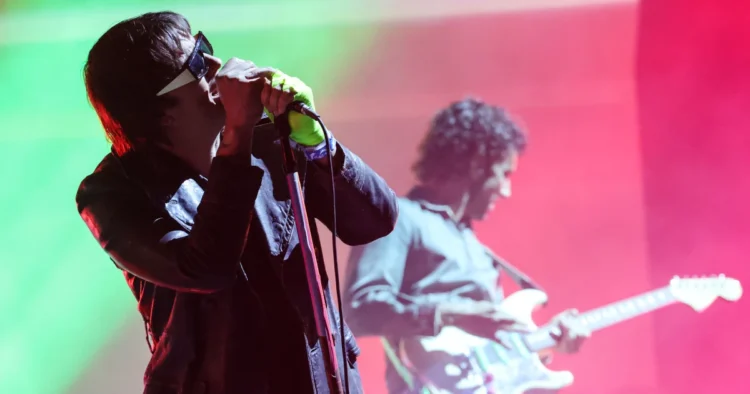
The Strokes closed their Coachella set with a searing political statement that has quickly become one of the festival’s most debated moments, blending live music with a provocative video montage condemning US foreign policy.
Performing on the main stage during the second weekend of the Coachella Valley Music and Arts Festival, the New York band ended their show with visuals depicting global conflict, alleged covert interventions and recent bombings in the Middle East.

AD: Capeesh Restaurant
The footage, played during their song “Oblivius,” featured stark imagery and political messaging that directly criticised actions attributed to the United States government.
Frontman Julian Casablancas repeatedly echoed the refrain “What side are you standing on?” as the montage unfolded, before the band exited the stage without further comment. The performance marked a dramatic escalation from earlier remarks made during the festival’s first weekend, when Casablancas had already alluded to US military policy in a more satirical tone.
The visuals displayed behind the band went beyond general protest imagery, presenting a pointed critique of US foreign intervention. According to reports, the montage included references to alleged CIA involvement in regime change across countries such as Chile, Bolivia and the Democratic Republic of the Congo, alongside historical figures associated with those events.

AD: Oysterian Sea Food Restaurant And Bar
The sequence culminated in footage of bombings in Gaza and Iran, paired with captions that attributed responsibility to Israel and the United States. The inclusion of both historical and contemporary material created a narrative linking past interventions to present-day conflicts, amplifying the political weight of the performance.
Political messaging is not new to Coachella, the scale and directness of the Strokes’ statement stood out. The festival, known for its global audience and livestream reach, has often been a platform for artists to address social issues. However, performances that explicitly accuse governments of wrongdoing particularly using graphic visual material remain relatively rare.
The band did not issue an immediate public statement following the performance, and organisers of the festival have not commented on the content of the video. Nonetheless, the moment was broadcast widely, ensuring that its impact extended far beyond the desert setting of the event.
Divided reaction and political echoes
Reaction to the performance has been swift and polarised. Online discussions have ranged from praise for the band’s willingness to use their platform for political expression to criticism of what some see as oversimplified or controversial claims.
On social media forums, some viewers described the performance as “shocking” and “bold,” noting that such overt political messaging is uncommon on a stage as commercially significant as Coachella. Others questioned the framing of the video, arguing that it presented a selective view of complex geopolitical issues.
The incident also reflects a broader trend of musicians re-engaging with political activism in high-profile settings. In recent years, artists across genres have increasingly used festival appearances to address issues ranging from climate change to international conflict. The Strokes themselves have a history of political involvement, having previously performed at campaign events and benefit concerts.
What distinguishes this moment is the convergence of timing, content and platform. With ongoing tensions in the Middle East dominating global headlines, the decision to foreground those conflicts in such a direct manner has heightened both the visibility and the controversy of the performance.
Music industry analysts suggest that such moments can carry both risks and rewards. While they may alienate some audiences or provoke backlash, they can also reinforce an artist’s identity and deepen engagement with fans who share similar views.
At Coachella, the episode underscores the evolving nature of festival culture. Once primarily a showcase for music and celebrity, it has increasingly become a space where cultural, social and political debates play out in real time.
The Strokes have reignited a familiar debate about the role of musicians in political discourse. In doing so, they have ensured that their Coachella Valley Music and Arts Festival set will be remembered not just for its sound, but for the statement it made and the questions it leaves behind.
Popular music has functioned as a vehicle for protest, from the anti-war anthems of the 1960s to more recent calls for social and political reform. Artists have long grappled with how far to push their messaging, particularly when performing on global stages tied to commercial interests.
What distinguishes this moment is the immediacy and scale of the reaction. In an era defined by instant sharing and algorithm-driven visibility, a single performance can reverberate across the world within minutes, drawing in audiences far beyond those physically present. The band’s decision to deliver such a pointed critique in a festival setting raises broader questions about expectation and responsibility.
Should artists use their platform to challenge political power, or does doing so risk oversimplifying complex international issues for the sake of impact? Supporters argue that musicians, like any public figures, have the right and perhaps the obligation to speak out. Critics counter that large-scale performances are ill-suited to nuanced debate, reducing serious matters to slogans and imagery.
There is also the question of audience reception. Festivals like Coachella attract diverse crowds, many of whom may not anticipate or welcome overt political messaging. Yet others view such interventions as a vital disruption, a reminder that entertainment does not exist in a vacuum.
The tension between these perspectives is not new, but it has become more pronounced as global events increasingly intersect with cultural spaces.
Industry observers note that moments like this can have lasting consequences for both artists and organisers. With the performers, taking a clear stance can strengthen loyalty among some fans while alienating others. With festivals, it raises the issue of how much editorial control should be exercised over content, particularly when performances are broadcast to international audiences.
The Strokes’ finale confirms a shifting landscape in which music, politics and media are more tightly intertwined than ever. Whether seen as an act of courage or controversy, it highlights the enduring power of live performance to provoke, unsettle and inspire.

AD: Heritage And Restaurant Lounge Bar