
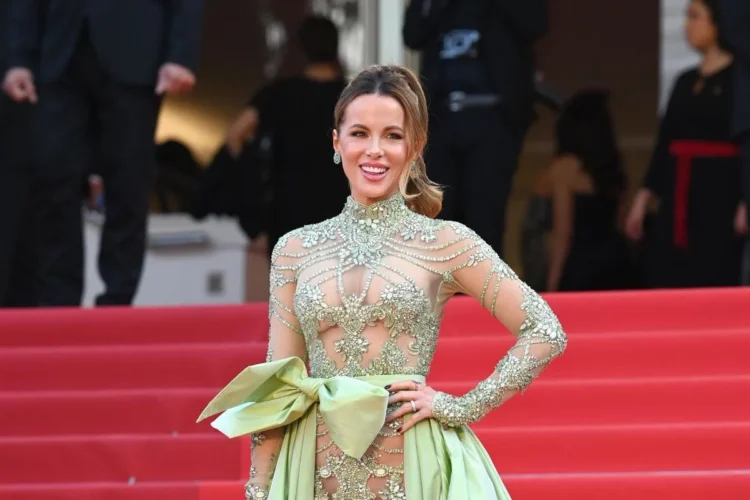
By Lucy Caulkett-
British actress Kate Beckinsale has reportedly found herself at the center of a growing debate over free expression in the entertainment industry after claiming she was dropped by her agent for engaging with a social media post calling for a ceasefire in Gaza.
The allegation, which has not yet been publicly confirmed by the unnamed agent or agency, has sparked widespread discussion about the boundaries of political speech, the pressures faced by public figures, and the increasingly fraught intersection between celebrity influence and global conflict—particularly in relation to the ongoing crisis in Gaza Strip.

AD: Capeesh Restaurant
According to reports circulating across entertainment and media outlets, Beckinsale’s alleged dismissal stemmed not from a formal public statement, but from a relatively subtle act: “liking” a post on social media. The post in question reportedly called for an immediate ceasefire amid escalating violence in the region.
While liking a post might once have been considered a minor, even ambiguous gesture, in today’s hyper-politicized and highly scrutinized digital landscape, such actions are often interpreted as endorsements of specific political positions.

AD: Oysterian Sea Food Restaurant And Bar
The reported incident highlights the growing sensitivity surrounding the conflict in Gaza, where renewed violence has drawn international concern and polarized public opinion. The situation in the region has become a litmus test for public figures, many of whom face intense scrutiny regardless of the stance they take—or even if they attempt to remain neutral.
Calls for a ceasefire, while supported by humanitarian organisations and segments of the global public, have also become politically charged, particularly in Western countries where discussions around the conflict are deeply intertwined with broader geopolitical alliances and domestic political considerations.
For Beckinsale, a long-established figure in British and Hollywood cinema known for roles in films ranging from period dramas to action franchises, the reported fallout with her agent underscores the professional risks that can accompany even minimal engagement with contentious issues.
While actors and other creatives have historically used their platforms to advocate for social and political causes, the current climate appears to have raised the stakes significantly.
Industry insiders note that talent agents often operate with a keen awareness of how their clients are perceived by studios, brands, and audiences. In an era where social media activity can be instantly amplified and dissected, agencies may adopt increasingly cautious approaches to managing reputational risk. If Beckinsale’s account is accurate, it suggests that even passive forms of engagement—such as liking a post rather than sharing or creating one—can trigger professional consequences.
The reported decision to sever ties over such an action has prompted questions about the limits of personal expression within professional relationships in the entertainment world. Agents are typically responsible for securing roles, negotiating contracts, and guiding career trajectories, but their influence can extend into advising clients on public image and conduct.
This dynamic raises a fundamental question: to what extent should representatives have a say in the personal or political expressions of the individuals they represent? Supporters of Beckinsale have argued that the alleged incident represents an overreach and a troubling sign of self-censorship within the industry.
They contend that calling for a ceasefire—generally framed as a humanitarian appeal to halt violence and protect civilian lives—should not be grounds for professional repercussions. From this perspective, the situation reflects a broader pattern in which voices advocating for de-escalation or humanitarian considerations may face backlash or marginalization.
Critics, however, point out that agents and agencies operate within a complex ecosystem where public perception can directly impact financial outcomes. Film studios, streaming platforms, and corporate partners may be wary of controversy, particularly when it involves highly sensitive geopolitical issues.
In this context, decisions about representation may be influenced less by ideology and more by calculations about marketability and risk management.
The entertainment industry has long grappled with questions of political engagement, but the rise of social media has transformed the landscape. Platforms such as Instagram, X (formerly Twitter), and others have blurred the lines between personal and professional identities, making it difficult for public figures to separate their private views from their public personas. A single interaction—whether a like, share, or comment—can quickly become a headline, as appears to be the case here.
The situation also reflects the broader challenges faced by celebrities navigating the Gaza conflict. The crisis has elicited strong reactions across the globe, with many public figures speaking out in support of either Israeli or Palestinian perspectives, while others attempt to emphasize humanitarian concerns without aligning themselves with a particular political stance. In many cases, even carefully worded statements have been met with criticism, highlighting the difficulty of addressing such a deeply complex and emotionally charged issue in a public forum.
The reported fallout may have both immediate and longer-term implications for Beccksline Losing representation can disrupt ongoing negotiations, affect future opportunities, and create uncertainty about career direction. At the same time, the visibility of the controversy could also galvanize support from fans and peers who view the situation as emblematic of broader issues within the industry.
It remains unclear whether Beckinsale plans to seek new representation or to address the matter further in a public statement. As of now, the lack of confirmation from the agent involved leaves some aspects of the story open to interpretation. Nevertheless, the discussion it has sparked is unlikely to fade quickly.
The reported incident comes at a time when debates over free speech, accountability, and professional consequences are intensifying across multiple sectors, not just entertainment. From academia to corporate environments, individuals are increasingly aware that their online activities can have real-world repercussions. For public figures, whose platforms are inherently more visible, the stakes are even higher.
In this context, Beckinsale’s experience—if substantiated—may serve as a cautionary tale about the evolving expectations placed on celebrities and the potential costs of engaging with contentious issues, even in seemingly minor ways. It also raises broader questions about the role of artists and entertainers in public discourse.
Should they be encouraged to use their platforms to advocate for causes they believe in, or should they exercise restraint to avoid jeopardizing their careers?
There is no easy answer, and opinions are likely to remain divided. What is clear, however, is that the boundaries between personal expression and professional consequence are becoming increasingly blurred. As the situation in Gaza continues to unfold and global attention remains fixed on the region, the pressures on public figures to navigate these complexities will only intensify.
The focus remains on Beckinsale and the reported circumstances surrounding her departure from her agent. Whether the incident leads to tangible changes in how the entertainment industry approaches social media engagement remains to be seen. But it has already contributed to a wider conversation about the costs of speaking out—or even appearing to do so—in an age where every digital interaction can carry significant weight.
As audiences, industry professionals, and observers continue to debate the implications, one thing is certain: the intersection of celebrity, politics, and social media is more consequential than ever. And for figures like Kate Beckinsale, navigating that terrain may prove to be as challenging as any role they have played on screen.

AD: Heritage And Restaurant Lounge Bar
-
Share On
- Categories
- Date