
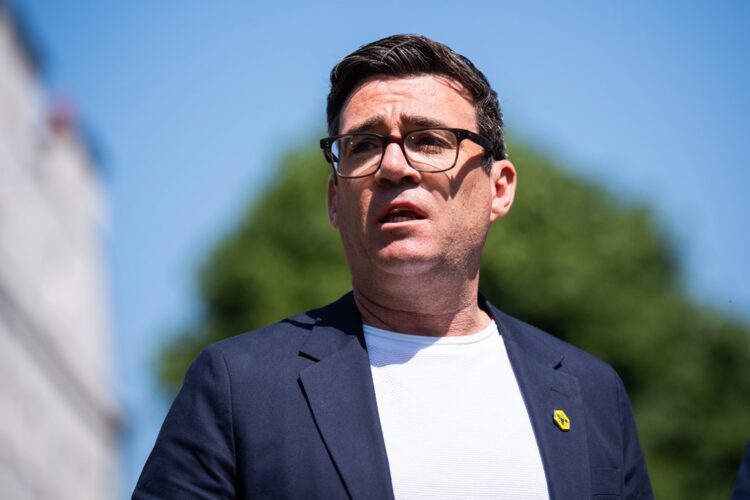
By Ben Kerrigan-
Prime Minister vows to make Britain a world leader in dementia research, with £33m in government funding and backing from major pharmaceutical companies aimed at accelerating clinical trials and the search for effective treatments.
Andy Burnham has pledged to make dementia research a national priority, announcing a £48 million partnership between the Government and major pharmaceutical companies in an ambitious drive to accelerate the development of treatments and bring the prospect of a cure closer to reality.

AD: Capeesh Restaurant
The announcement carries a deeply personal significance for the Prime Minister, whose father, Roy, died last month after suffering from Alzheimer’s disease. Speaking ahead of Friday’s Innovation Nation Summit in Manchester, Mr Burnham said Britain should no longer accept dementia as an inevitable consequence of ageing, declaring that he wanted the country to deliver the scientific breakthrough that millions of families affected by the disease have been waiting for.
The £48 million initiative will combine £33 million in government funding with investment from pharmaceutical companies Bristol Myers Squibb and GSK, alongside Gates Ventures, the investment and philanthropic organisation founded by Bill Gates.

AD: Oysterian Sea Food Restaurant And Bar
The money will support The Barbara Alliance, a partnership established in memory of the late EastEnders actress Dame Barbara Windsor, whose highly public battle with Alzheimer’s helped bring the devastating consequences of dementia to national attention.
At the heart of the initiative is a new platform designed to connect health data, research institutions and clinical trial capabilities, making it easier for scientists to identify suitable participants and recruit them into studies. By addressing one of the persistent obstacles to dementia research—the difficulty of finding and enrolling enough eligible participants—the partnership aims to help promising treatments progress through clinical development more quickly.
Mr Burnham said the country needed to move beyond an approach that concentrated primarily on managing the condition after diagnosis and instead commit itself to the possibility of preventing, treating and ultimately defeating the disease.
“Dementia is a devastatingly cruel disease, not only for those who live with it, but for the families who care for them,” he said. “For too long, we have accepted dementia as something to be managed later in life, rather than a disease we can defeat. I don’t accept that.”
He added: “I want Britain to be the country that makes the breakthrough and delivers the cure for dementia the world has been waiting for.”
The Prime Minister said the investment would bring together the NHS, universities, researchers and private industry in an effort to accelerate scientific progress, while forming part of a wider commitment to improving the care available to people living with dementia and the families supporting them.
The announcement represents a significant statement of political ambition, although the development of a cure remains uncertain. Dementia encompasses a range of conditions, including Alzheimer’s disease, that affect memory, cognition and everyday functioning. Researchers are investigating different biological mechanisms and potential treatments, but the complexity of the diseases means that a funding commitment, however substantial, cannot guarantee when a breakthrough might occur or whether it will result in a single treatment capable of curing all forms of dementia.
The Government is also making dementia one of the principal priorities of the new Health Data Research Service, which is backed by up to £600 million from the Government and the Wellcome Trust. The service is intended to bring NHS and research data together through a common system, helping scientists identify people who may be suitable for particular clinical trials and potentially reducing delays in the development of new treatments.
One project is understood to involve GSK using health data to investigate a possible association between its shingles vaccine and a reduced risk of dementia. Such research could provide valuable evidence about whether vaccination is linked to changes in dementia risk, although an association would not, by itself, establish that the vaccine directly prevents the disease. Any conclusions would depend on the quality of the evidence and the results of the research.
Health and Social Care Secretary Yvette Cooper said the investment would help accelerate diagnosis, expand access to clinical trials and improve the prospects of developing treatments capable of changing the lives of people affected by dementia.
She also stressed that scientific progress must be accompanied by better care, arguing that families should not be left to navigate the challenges of dementia without adequate support. The Government intends to make dementia care a central priority of its proposed National Care Service, linking the research initiative with a broader commitment to supporting people whose needs may become increasingly complex as their condition progresses.
The involvement of The Barbara Alliance gives the initiative an additional emotional and public dimension. Dame Barbara Windsor, who became a household name through the Carry On films and her portrayal of Peggy Mitchell in EastEnders, was diagnosed with Alzheimer’s disease in 2014 and died in December 2020. Her illness became a cause championed by her husband, Scott Mitchell, who has repeatedly called for greater investment in research and more effective support for families confronting the condition.
Mr Mitchell welcomed the latest announcement, recalling how his wife had personally urged then-prime minister Boris Johnson to provide more funding for dementia. He said the new initiative meant her legacy would extend beyond her celebrated entertainment career and include a lasting contribution to the effort to improve dementia treatment.
“For me, this means Barbara won’t just be remembered for her bra flying off in Carry On Camping, she’s got a second legacy,” he said, expressing excitement about the progress being made and the Government’s commitment to the research programme.
Families who have watched loved ones gradually lose their memories, independence and ability to recognise familiar people, the prospect of more effective treatments carries significance well beyond the laboratory.
Dementia can place enormous emotional and financial pressure on relatives, who often take on substantial caring responsibilities while confronting the uncertainty of a condition that can progress over many years.
Michelle Dyson, chief executive of the Alzheimer’s Society, described the investment as a significant moment for dementia research, welcoming the Government’s ambition to establish Britain as a world leader in the development of new treatments. She said the partnership’s ability to bring together government, industry, researchers and the NHS could help remove barriers to clinical trials and accelerate progress.
The challenge now will be to turn that ambition into measurable results. The £48 million partnership and the wider investment in health data offer researchers additional resources and a potentially more efficient route to identifying trial participants, but their ultimate value will depend on whether they produce stronger evidence, successful treatments and meaningful improvements in patients’ lives.
The commitment is both a matter of public policy and a personal determination to change the future for other families. His pledge that Britain should be the country to make the breakthrough sets an ambitious goal; the test will be whether sustained investment, effective research and better access to care can bring that ambition within reach.

AD: Heritage And Restaurant Lounge Bar