
By Gabriel Princewill-
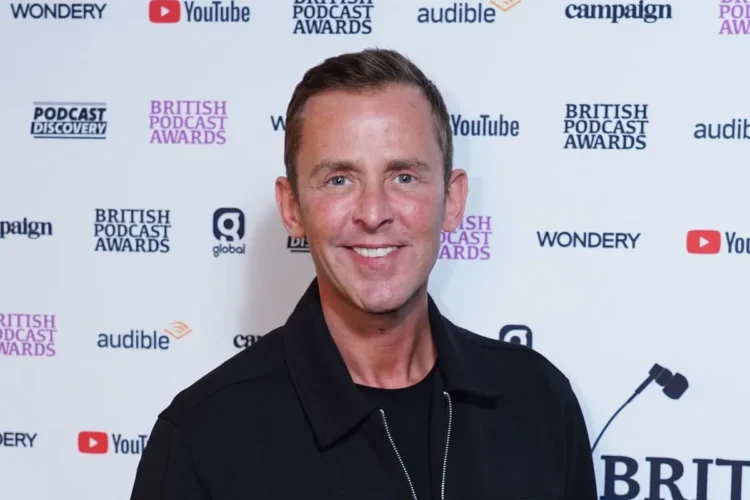
DJ Scott Mills (pictured),has been sacked from the BBC for misconduct, the broadcaster has revealed.
Mills, a veteran presenter with nearly three decades of service, had become one of the defining voices of modern British radio, rising from early morning slots on Radio 1 in the late 1990s to fronting the flagship Radio 2 Breakfast Show—a role that cemented his place among the BBC’s most recognisable and highest-paid personalities.

AD: Capeesh Restaurant
That long-standing relationship came to an abrupt and unexplained end, replaced by a terse corporate statement and a vacuum of public detail.
The BBC confirmed that Mills was “no longer contracted” and had left the organisation, citing concerns relating to “personal conduct” but declining to elaborate further. This phrase,deliberately broad, legally cautious, and institutionally familiar, has become the focal point of intense speculation.

AD: Oysterian Sea Food Restaurant And Bar
Unlike previous high-profile disciplinary cases within the corporation, where suspensions, internal reviews, or external investigations unfolded over weeks or months, Mills’ exit was executed with striking immediacy.
Mills signed off his final broadcast on March 24 with the expectation of returning the following day, only for a replacement presenter to appear without warning. The abruptness has been interpreted by some analysts as evidence that the BBC believed it possessed sufficiently serious or legally robust grounds to act decisively, possibly to avoid reputational damage or accusations of delay.
Internally, the shock was palpable. Staff were informed via an email from senior leadership that acknowledged the unexpected nature of the decision and the likelihood that it would come as a surprise to colleagues who had worked with Mills across multiple platforms.
The reaction among fellow presenters was similarly immediate; some learned of the dismissal moments before going on air. Such reactions underline the extent to which Mills had been embedded within the institutional fabric of the BBC—a figure whose departure would ordinarily have been managed with greater ceremony or transition.
What distinguishes this case most sharply is not merely the dismissal itself, but the near-total absence of publicly confirmed details regarding the alleged misconduct. The BBC’s refusal to expand beyond the phrase “personal conduct” has left a void that has quickly been filled by conjecture, media leaks, and partial reporting.
Some accounts suggest the issue may relate to a “historic” personal matter, potentially dating back more than a decade, though the precise nature of the allegation remains unverified and contested.
This pattern—whereby an institution confirms disciplinary action without disclosing the underlying facts—is not unprecedented, but it is particularly consequential in cases involving public figures of Mills’ prominence.
Timing also plays a role. The decision to remove Mills came at a moment of leadership transition within the BBC, with senior figures preparing to step down or assume interim roles. Some commentators have suggested that resolving a potentially damaging issue swiftly may have been viewed as preferable to allowing it to linger into a new administrative era.
Whether or not this interpretation is accurate, it underpins the extent to which organisational considerations intersect with individual cases in large public institutions.
In recent years, the BBC has taken decisive action against several high-profile figures following substantiated allegations. The dismissal of Gregg Wallace, for example, followed an extensive independent investigation that upheld dozens of complaints spanning nearly two decades, including inappropriate sexual language and behaviour.
Similarly, his co-presenter John Torode was removed after findings that he had used offensive language on set. In these instances, the BBC’s actions were accompanied by detailed findings, providing a clear—if damaging—account of the misconduct in question.
Another case that looms large in the corporation’s recent history is that of Huw Edwards, whose legal troubles and subsequent conviction over criminal offences marked one of the most serious scandals to affect the broadcaster in decades. That episode prompted intense scrutiny of the BBC’s internal processes, including how complaints are handled and when action is taken.
Compared with these cases, the Mills situation appears markedly different. There has been no public report, no confirmed list of allegations, and no indication of an external investigation. Instead, the decision appears to have been made internally and communicated with minimal elaboration.
This contrast raises important questions about consistency: why are some cases accompanied by detailed disclosures while others remain opaque? The answer may lie in the nature of the allegations themselves, the availability of evidence, or the legal risks associated with publication.
At least 200 powerful figures lost jobs due to misconduct allegations. Career collapse due to misconduct allegation has become a pattern, not a rarity. What distinguishes each case is not only the severity of the allegations but the degree of transparency with which they are addressed.
In Mills’ case, the lack of detail has amplified the sense of rupture. Given the fact that Mills is a figure who had been a consistent presence on British airwaves for nearly thirty years, the transition from daily host to dismissed employee occurred with extraordinary and minimal explanation. T
hat contrast between the familiarity of the voice and the abruptness of the silence, may well contributed to the intensity of public reaction.
The dismissal of Scott Mills ultimately sits at the intersection of several competing imperatives: the BBC’s duty to uphold standards, its obligation to protect individuals’ rights, and its need to maintain public trust.
The decision to act swiftly and without detailed explanation reflects a particular balancing of those factors. One that prioritises immediate action over public disclosure. Whether that balance proves sustainable will depend on what, if anything, emerges in the weeks and months ahead.
The story remains defined as much by what is unknown as by what is confirmed. Mills’ career, which spanned from teenage beginnings in local radio to the pinnacle of national broadcasting, has been halted not by a clearly articulated scandal, but by a phrase—“personal conduct”—that conceals more than it reveals.
It is highly unlikely that the alleged misconduct meets the threshhold of a criminal prosecution, although it is quite conceivable that even if it does, there is no will by any alleged victim or the corporation to pursue the matter any further.
In that ambiguity lies both the power and the problem of the BBC’s response It appears to close the case institutionally, whilst leaves it open in the public imagination.

AD: Heritage And Restaurant Lounge Bar
-
Share On
- Categories
- Date