
By Aaron Miller-
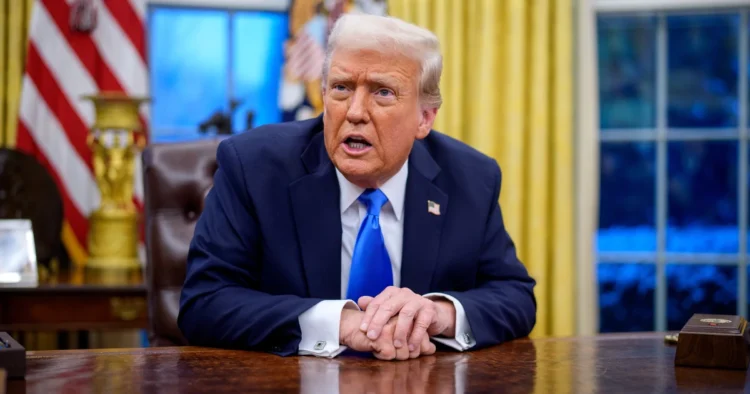
Donald Trump has renewed his threat to “obliterate” Iran’s energy infrastructure unless Tehran capitulates to demands for peace has crystallised a moment of acute strategic tension, raising profound questions about deterrence, legality, morality and the limits of power in modern warfare.
The war now engulfing large parts of the Middle East has entered a phase defined as much by rhetoric as by missiles, a volatile convergence of battlefield escalation and political brinkmanship that has drawn the United States, Israel, Iran and a constellation of regional actors into a confrontation whose consequences are becoming harder to contain

AD: Capeesh Restaurant
As Israeli forces extend operations into Lebanon and Iranian retaliation continues across multiple fronts, the prospect of a deliberate widening of the war—driven in part by presidential threat—has become not merely conceivable but increasingly plausible.
The immediate context is one of intensifying conflict. The war, now more than a month old, has already produced thousands of casualties, mass displacement and severe disruption to global energy markets, with oil prices surging amid fears over the Strait of Hormuz, one of the world’s most critical shipping routes.
Iran has launched missile and drone attacks against Israel and regional targets, while Israel has expanded its campaign beyond Iranian territory into Lebanon, where operations against Hezbollah have created a second active front.

AD: Oysterian Sea Food Restaurant And Bar
Reports of Israeli soldiers pushing into Lebanese terrain—even in symbolic or unexpected ways—underline how far the conflict has spread from its original axis, transforming into a regional war with unpredictable trajectories.
It is against this backdrop that Trump’s threat must be understood—not as an isolated statement, but as part of a broader strategic posture that combines coercive diplomacy with the possibility of overwhelming force.
The logic underpinning such threats is not new. Throughout modern history, leaders have relied on the projection of credible, even extreme, military consequences to compel adversaries into negotiation or submission. In theory, the threat to destroy Iran’s energy infrastructure—targeting power stations, oil facilities and desalination plants—serves as a powerful deterrent, signalling that continued resistance would carry unbearable costs for the Iranian state.
In this sense, Trump’s approach reflects a classic doctrine of escalation dominance; the belief that by demonstrating a willingness to go further than one’s opponent, one can force de-escalation on favourable terms.
There are, undeniably, potential advantages to such a strategy. First and foremost is the possibility of accelerating a diplomatic resolution. If Iran’s leadership calculates that the threatened destruction would cripple its economy and provoke domestic instability, it may be incentivised to return to negotiations or accept conditions it would otherwise reject.
Indeed, Trump himself has suggested that talks may be ongoing with elements of what he describes as a “more reasonable regime” within Tehran, implying that internal divisions could be exploited through external pressure. In this reading, the threat functions not as a prelude to action but as a lever—an instrument designed to shift the balance within Iran’s political system in favour of compromise.
A second advantage lies in the reinforcement of deterrence beyond the immediate conflict. Trump signalling a willingness to target critical infrastructure, may help the United States seek to deter not only Iran but also its regional proxies, including Hezbollah and the Houthis, whose involvement has already expanded the scope of the war.
The message is that escalation will be met with disproportionate response. For allies such as Israel and Gulf states, this posture may provide reassurance of American commitment, particularly at a time when the war’s trajectory has raised fears of abandonment or insufficient support.
In this sense, Trump’s rhetoric could be seen as an attempt to stabilise alliances through strength, projecting an image of resolve intended to unify coalition partners.
There is also a domestic political dimension. Strong, uncompromising language in times of crisis can consolidate support among constituencies that prioritise national security and decisive leadership.
Framing the conflict in stark terms—good versus threat, order versus chaos—Trump reinforces a narrative of control and authority that has long been central to his political identity. In a media environment where perception often shapes reality, the ability to dominate the narrative may itself be considered a strategic asset.
These advantages are inseparable from profound and potentially catastrophic disadvantages, many of which stem from the very extremity that gives the threat its force. The most immediate concern is the risk escalation beyond control.
Threatening to destroy civilian energy infrastructure crosses into a domain that international law treats with particular seriousness, as such actions are likely to have widespread humanitarian consequences.
Amnesty International and other organisations have already warned that targeting facilities essential to civilian life could constitute war crimes, especially if the harm inflicted is disproportionate to the military objective. In practical terms, the destruction of power grids and water systems would not merely weaken the Iranian state; it would endanger millions of civilians, potentially triggering a humanitarian crisis on a scale that would reverberate far beyond Iran’s borders.
This, in turn, raises the question of legitimacy. Military action, even when strategically effective, depends on a degree of international acceptance to sustain long-term objectives. A campaign perceived as indiscriminate or excessively punitive risks alienating allies, undermining diplomatic support and fuelling anti-American sentiment across the region.
Already, countries including the United Kingdom and Spain have urged restraint, reflecting broader concerns about the trajectory of the conflict. If Trump were to act on his threat, the United States could find itself increasingly isolated, its actions framed not as defensive but as aggressive, thereby weakening the very alliances it seeks to strengthen.
Another critical disadvantage lies in the unpredictability of Iran’s response. Far from capitulating under pressure, Tehran may interpret the threat as confirmation that existential stakes are at play, prompting a doubling down rather than retreat.
The possibility of Iran withdrawing from the Nuclear Non-Proliferation Treaty, already under consideration, illustrates how escalation can push adversaries toward more extreme positions.
Moreover, Iran’s network of regional allies provides multiple avenues for asymmetric retaliation, from missile strikes to attacks on shipping lanes and energy infrastructure across the Gulf. In this scenario, the destruction of Iranian facilities could trigger a cascade of responses that expand the conflict geographically and intensify its economic impact globally.
The economic dimension cannot be overstated. The war has already disrupted oil supplies, driving prices upward and prompting warnings from institutions such as the IMF and G7 about potential global repercussions.
Targeting Iran’s energy infrastructure would likely exacerbate these disruptions, removing significant capacity from global markets and potentially triggering a sustained energy crisis. For economies still recovering from previous shocks, the consequences could be severe, affecting everything from inflation to supply chains and political stability in energy-dependent regions.
Credibility
There is also the question of credibility. While threats can be powerful tools, their effectiveness depends on the belief that they will be carried out. If Trump issues an ultimatum and fails to act, the result could be a weakening of American deterrence, emboldening adversaries and undermining future negotiations.
Conversely, if he follows through, the United States becomes directly responsible for the consequences, both humanitarian and geopolitical. This dilemma—act and risk escalation, or refrain and risk credibility—illustrates the inherent tension in coercive strategies.
Compounding these challenges is the complexity of the battlefield itself. The involvement of multiple actors, each with their own objectives and constraints, creates a dynamic environment in which actions by one party can have unintended effects on others.
Israeli operations in Lebanon, for example, are driven by security concerns related to Hezbollah, yet they also contribute to the broader escalation that shapes Iran’s calculations. The image of Israeli soldiers advancing into Lebanese territory, whether symbolic or strategic, underscores how the war is no longer confined to a single front but has become a multi-theatre conflict with interlocking dynamics.
In such a context, the notion that a single, decisive action—such as the destruction of infrastructure—could resolve the conflict appears increasingly uncertain. Wars of this nature are rarely concluded through singular blows; rather, they evolve through cycles of escalation and negotiation, shaped by shifting alliances, domestic pressures and unforeseen developments.
The risk is that by pursuing a strategy centred on maximum pressure, the United States may foreclose opportunities for incremental de-escalation, locking itself into a trajectory that becomes progressively harder to reverse.
The situation raises fundamental questions about the nature of power in the 21st century. The ability to inflict damage remains a core component of military strength, yet the consequences of such damage—humanitarian and political—are more interconnected than ever before.
In an era of globalised media and instantaneous communication, actions taken in one part of the world reverberate across continents, shaping perceptions and influencing decisions in ways that are difficult to predict or control. The threat to “obliterate” infrastructure is thus not merely a military statement; it is a signal that carries implications for international norms, alliances and the broader architecture of global governance.
Deterrence and escalation are two sides of the same coin, and the line between them is often visible only in retrospect. The question as the war continues to unfold is not simply whether the threat will be carried out, but how it will shape the decisions of all parties involved, from Tehran to Tel Aviv to Washington and beyond.
This conflict has already exceeded initial expectations and shows little sign of abating. Trump’s ultimatum hangs over the situation like a storm yet to break, its impact uncertain but its significance undeniable.
Whether it serves as a catalyst for peace or a trigger for further destruction will depend on calculations being made behind closed doors, in capitals and command centres far from the front lines.
The stakes are extraordinarily high,not only for those directly involved, but for a global order increasingly defined by instability, interdependence and the ever-present possibility that words, once spoken, may become actions with consequences no one can fully control.

AD: Heritage And Restaurant Lounge Bar