
By Aaron Miller-
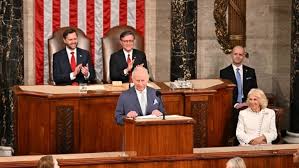
King Charles III’s historic address to the United States Congress today marked a carefully calibrated moment of diplomacy, symbolism, and strategic intent, as the British monarch sought to reinforce transatlantic ties at a time of shifting global alliances.
Speaking before a joint session at United States Congress in Washington, D.C., King Charles III delivered a speech that blended historical reflection with forward-looking cooperation, emphasising shared democratic values and a renewed commitment to partnership between the United Kingdom and the United States.

AD: Capeesh Restaurant
The address, only the second by a reigning British monarch to Congress—following Queen Elizabeth II’s landmark speech in 1991—was framed as part of a broader state visit intended to “reaffirm not only the bonds of history, but the responsibilities of the present.”
In tone and substance, the speech underscored how both nations are navigating a complex international landscape shaped by geopolitical tensions, economic uncertainty, and global challenges such as climate change and technological disruption.

AD: Oysterian Sea Food Restaurant And Bar
King Charles struck a tone of continuity and shared heritage. Referencing the long arc of Anglo-American relations—from conflict to alliance—he acknowledged the “lessons of history that have forged a partnership rooted not in uniformity, but in mutual respect.” This framing was widely interpreted as an effort to emphasise maturity in the relationship, moving beyond nostalgia toward pragmatic cooperation.
However, the speech was not merely ceremonial. Observers noted its clear diplomatic purpose: to strengthen ties at a moment when both countries are re-calibrating their global roles. The King spoke of a “renewed era of collaboration,” highlighting areas such as defense, clean energy, and scientific innovation. While avoiding overt political commentary, he made pointed references to “the defense of democratic institutions” and “the rule of law,” themes that resonated strongly within the chamber.
Members of Congress responded with sustained applause at several junctures, particularly when the King praised the enduring alliance between the UK and the US as “a cornerstone of global stability.” The optics of the moment—British monarch addressing American lawmakers in the heart of Washington—carried symbolic weight, reinforcing the notion that historical ties remain relevant in contemporary policy making.
The visit itself has been widely framed as an effort to improve and modernise relations between the two countries. While the UK-US partnership has long been described as “special,” recent years have seen subtle strains, including differences over trade, defence priorities, and diplomatic strategy. By engaging directly with Congress, King Charles appeared to be reinforcing not just executive-level cooperation, but also legislative goodwill—an often overlooked dimension of bilateral relations.
In his speech, the King highlighted shared commitments to NATO and collective security, implicitly referencing ongoing global conflicts without naming specific adversaries. He also devoted significant attention to climate change, a longstanding personal priority. Calling it “the defining challenge of our time,” he urged both nations to lead in developing sustainable solutions, positioning environmental cooperation as a key pillar of the future relationship.
Addressing the importance of NATO to a joint session of the U.S. Congress Tuesday afternoon, he said:
“From the depths of the Atlantic to the disastrously melting ice-caps of the Arctic, the commitment and expertise of the United States Armed Forces and its allies lie at the heart of NATO, pledged to each other’s defence, protecting our citizens and interests, keeping North Americans and Europeans safe from our common adversaries,” Charles said to resounding applause.
This emphasis aligns with King Charles’s broader public identity as an advocate for environmental causes, and it added a distinctive dimension to the address. By integrating climate policy into a traditionally security-focused alliance narrative, he signalled a shift toward a more holistic understanding of international partnership.
Economic cooperation also featured prominently. The King spoke of “deepening trade and investment ties” and fostering innovation across sectors, particularly in technology and green energy. While he avoided specifics, the message was clear: the UK seeks to position itself as a vital economic partner in a rapidly evolving global market.
The speech’s reception was largely positive, with lawmakers from both parties praising its tone and substance. Some noted the King’s ability to navigate political sensitivities while still delivering a message of substance. Others highlighted the importance of such symbolic gestures in maintaining diplomatic momentum, especially during periods of uncertainty.
Critics, however, questioned the tangible impact of the visit, arguing that symbolic diplomacy must be matched by concrete policy actions. They pointed out that while speeches can set the tone, the real test of the relationship lies in negotiations over trade agreements, defense commitments, and joint initiatives.
Nonetheless, the broader context of the visit suggests a deliberate effort to reset and strengthen ties. King Charles extended the reach of British diplomacy beyond traditional executive channels, reinforcing the idea that the relationship is multifaceted and enduring.
The historical significance of the moment was not lost on attendees. The image of a British monarch addressing American legislators was a powerful reminder of how far the relationship has evolved. From colonial conflict to strategic alliance, the journey has been marked by both tension and cooperation, culminating in the deeply interconnected partnership seen today.
Meetings with congressional leaders, business figures, and civil society representatives are expected to build on the themes outlined in the speech, translating rhetoric into action.
In the final analysis, King Charles’s address to Congress can be seen as both a reaffirmation and a re-calibration. It reaffirmed the enduring values and shared history that underpin the UK-US relationship, while also re-calibrating its focus toward contemporary challenges and opportunities.
The king’s stress of cooperation, mutual respect, and forward-looking priorities, positioned the visit as a meaningful step toward strengthening ties in an increasingly complex world.
Whether the speech will lead to tangible outcomes remains to be seen. But as a piece of diplomatic theatre—and as a statement of intent—it succeeded in its primary aim: to remind both nations of the importance of their partnership, and to signal a commitment to its continued evolution

AD: Heritage And Restaurant Lounge Bar
-
Share On
- Categories
- Date