
By Theodore Brown-
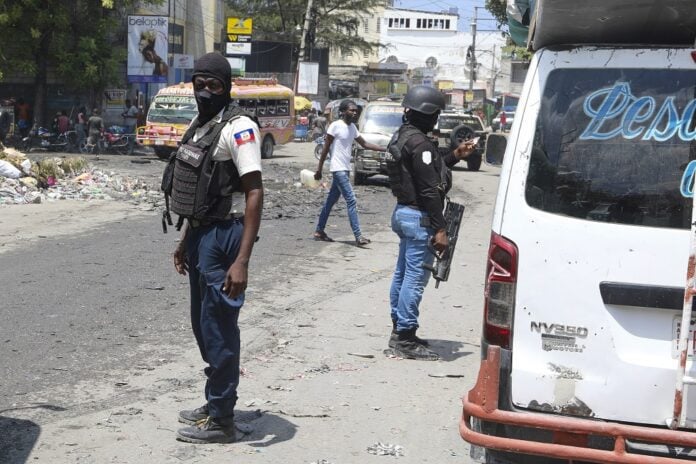
Bodies lie on the streets of a Haitian town after a brutal gang attack that brought arson, slaughter and panic to the central region of the impoverished Caribbean nation, according to eyewitnesses and local officials. On March 29 2026, the town of Petite‑Rivière de l’Artibonite was left smoldering and silent following an offensive by the powerful Gran Grif gang that left homes in flames and numerous civilians dead. The violence illustrates how deeply criminal groups have embedded themselves in the social and political fabric of Haiti, where law enforcement struggles to protect citizens.
Videos and accounts from inside the devastated neighborhood of Jean‑Denis show bodies scattered across boulevards and alleyways amid the charred remains of houses set alight during the rampage. Although precise casualty figures remain unclear, local residents described scenes of “utter terror” and “chaos” as gunmen swept through residential streets, killing and displacing families in their path.

AD: Capeesh Restaurant
The attack is one of the latest in a years‑long spiral of gang violence that has gripped Haiti since the 2021 assassination of President Jovenel Moïse and the ensuing collapse of central authority.
The assault in the Artibonite region reflects a broader trend: criminal groups now control or influence large swathes of the country, from the capital, Port‑au‑Prince, to outlying towns and rural areas.
A recent United Nations report found that gangs have tightened their grip, controlling territories where millions of civilians live and restricting movement, trade and access to basic services. Thousands have been killed and injured in clashes between rival gangs and security forces, with children and women among the victims.

AD: Oysterian Sea Food Restaurant And Bar
To many Haitians, the vivid images coming out of Petite‑Rivière de l’Artibonite are neither surprising nor isolated. Since the state’s authority weakened and police capacity eroded, gangs such as Gran Grif, G9, Viv Ansanm and others have become de facto rulers of entire neighbourhoods and municipalities.
These groups engage in extortion, kidnapping, drug trafficking and violent territorial battles that regularly spill into civilian life, leaving ordinary residents caught in the crossfire.
The United States and other countries have labeled some of these organizations as terrorist groups, partly due to their involvement in repeated massacres, sexual violence and forced displacement. The U.S. government has offered millions of dollars in rewards for information on gang financial networks, a sign of how entrenched these organisations have become.
Yet even this international attention has done little to halt the bloodshed, as gangs continue to operate with impunity in regions where the presence of effective law enforcement is minimal or nonexistent.
The situation is often described as akin to a state of war, where civilians face daily threats from bandits who wield automatic weapons and heavy firepower. Humanitarian agencies have repeatedly reported that food insecurity, school closures and restricted access to medical care accompany the violence as essential infrastructure collapses under pressure.
In Port‑au‑Prince and other cities, gang checkpoints and roadblocks have made it nearly impossible for ordinary people to travel for work, education or healthcare without fear of attack.
Neighbours who once hoped that elections or foreign peacekeeping forces could restore order see little change in their daily reality. Instead, “self‑defence” vigilante groups have emerged in some communities, adopting brutal tactics of their own in attempts to push back against the gangs a sign of how deeply the conflict has fragmented Haitian society.
These groups have, in some cases, resorted to stoning, beheading and burning suspected gang members alive, reflecting the level of desperation felt by many residents.
International efforts to stabilize Haiti have had mixed results. A U.N.‑backed security mission deployed to retake control of gang‑held areas has been slow to materialise, and even then would face formidable challenges in an environment where weapons and influence are widespread.
Critics of foreign intervention point out that without a coherent political strategy and buy‑in from local communities, security forces alone cannot rebuild trust or governance structures.
Meanwhile, the toll on Haiti’s civilian population continues to mount. Mass displacements are common as families flee violence and seek refuge in supposedly safer rural areas or across international borders. Schools, hospitals and markets have closed or operate at severely reduced capacity, deepening the humanitarian crisis that has enveloped the country.
Many Haitians live in a state of fear, uncertain whether the next explosion of violence will erupt near their homes or sweep through their town in a matter of hours.
Analysts point out that the Haitian government’s inability to deliver basic services and security has opened the door for gangs to establish parallel power structures.
These armed groups collect “taxes,” administer justice in their territories and decide who moves Where, often without any accountability. This dynamic has eroded faith in state institutions and left many communities feeling abandoned and vulnerable.
While the bodies piled up in the streets of Petite‑Rivière de l’Artibonite, the cries of residents for help were met with silence, punctuated only by the distant sound of gunfire and smoke rising from burning residences. In towns and cities throughout Haiti, this cycle of violence and suffering has become tragically familiar.
To those who remain, the question is not just how the country will end this chapter of bloodshed, but whether peace and stability will ever return.
Despite international offers of rewards for information on gang activities and efforts to bolster policing, Haiti’s crisis remains deeply entrenched, with no clear resolution in sight. The government continues to struggle with limited authority, leaving law enforcement agencies under‑resourced and unable to maintain security in many parts of the country.
Families are trapped in a dangerous limbo, caught between rival militias whose turf wars spill into residential areas, markets, and schools. Daily life has become a struggle for survival as access to food, healthcare, and education is increasingly restricted by the violence.
Civilians live in constant fear, with some fleeing their homes entirely, only to encounter the same threats in supposedly safer areas. The psychological toll is immense, as parents worry for their children and communities are fractured by trauma and displacement. Meanwhile, the international community observes the escalating bloodshed, offering aid and monitoring the situation, yet large-scale interventions have been slow and complicated by political instability and logistical challenges.

AD: Heritage And Restaurant Lounge Bar