
By Ben Kerrigan-
Jewish community in London reels from a brazen arson attack that saw volunteer ambulances set ablaze in Golders Green, leaders are voicing deep anxiety about the possibility of further, even more sinister acts of terror including potential chemical threats in a climate of rising antisemitism.Authorities and community groups say heightened vigilance and stepped‑up security measures reflect fears that today’s violent incidents could be precursors to future threats.
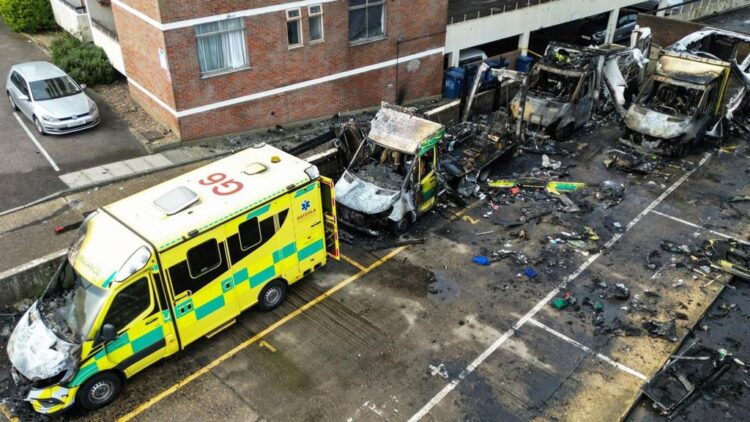
In the early hours of Monday, four ambulances operated by the Jewish volunteer emergency service Hatzola were deliberately set on fire in the heart of the Golders Green neighbourhood, a historically Jewish area in north London.

AD: Capeesh Restaurant
The Metropolitan Police are treating the blaze as an antisemitic hate crime, and the incident has reverberated beyond London, underscoring a broader sense of vulnerability among Jewish communities across Europe.
Most members of the London’s Jewish community, would consider the arson attack was more than destruction of property: it was a symbol of how volatile the current climate feels. Highfield Road, where the ambulances were parked outside a synagogue, has long been a focal point of community life in Golders Green.
Early CCTV footage, released by investigators, shows three hooded individuals pouring accelerants on the vehicles before igniting them, a calculated act that triggered explosions from oxygen cylinders and shattered nearby windows though, remarkably, no one was physically injured.

AD: Oysterian Sea Food Restaurant And Bar
Prime Minister Keir Starmer condemned the attack as “deeply shocking,” a sentiment echoed by London Mayor Sadiq Khan and Jewish leaders who described it as an affront to British values and public safety. “Antisemitism has no place in our society,” Starmer said in a statement, urging the public to support investigations and report information.
Shortly after the incident, two men aged 45 and 47 were arrested on suspicion of arson with intent to endanger life, though both have since been released on strict bail conditions as the investigation continues. Searches of several properties in north London have been conducted as part of the wider inquiry, led by the Metropolitan Police’s counter‑terrorism unit.
Community leaders, who had already been grappling with heightened antisemitic incidents since geopolitical conflicts intensified last year, say the ambulance arson has intensified fears that future attacks will be more aggressive and targeted.
One local Jewish elder told journalists the community now feels “besieged,” and while resolute in spirit, increasingly aware of the need for proactive defensive measures.
In many years, Jewish institutions and organisations in the UK have worked closely with law enforcement to bolster physical security at synagogues, schools and charity centres.
But in recent months, discussions among community security groups have broached scenarios once considered remote including chemical threats aimed at places of worship or large public gatherings. This sense of vulnerability, leaders say, stems from a broader environment of foreign and domestic hate networks that seek to exploit rising tensions.
Although no specific chemical threat has been publicly verified by authorities, intelligence briefings cited in internal community security updates have emphasised the need for preparedness given growing international extremist activities. London’s Golders Green, along with other Jewish population centres, has seen repeated antisemitic incidents culminating in this weekend’s attack.
While Hatzola has vowed to remain operational despite losing vehicles that were critical to emergency responses in the community, the charity and its partners have ramped up surveillance systems, installed additional perimeter protections, and coordinated with police to staff patrols around key Jewish sites, especially ahead of major religious holidays.
The torching of ambulances has drawn condemnation not just in London but internationally. Jewish organisations in Europe and North America have issued statements of solidarity, highlighting similar attacks on Jewish sites in recent months.
In Amsterdam and Rotterdam, for example, community buildings and schools have been targeted, and a militia styling itself as Harakat Ashab al‑Yamin al‑Islamia has claimed though without verification responsibility for some European incidents, including the London arson.
This group, described by Western intelligence monitors as “Iran‑aligned,” has also been linked to other recent hostile acts against Jewish institutions in Belgium and the Netherlands, underscoring how interconnected such threats appear to be. British counter‑terror officials say establishing the authenticity of online claims of responsibility remains a priority in their ongoing inquiry.
Back home, the political response has been largely unified: leaders across the political spectrum are urging calm while reaffirming support for Jewish citizens. London’s police commissioner has pledged continued high‑visibility patrols and strengthened cooperation with local community groups.
Speaking at a press briefing, Commander Helen Flanagan said that while the investigation into the arson attack is still active, authorities are treating any hate crime with the utmost seriousness and will pursue all leads.
Meanwhile, fundraisers to replace the destroyed ambulances have exceeded expectations, with supporters from across the UK contributing to efforts to rebuild Hatzola’s capacity. Organisers stress that the swift outpouring of support reflects Londoners’ shared rejection of hate and solidarity with the city’s Jewish population.
Jewish community security analysts caution, however, that tangible solidarity must translate into sustained vigilance. Beyond physical protections, they contend, societal resilience against antisemitism and terror threats requires continuous political commitment, cross‑community dialogue, and education to counter prejudice. With one security specialist put it: prevention is not a moment, it’s a movement.
While Londoners absorb the shock of incendiary attacks on essential emergency vehicles, and as leaders publicly denounce hatred, the Jewish community prepares for an uncertain period. Whether the fear of more serious threats, including chemical attacks, materialises remains to be seen.
But for many, the events in Golders Green have marked a turning point in how Jewish life in London will be secured in the months and years ahead.
Community leaders are increasingly emphasising the need for comprehensive preparedness that extends beyond physical security. Workshops on emergency response protocols, coordination with local law enforcement, and public awareness campaigns are being intensified to ensure residents know how to respond to any potential threats.
Schools, synagogues, and community centers are reviewing evacuation plans, while volunteers are receiving additional training in identifying suspicious activity and handling hazardous substances.
The psychological impact of living under the shadow of potential attacks is also being addressed, with counselling services and support networks being strengthened to help families cope with fear and anxiety.
Moreover, interfaith groups and civic organisations are said to be stepping up initiatives to foster understanding and solidarity, aiming to counteract the isolation and stigma that can accompany targeted threats.
While security measures become more visible, the Jewish community is striving to maintain its daily life and cultural vibrancy, demonstrating resilience in the face of adversity while signalling to would-be attackers that fear will not disrupt communal cohesion.

AD: Heritage And Restaurant Lounge Bar